Nvidia has established a new committee on its board of directors to oversee national security policy and global trade compliance. This comes in response to the recent resignation drama of the former CEO and suspicions regarding the leakage of advanced AI semiconductors to China, with the aim of reinforcing its governance framework and ensuring strict regulatory compliance.
- Establishment of the Export Control Oversight Committee by the Board of Directors and Its Structure
- The Upheaval Caused by the Founder’s Resignation and Leadership Vacuum
- Investigations Surrounding Singaporean Companies and the Expansion of Regulatory Oversight
- The U.S. Government’s Remote Access Regulations and the Direction of Law Enforcement
- Earnings Risks Hiding Behind Business Expansion and Analyst Estimates
- Future Developments and Key Points to Watch in the Semiconductor Hegemony Struggle
Establishment of the Export Control Oversight Committee by the Board of Directors and Its Structure
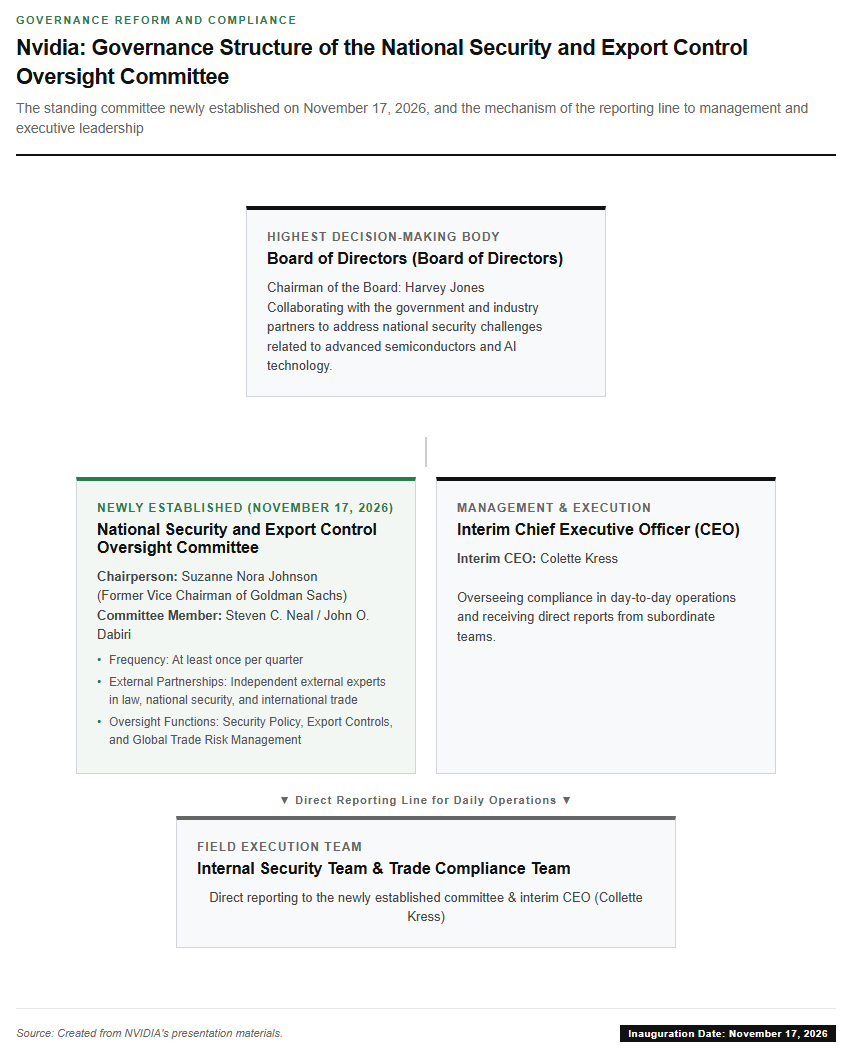
On November 17, 2026, NVIDIA announced the establishment of a permanent “National Security and Export Control Oversight Committee” under its Board of Directors. The committee will assume board-level oversight functions for security policy, export compliance, and global trade risk management. Existing internal security and trade compliance teams will report directly on a day-to-day basis to the committee and interim Chief Executive Officer (CEO) Colette Kress. Suzanne Nora Johnson, former Vice Chairman of Goldman Sachs and a member of the Board of Directors, has been appointed as Chair of the committee, with board members Stephen C. Neal and John O. Dabiri serving as members. The committee will meet at least once a quarter and will work with independent external experts in law, national security, and international trade to promote the strengthening of its framework. Board Chairman Harvey Jones expressed the company’s commitment to building a robust framework in cooperation with governments and industry partners to address the challenges that advanced semiconductors and AI technology pose to national security. The following diagram illustrates the governance structure of the new committee.
The Upheaval Caused by the Founder’s Resignation and Leadership Vacuum
Right before the establishment of this supervisory committee, a major crisis had occurred that shook the company’s management structure. Jensen Huang, the founder and CEO who had led the company for 33 years since its founding in 1993, resigned effective November 11, 2026, after disclosing personal conduct that violated the company’s code of conduct. The Board of Directors unanimously accepted his resignation and stated clearly that they have no intention of reinstating Huang as CEO. Currently, Chief Financial Officer (CFO) Colette Kress is serving as interim CEO, and a top executive search firm has been retained to conduct a search for a permanent successor from both inside and outside the company. Since Huang’s resignation, a series of developments have emerged, including a criminal investigation by the Department of Justice, an information disclosure investigation by the Securities and Exchange Commission (SEC), and a securities class-action lawsuit by investors. NVIDIA has retained the law firm Wachtell, Lipton, Rosen & Katz and former Acting U.S. Attorney Joon H. Kim for an independent investigation, rushing to conduct an internal review.
Suspected Chip Leakage and the Background Behind Tightening Export Controls Against China
Investigations Surrounding Singaporean Companies and the Expansion of Regulatory Oversight
At the core of the issue is suspected circumvention exports to China through Megaspeed International, a Singapore-based AI cloud provider. Reports have revealed that the company’s Malaysian subsidiary received over 200 shipments of advanced NVIDIA GPUs, which are subject to export restrictions. The U.S. Department of Commerce and the Department of Justice are investigating suspicions that restricted chips were diverted to China in violation of U.S. export controls, and Singaporean authorities are also conducting investigations on suspicion of false declarations. Furthermore, crackdowns on loophole transactions via third countries are mounting, with Malaysian customs seizing servers containing advanced AI chips worth approximately $12.1 million at Kuala Lumpur International Airport. The U.S. House Foreign Affairs Committee and other bodies are scheduled to hold a recorded hearing with Mr. Huang and Chief Legal Officer Tim Teter in early December 2026, and scrutiny from political circles is intensifying.
The U.S. Government’s Remote Access Regulations and the Direction of Law Enforcement
The U.S. government is expanding its regulatory net beyond the physical shipment of products themselves to restrict the use of computing power via remote access through the cloud. The U.S. Department of Commerce’s Bureau of Industry and Security (BIS) has published an interim final rule addressing remote access to advanced semiconductors via overseas data centers. This new rule adds licensing requirements for exports of advanced semiconductors to five countries—Malaysia, Singapore, Thailand, Indonesia, and Brazil—and requires licenses when entities such as Chinese companies access a total Total Processing Performance (TPP) of 12 million or more. This is equivalent to the computing power of approximately 750 H100 or H200 servers. Moving away from traditional controls based on nationality or registered location, businesses are now required to establish strict verification systems to identify de facto control and end-users, increasing the importance of trade risk management in corporate governance.
Impact on Markets and Financial Performance, and Medium- to Long-Term Outlook
Earnings Risks Hiding Behind Business Expansion and Analyst Estimates
Nvidia’s financial performance itself remains extremely strong. In the third quarter of fiscal 2027, revenue reached $115.8 billion, a 103% increase year-over-year, breaking the historic $100 billion mark for a single quarter for the first time. Driven by this, the data center segment’s revenue hit $107.6 billion, accounting for over 90% of the total. However, regulatory risks and governance concerns have acted as a drag, with the stock price dropping by nearly 30% in market capitalization from its October peak. According to estimates by financial analysts, if cloud-based GPU rentals in regions such as Southeast Asia were to be cut off, it could impact Nvidia’s 2027 chip revenue by approximately $44 billion. While demand itself will not immediately disappear, there are cautious concerns that customer reviews of deployment plans and delays in licensing and approvals could become short-term headwinds. The following figure illustrates the concept of market impact.
Future Developments and Key Points to Watch in the Semiconductor Hegemony Struggle
Moving forward, the biggest focus will be on the extent to which the newly established oversight committee can ensure the effectiveness of measures such as customer screening and post-sale usage monitoring. Furthermore, depending on the results of independent investigations or government probes, and whether company-wide regulatory evasion or legal violations are confirmed, there is a possibility of severe impacts such as massive fines and restrictions on export privileges. The hegemony struggle over AI semiconductors between the U.S. and China has shifted phases from merely competing on hardware technical performance to a management competition over who designs and manufactures them, and ultimately who controls and operates that massive computing power. For Japanese companies as well, it will be essential to thoroughly conduct due diligence to visualize the ultimate beneficial owners of business partners in the supply chain, delivery facilities, and remote-use risks. How to balance both management renewal and regulatory compliance will determine the future direction of the entire semiconductor market.
Reference page
- 【NVIDIA Board of Directors Establishes National Security and Export Control Oversight Committee】https://nvidianews.nvidia.com/news/nvidia-board-of-directors-establishes-national-security-and-export-control-oversight-committee
【#NVIDIA #AIChips #ExportControls #NationalSecurity #CorporateGovernance #USChinaHegemony】


コメント