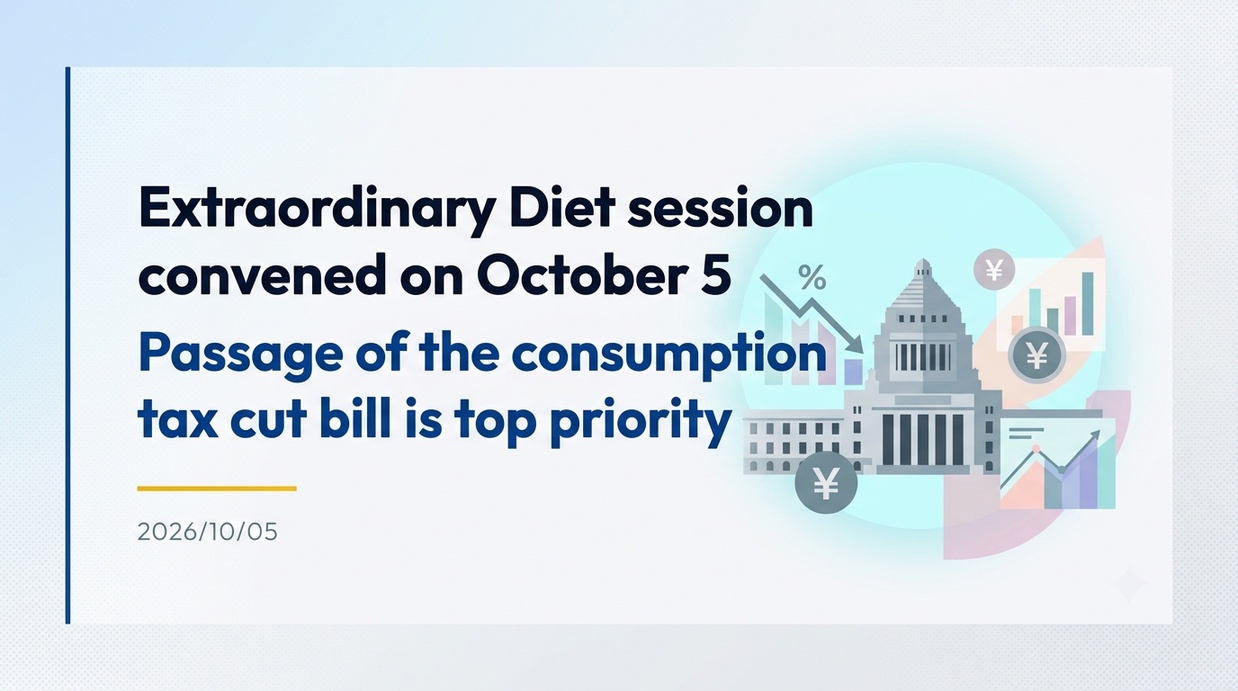
The 222nd Extraordinary Diet was convened on October 5, 2026, and the government and the ruling parties set the passage of related bills to lower the consumption tax rate on food to 1% for a limited period of two years as their top priority. While aiming to ease the household burden caused by prolonged inflation, securing financial resources amounting to approximately 5 trillion yen annually and the impact on financial markets are sparking intense debate.
- The 222nd Extraordinary Diet Session Convened on October 5 and the Objective of a 1% Tax Rate
- Bill deliberations and showdowns between the ruling and opposition parties in a divided Diet
- Securing ¥5 Trillion in Annual Financial Resources and Verifying the Policy of “Not Relying on Deficit-Covering Government Bonds”
- Concerns Over Rising Interest Rates Due to Expanding AI Investment and the Risk of Ballooning Fiscal Interest Payments
- “1%, 8%, 10%”: The Coexistence of Three Tax Rates and the Operational Burden on Businesses and Register Operations
- Transition to Refundable Tax Credits and Future Points to Watch
The 222nd Extraordinary Diet Session Convened on October 5 and the Objective of a 1% Tax Rate
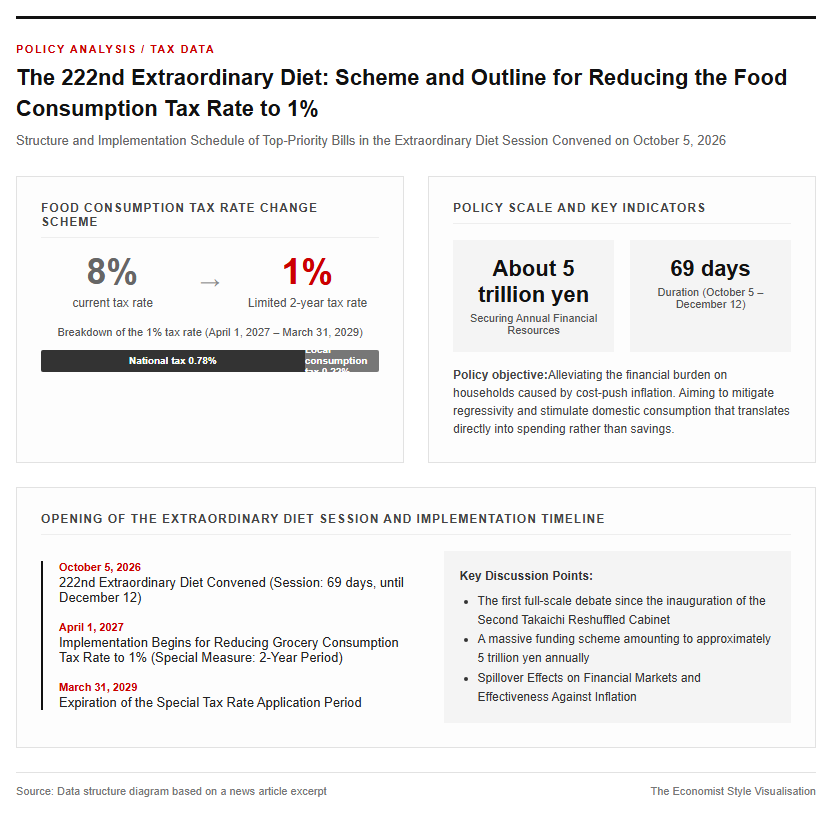
The 222nd Extraordinary Diet was convened on October 5, 2026, with a 69-day session running until December 12. Serving as the first major arena for parliamentary debate following the establishment of the Second Takaichi Reshuffled Cabinet, the government submitted related bills as its top priority for enactment, aiming to lower the consumption tax rate on food and beverages from the current 8% to 1% for a limited two-year period. The implementation period is two years, from April 1, 2027, to March 31, 2029, with the 1% tax rate structured as 0.78% for the national tax and 0.22% for the local consumption tax. Amid prolonged cost-push inflation and sluggish growth in real wages, purchasing power has declined significantly, particularly among low-income households for whom spending on daily necessities accounts for a high proportion. The direct aim of this food tax cut is to alleviate the regressive nature of the consumption tax—where the tax burden weighs more heavily on lower incomes—and have it function as a robust safety net supporting livelihood foundations. Moreover, unlike cash handouts, because the checkout amount itself at stores will be reduced, it is expected to effectively stimulate domestic consumption without funds being diverted into savings. Please refer to the following diagram.
Bill deliberations and showdowns between the ruling and opposition parties in a divided Diet
Unlike a budget bill, the upcoming consumption tax cut bill is a regular legislative bill, meaning that the House of Representatives’ provision of supremacy (Article 60 of the Constitution) does not automatically apply. While the ruling coalition holds a dominant 315 seats—well over a two-thirds supermajority—in the House of Representatives, a “twisted” Diet exists in the House of Councillors, where the ruling forces fall short of the 125 seats needed for a majority. Even if the bill is voted down in the House of Councillors, it can be re-passed in the House of Representatives under Article 59 of the Constitution. However, there are also strong calls for cautious handling, driven by concerns over undermining the significance of the upper house and deepening political conflict. While acknowledging the need for a tax cut on food items, the opposition parties are poised to fiercely press the government on the opacity of the funding sources—which scale to roughly 5 trillion yen annually—and its impact on mid- to long-term fiscal consolidation. In addition, certain subscription newspapers previously eligible for canyons of the reduced tax rate are slated to remain at 8%, prompting a series of criticisms from the opposition regarding overall tax fairness and the consistency of application categories. The ruling bloc is aiming to pass and enact the legislation during the extraordinary Diet session, engaging in fierce debates with opposition parties.
Measures to Secure Funding for Tax Cuts and Their Spillover Effects on Financial Markets and the Macroeconomy
Securing ¥5 Trillion in Annual Financial Resources and Verifying the Policy of “Not Relying on Deficit-Covering Government Bonds”
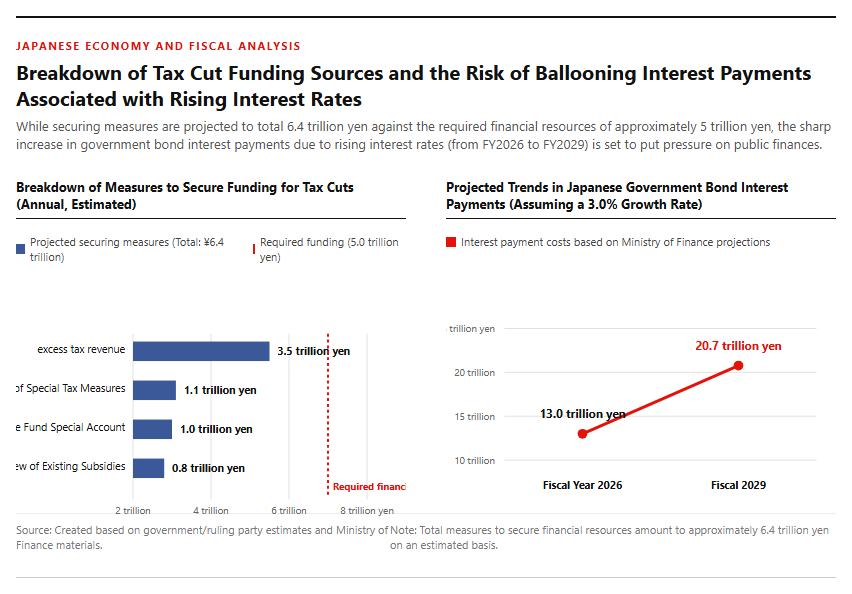
It is estimated that the necessary financial resources for lowering the tax rate on food to 1% and combining it with benefit support aimed at effectively reducing it to zero will amount to approximately 5 trillion yen annually (about 10 trillion yen over two years). To prevent a decline in confidence from international financial markets, Prime Minister Takaichi has clearly stated a policy of “not relying on deficit-covering bonds” to cover the funding shortfall. As for the breakdown of revenue-securing measures being considered by the government and ruling coalition, they include windfall tax revenues resulting from recent high prices and improved corporate performance (about 3.5 trillion yen), a review of special taxation measures (about 1.1 trillion yen), transfers from the Foreign Exchange Fund Special Account (about 1 trillion yen), and a review of existing subsidies (about 0.8 trillion yen). They expect a total scale of about 6.4 trillion yen, claiming this will be enough to cover the required 5 trillion yen. However, because tax revenue windfalls are easily affected by economic fluctuations and there is no guarantee they will occur stably every year, there is persistent criticism from market participants and opposition parties that this is “a postponement of the funding debate and lacks realism.” Concerns remain that if the tax cuts are pushed through while expenditure cuts and the securing of permanent financial resources are insufficient, it will inevitably lead to a de facto reliance on deficit-financing bonds.
Concerns Over Rising Interest Rates Due to Expanding AI Investment and the Risk of Ballooning Fiscal Interest Payments
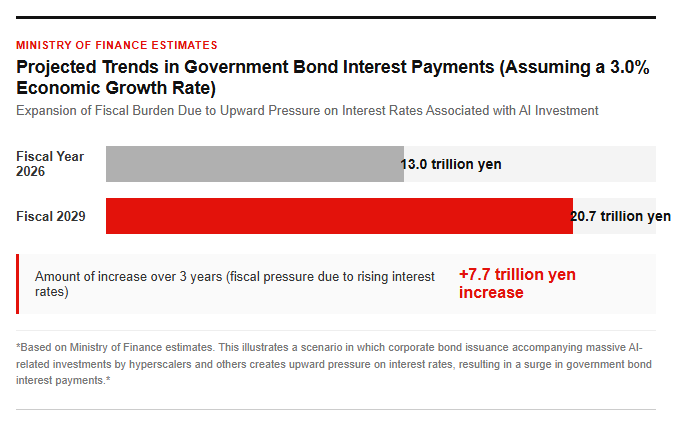
What is further complicating the debate over funding sources is the upward pressure on interest rates and the risk of ballooning government bond interest payments accompanying the global AI boom. Amid massive investments such as data center construction by major tech companies (hyperscalers), corporate bonds are being issued in large quantities, absorbing investor funds and raising concerns in the market about a phenomenon known as “reverse crowding out,” which involves the selling of government bonds and rising interest rates. Japan’s 10-year government bond yields have also occasionally reached high levels, and according to Ministry of Finance estimates, if an economic growth rate of 3.0% continues, government bond interest payments are projected to surge from 13.0 trillion yen in fiscal 2026 to 20.7 trillion yen in fiscal 2029 due to rising 10-year bond yields. If long-term interest rates rise, the government’s burden of bond interest payments will increase, potentially further squeezing the funding framework necessary for tax cuts. In financial markets, risks have been pointed out that concerns over fiscal deterioration could trigger a depreciation of the yen and a drop in government bond prices, strongly necessitating careful macroeconomic policy steering to prevent a vicious cycle of demand stimulation through tax cuts, rising interest rates, and soaring prices. Please refer to the graph below.
Impact on Business Operations and the Transition Period to “Refundable Tax Credits”
“1%, 8%, 10%”: The Coexistence of Three Tax Rates and the Operational Burden on Businesses and Register Operations
When this tax reduction measure is implemented, three tax rates—1% (groceries and takeout), 8% (subscription newspapers and bundled assets, etc.), and 10% (dine-in, alcohol, daily necessities, etc.)—will coexist simultaneously in business operations. In restaurants in particular, even for the same dish, a 9-percentage-point tax rate difference arises between takeout (1%) and dine-in (10%), requiring strict management in price displays and POS register operation distinctions. In addition, since the tax rates are scheduled to return to their original levels in April 2029, accounting and system modifications will occur twice in total—at the start and at the end—which differs significantly from conventional tax increase responses. Since system modifications require several months of preparation, the government will introduce an advance commencement system for subsidies starting September 15, 2026, and is promoting the widespread adoption of cloud-based smart register systems. Furthermore, to alleviate the burden on small and medium-sized businesses, transitional measures have also been established, such as a special exception for full purchase tax credits on 1%-targeted sales under simplified taxation, and a grace period exception for the total price display obligation regarding price labeling.
Transition to Refundable Tax Credits and Future Points to Watch
The Takaichi administration does not position this temporary grocery tax cut merely as a transitional measure against inflation, but rather as a “provisional regressive measure” to facilitate the transition to a “refundable tax credit,” which is a medium- to long-term tax reform. While a refundable tax credit is a sophisticated system that provides direct tax credits and benefits to low-income households, it requires the accurate assessment of income and assets as well as integration with the My Number system, presenting technical challenges for immediate, comprehensive implementation. Consequently, the administration has outlined a roadmap to hastily build a My Number-based tax infrastructure during the two-year tax cut period, allowing for a smooth transition to a mechanism that directly refunds those truly in need of support once the temporary measure ends. Moving forward, the main focal points will be the progress of deliberations on related bills in the extraordinary Diet session, the final compilation of specific funding sources for the FY2027 budget formulation at the end of the year, and the state of preparations for on-site environments, such as support for cash register modifications. Please refer to the figure below.
Reference page
- [Cabinet Secretariat] “Reduction of the Consumption Tax Rate on Food and Beverages” and “Tax Credit with Benefits” (Government’s Basic Policy) https://www.cas.go.jp/jp/seisaku/shouhizei_zeigakukoujo/index.html
- [Cabinet Public Relations Office, Cabinet Secretariat] Press Conference on the “Reduction of the Consumption Tax Rate on Food and Beverages” and “Refundable Tax Credits” https://www.kantei.go.jp/jp/105/statement/2026/0730kaiken.html
- [Ministry of Economy, Trade and Industry] Strongly Promoting Initiatives for the Spread of Smart Cash Register Systems https://www.meti.go.jp/press/2026/04/20260430003/20260430003.html
[#ConsumptionTaxCut #ExtraordinaryDietSession #Food1Percent #RevenueIssue #SmartRegister]


コメント