
On November 20, 2026, the Fiscal System Council submitted a recommendation to Finance Minister Satsuki Katayama, calling for the securing of market confidence to be treated as the highest priority in response to a new economic environment of rising prices and interest rates. Amid growing caution over massive preliminary budget requests exceeding 140 trillion yen for the compilation of the fiscal 2027 budget, the shifting of fiscal consolidation targets and risk management in the government bond market have emerged as pressing issues.
- Submission of Recommendations for FY2027 Budget Formulation and a Powerful Opening Warning
- Full-Scale Transition to a World with Interest Rates and Strong Vigilance Regarding the 143.1 Trillion Yen Preliminary Budget Requests
- Consistency of Policy Stance and Stricter Investment Limits under Responsible Proactive Fiscal Policy
- The Shift from Single-Year Primary Balance Surplus to a Focus on the Debt-to-GDP Ratio and Market Concerns
- The Contrast Between Growth-Driven “Good” Interest Rate Rises and Uncertainty-Induced “Bad” Interest Rate Rises
- Transmission Channels to Businesses and Households Caused by Government Bond Downgrade Risk and “Triple Depreciation”
- Securing Future Fiscal Capacity and Key Focus Areas for the Japanese Economy Moving Forward
Submission of Recommendations for FY2027 Budget Formulation and a Powerful Opening Warning
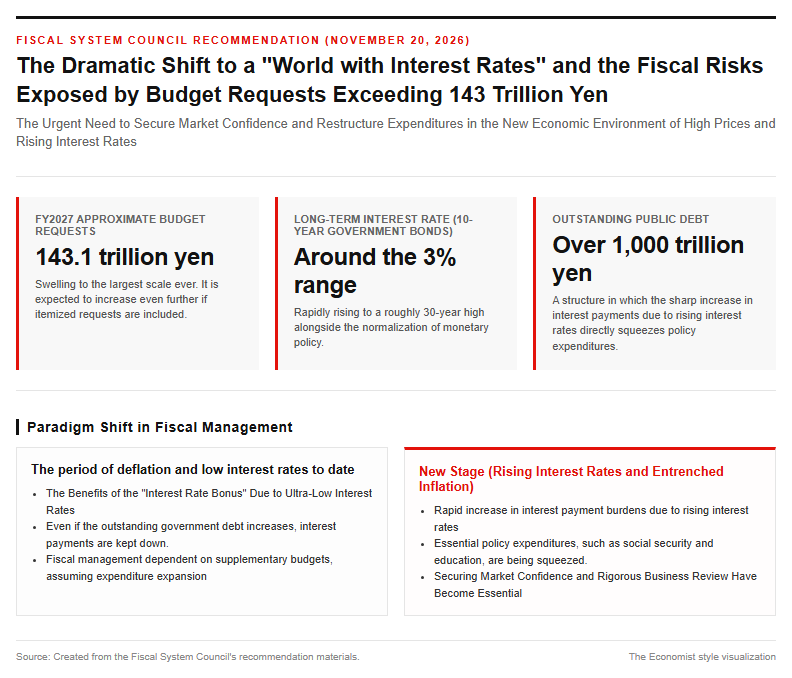
On the afternoon of November 20, 2026, the Fiscal System Council, an advisory body to the Ministry of Finance, formally submitted its recommendations (written opinion) for the FY2027 budget compilation from Chairman Masakazu Tokura to Finance Minister Satsuki Katayama. From the very beginning, the recommendations use the unusually strong expression, “There has never been a time when securing ‘market credibility’ is more important,” expressing a deep sense of crisis regarding the tectonic shifts in the economic environment. In the background is the reality that, as the Bank of Japan grows increasingly confident in achieving its underlying 2% inflation target and promotes the normalization of monetary policy, the deflationary structure of low interest rates and low inflation that has long shrouded the Japanese economy has come to an end. In the Tokyo bond market, the long-term interest rate on newly issued 10-year government bonds temporarily reached the 3% range for the first time in about 30 years, rapidly advancing the transition to a world with interest rates. The Fiscal System Council analyzes that in this new stage where prices, wages, and interest rates move actively in tandem, a fundamental shift away from conventional fiscal management premised on expenditure expansion is indispensable. To defend the livelihoods of citizens and continue sustainable social security and important policies, unwavering trust from the market serves as an essential prerequisite.
Full-Scale Transition to a World with Interest Rates and Strong Vigilance Regarding the 143.1 Trillion Yen Preliminary Budget Requests
As the Japanese economy steps into a new normal of entrenched inflation and rising interest rates, rough estimate requests for the fiscal 2027 budget have ballooned to a record-high scale of approximately 143.1 trillion yen. The final budget scale is expected to increase even further if “itemized requests,” which do not specify amounts in advance, are included, prompting Acting Chair Hiroya Masuda and other members of the Fiscal System Council’s Fiscal System Subcommittee to express strong concerns at a press conference. Under the former ultra-low interest rate environment, there was the benefit of an interest rate bonus where debt-servicing costs were kept low even as the balance of government bonds increased. However, in a phase of rising interest rates, for Japan’s public finances—which shoulder over 1,000 trillion yen in outstanding public debt—this completely transforms into a structure where rising debt-servicing costs directly squeeze expenditures. A sudden surge in interest payment burdens could crowd out policy expenditures that should inherently be prioritized, such as social security, education, and disaster prevention and infrastructure development, potentially having a direct, adverse impact on public livelihoods. Amid growing uncertainty regarding the market’s capacity to absorb government bonds, there is a strong demand to rigorously scrutinize the true necessity and policy effectiveness of administrative projects, and to break away from the chronic fiscal structure of relying on annual supplementary budgets. Please refer to the figure below.
Consistency of Policy Stance and Stricter Investment Limits under Responsible Proactive Fiscal Policy
The Takaichi administration prominently advocates for a “responsible proactive fiscal policy” aimed at simultaneously building a strong economy and ensuring fiscal sustainability. However, the proposal emphasizes that “responsibility” and “proactive fiscal policy” should be pursued as an indivisible entity. It warns that losing the market’s trust could shake the very foundation of government-led growth investment and crisis management investment. Specifically, regarding the “Strong and Prosperous Japan” investment framework—which allocates funds to 17 strategic fields such as semiconductors, AI, drug discovery, and advanced medicine—it strictly cautions against the mindless continuation of support. It proposes the introduction of an evaluation mechanism to objectively determine whether to continue or terminate support based on the achievement level of each project and the progress of specific outcome targets. Rather than merely expanding budget frames or serving as a receptacle for requests, thoroughly implementing third-party effectiveness verification and highly transparent information disclosure—and continuously demonstrating to domestic and international market participants and the public that the government’s stance is consistent—will be the key to securing trust.
The Risk of Shifting Fiscal Consolidation Targets and the Turning Point for “Good” Interest Rate Hikes
The Shift from Single-Year Primary Balance Surplus to a Focus on the Debt-to-GDP Ratio and Market Concerns
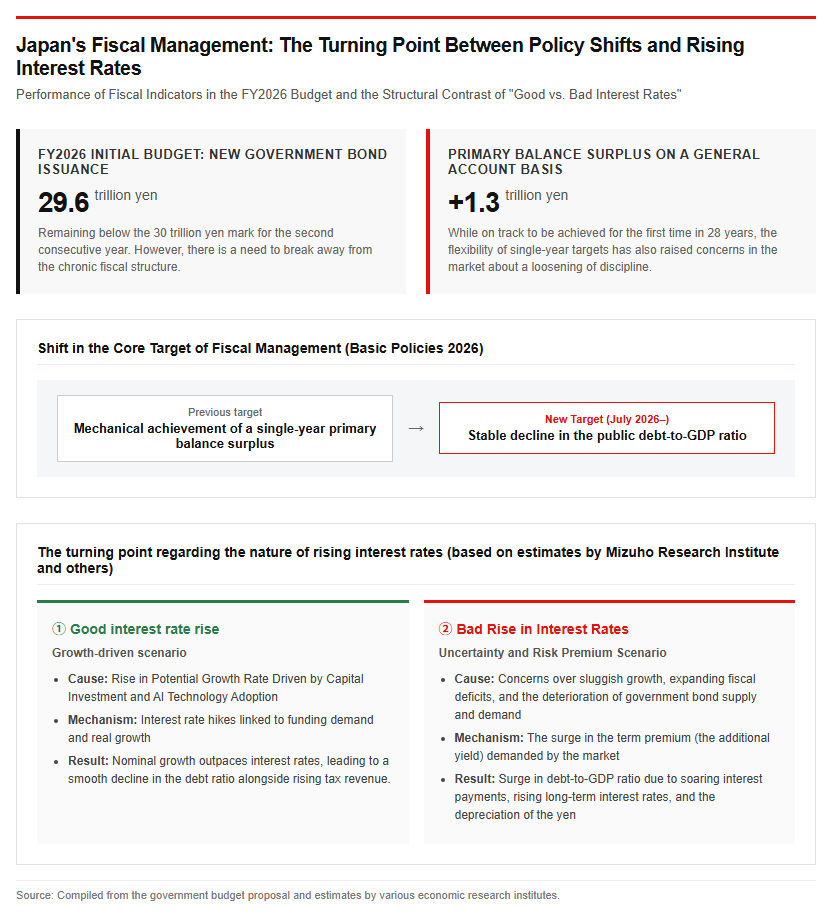
In the Basic Policy 2026 in July 2026, the government changed the core target of its fiscal management from the conventional mechanical achievement of a single-year primary balance (PB) surplus to a steady decline in the ratio of national and local outstanding public debt to GDP. In the initial budget for fiscal 2026, the amount of newly issued government bonds stands at 29.6 trillion yen, falling below 30 trillion yen for the second consecutive year, and a general account-based primary surplus (+1.3 trillion yen) is projected to be achieved for the first time in 28 years. However, while the flexibility of single-year targets and the transition to multi-year management enable agile growth investment, they carry the risk of strongly raising market suspicions of a loosening of fiscal discipline. Even if rapid inflation temporarily causes a sharp expansion of nominal GDP—the denominator—resulting in a lower apparent debt-to-GDP ratio, if persistent inflation and rising interest rates continue, debt servicing costs (the numerator) will surge, creating a high risk that the ratio will turn upward once again. If financial markets harbor doubts about the sustainability of the government’s fiscal management, it could trigger a rise in long-term interest rates and further depreciation of the yen, bringing about severe negative repercussions for the domestic economy.
The Contrast Between Growth-Driven “Good” Interest Rate Rises and Uncertainty-Induced “Bad” Interest Rate Rises
There are decisive differences in the background and nature of rising interest rates, and the current Japanese economy faces a turning point between “good interest rate hikes” and “bad interest rate hikes.” According to estimates by the Mizuho Research Institute and others, a “good interest rate hike” is defined as a structure where potential growth rises due to corporate capital investment and the penetration of AI technological innovation, and interest rates rise in tandem with the expansion of capital demand and real economic growth. In this scenario, the nominal growth rate exceeds interest rates, and the government debt ratio smoothly declines alongside increased tax revenue. Conversely, a “bad interest rate hike” is a situation where growth sluggishly lags while term premiums (the premium added to interest rates demanded by the market as compensation for risk) surge due to concerns over the expansion of the fiscal deficit and deterioration in the supply and demand for government bonds. From the second half of 2025 onward, a factor decomposition of Japan’s 10-year yield shows a prominent contribution from the rise in Japan-specific risk premiums, making the adherence to fiscal discipline an urgent task alongside ensuring the effectiveness of growth strategies. Please refer to the figure below.
Uncertainty in the Government Bond Market and the Medium- to Long-Term Outlook Faced by the Japanese Economy
Transmission Channels to Businesses and Households Caused by Government Bond Downgrade Risk and “Triple Depreciation”
If market confidence in fiscal sustainability were to suffer a sudden collapse, the ripple effects and damage inflicted upon the Japanese economy would be extremely severe. According to quantitative risk assessments by the Daiwa Institute of Research and the Japan Research Institute, if Japanese government bond (JGB) ratings were downgraded, the credit ratings of domestic financial institutions and major corporations would also drop in tandem due to the sovereign ceiling effect. This would cause corporations’ foreign currency funding costs to skyrocket, directly pressuring economic activity through rising domestic lending rates. Furthermore, MSCI’s stress scenario analysis highlights concerns over a “triple depreciation”—where government bonds, equities, and the Japanese yen plummet simultaneously—triggered by a loss of confidence in inflation control. Under conditions of stress on confidence, drawdowns would reach 13% for yen-denominated multi-asset portfolios, and exceed 23% for US dollar-denominated investors due to the compounding effect of a dramatic depreciation of the yen, effectively eliminating safe-haven diversification options for investors. A lack of fiscal discipline directly damages confidence in the currency and government bonds, harboring the risk of rapidly eroding the purchasing power of public assets.
Securing Future Fiscal Capacity and Key Focus Areas for the Japanese Economy Moving Forward
As the Bank of Japan (BOJ) proceeds with the phased reduction of its government bond purchases (QT), a key focus of market structure is which entities will absorb the reduction, which scales to tens of trillions of yen annually. While expectations are growing for promoting the uptake of retail JGBs by utilizing households’ massive financial assets and for increased JGB purchases by domestic banks and pension funds, it has been pointed out that if foreign investors’ ownership ratio exceeds 20%, there is a risk of non-linear interest rate increases. In the event of large-scale disasters such as a Nankai Trough earthquake or a Tokyo metropolitan earthquake, or international defense and security contingencies, building up fiscal buffers during normal times is essential to enable agile fiscal spending. The focus moving forward lies in the execution capabilities for expenditure reviews in the fiscal 2027 budget formulation, the effectiveness of strengthening supply capacity through public-private investment in 17 strategic fields, and thorough, transparent, and consistent policy communication with domestic and international markets. Presenting a sustainable fiscal foundation will ultimately determine the trajectory of Japan’s economy in a world of interest rates.
Reference Page
- [Cabinet Office] Basic Policies on Economic and Fiscal Management and Reform 2026
https://www5.cao.go.jp/keizai-shimon/kaigi/cabinet/honebuto/2026/2026_basicpolicies_ja.pdf - [Cabinet Office] Visualization of Uncertainties to Ensure Fiscal Credibility and Strengthening Communication with the Market
https://www5.cao.go.jp/keizai-shimon/kaigi/minutes/2026/0511_shiryo04.pdf - [Ministry of Finance] Japan’s Fiscal Reference Materials (April 2026)
https://www.mof.go.jp/policy/budget/fiscal_condition/related_data/202604_00.pdf - [Ministry of Finance] Debt Management Report 2026 —Current Status of Government Debt Management and Public Debt—
https://www.mof.go.jp/jgbs/publication/debt_management_report/2026/saimu2026.pdf
【#FiscalSystemCouncilRecommendations #MarketConfidence #ResponsibleProactiveFiscalPolicy #RiskOfRisingInterestRates #PrimaryBalance #JapaneseEconomy】


コメント