On November 23, 2026, BCC Inc. launched a generative AI utilization and information security training service tailored for nursing care providers. This initiative comes in response to the growing burden of paperwork on facility directors and managers amid a severe labor shortage, alongside ongoing challenges such as the risk of personal information leaks and a lack of proper regulations.
- Key points of the launch of BCC’s training service
- Excessive administrative burdens and growing demand for AI in the field
- Handling of sensitive personal information and the threat of shadow AI
- A diversified training system with options ranging from a 90-minute introductory course to a 10-hour practical course
- Job-Direct Practical Curriculum Designed with Subsidies in Mind
- Establishing Secure Governance and a Sustainable Future for Nursing Care Front Lines
Key points of the launch of BCC’s training service
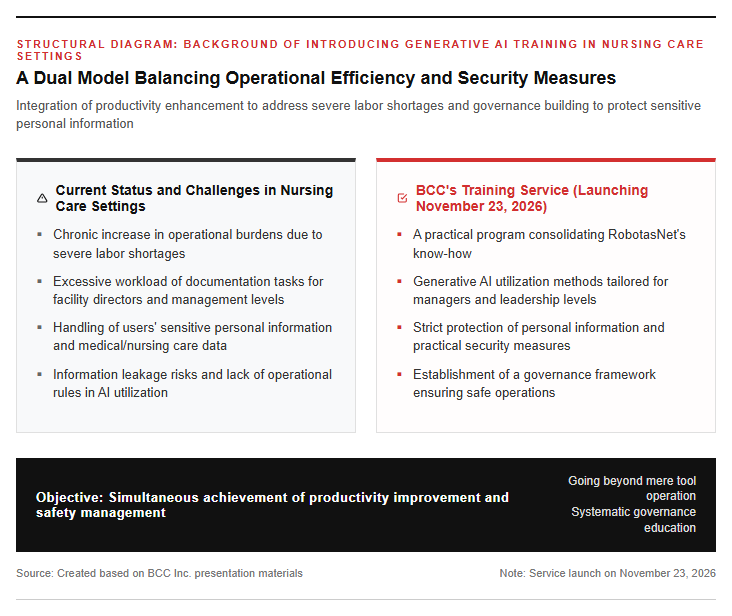
On November 23, 2026, BCC Inc., a company operating in the healthcare sector, launched a generative AI utilization training and information security course targeted at nursing care providers. This service consolidates the hands-on expertise cultivated by its group company, Robotas Net Co., Ltd., which provides support for the implementation of care technology, aiming to improve the productivity of facility directors, managers, and leaders in nursing care facilities. Although interest in leveraging AI to streamline operations is growing in the nursing care field, handling users’ sensitive personal information and medical/care data on a daily basis has made preventing information leaks and establishing safe operational rules an urgent priority. Against this backdrop, the training provides a systematic curriculum that goes beyond mere tool operation methods, offering comprehensive learning on thorough personal information protection, security measures, and the establishment of operational governance. The diagram below illustrates the relationship between safety management and AI utilization required in nursing care settings.
By providing practical guidance based on operational track records in the field, the service supports the dual goals of business improvement and risk management.
Excessive administrative burdens and growing demand for AI in the field
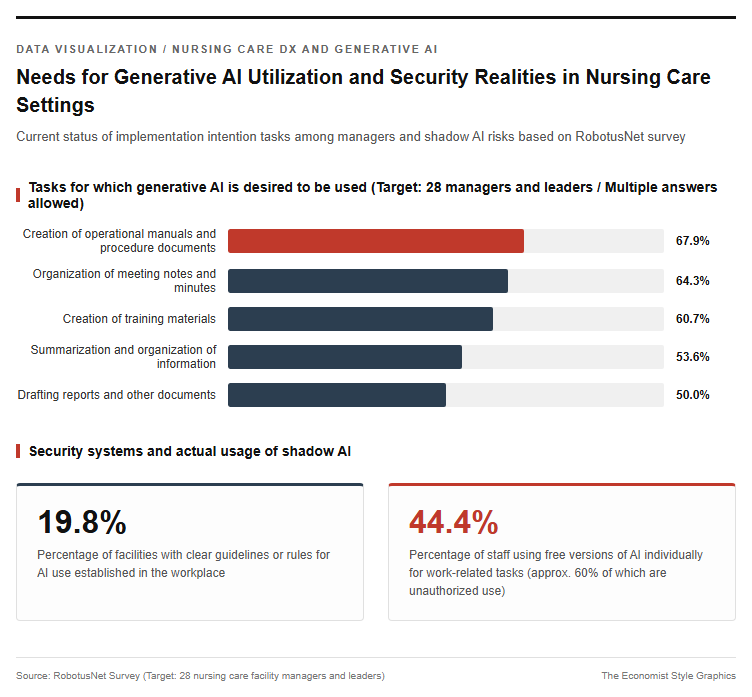
While the labor shortage in the nursing care industry has grown increasingly severe and the introduction of technology to support frontline staff in care operations is progressing, the excessive workload placed on management has become a major issue. Facility directors and leaders are overwhelmed by a vast amount of paperwork—such as creating meeting materials, minutes, training materials, reports, and operational manuals—leaving them without sufficient time to dedicate to staff development and improving care quality, which should be their primary focus. According to a survey conducted by Robotas Net targeting 28 managers and leaders at nursing care facilities, 92.9% responded that they would like to use generative AI in their actual work. Regarding specific tasks they wish to use it for, 67.9% (19 people) cited creating operational manuals and procedural guides—the highest percentage—followed by organizing meeting notes and minutes at 64.3% (18 people), creating training materials at 60.7% (17 people), summarizing and organizing information at 53.6% (15 people), and drafting reports and other text at 50.0% (14 people). As this data clearly shows, there is exceptionally high expectation in the field for labor-saving operations through the use of generative AI in routine, high-frequency document creation and information organization tasks.
Handling of sensitive personal information and the threat of shadow AI
Much of the information handled in nursing care settings falls under “specially designated personal information” (sensitive personal information) as defined by the Act on the Protection of Personal Information, including highly confidential data such as medical histories, disability statuses, family structures, and economic circumstances. However, survey results regarding AI utilization within the industry revealed that only 19.8% of workplaces have clear guidelines and usage rules in place, meaning that over 80% of business sites lack such rules. Furthermore, the percentage of individuals using free versions of AI for work purposes stands at 44.4%, with approximately 60% of staff using AI without reporting or consulting their supervisors. The rampant use of “shadow AI”—where patient and user information is entered into personal accounts and free tools without management’s knowledge—poses a serious threat that can lead to unintended data retraining and information leaks. Guidelines for information safety management in nursing care facilities, formulated by the Ministry of Health, Labour and Welfare, also mandate thorough ID management and the prevention of external data transmission. When introducing generative AI, establishing clear boundaries on what information can be input and setting up a monitoring system are indispensable alongside the pursuit of convenience.
Practical training programs and future prospects for nursing care DX
A diversified training system with options ranging from a 90-minute introductory course to a 10-hour practical course
The training program offered by BCC consists of multiple courses that can be flexibly selected according to the challenges of the facility and the roles of the trainees. The 90-minute introductory training on generative AI utilization, conducted either in-person or online, covers the basic structure of generative AI, a comparison of major services, safe usage procedures, information leakage prevention measures, basic prompt exercises, and steps for implementation within the facility, targeted specifically at facility directors and leaders. Additionally, a 60-minute video training course (available via corporate license) has been prepared for frontline staff who find it difficult to adjust their schedules. This video training is scheduled for release on December 4, 2026, and advance applications were accepted from November 12 to November 30, 2026 (at a special early-bird price of 39,600 yen including tax, limited to 15 corporations). Furthermore, a 60-minute information security course and digital literacy course aimed at all staff members are also provided concurrently. The diagram below shows the overall picture of this diversified training system.
By providing phased learning, the program achieves a raised baseline of IT literacy across the entire facility and ensures safe AI usage.
Job-Direct Practical Curriculum Designed with Subsidies in Mind
The most comprehensive support among BCC’s training programs is the generative AI practical training, conducted in a 10-hour face-to-face format. Unlike general operational training, this practical training features a job-direct curriculum that uses actual business documents and operational workflows from the participating nursing care facility as direct subject matter. Throughout the course, participants consistently work on creating a list of tasks for AI utilization within their organization, developing practical prompt collections tailored to their operations, formulating concrete AI utilization action plans, and establishing internal usage rules. Furthermore, this course is designed in accordance with the institutional requirements of the Ministry of Health, Labour and Welfare’s “Human Resources Development Support Grant – Business Expansion, etc. Reskilling Support Course.” By utilizing subsidies, facilities can reduce the burden of training costs while establishing a practical operational framework that functions immediately on-site after training completion. A major strength of this service is its hands-on support that goes beyond simply introducing tools, ensuring continuous integration and retention on the front lines.
Establishing Secure Governance and a Sustainable Future for Nursing Care Front Lines
The utilization of generative AI significantly reduces the time spent on document creation and information organization in nursing care settings, serving as a powerful guide to generating more time for staff to directly interact with care recipients. Surveys on employee satisfaction have even shown that establishing AI utilization rules is 2.2 times more effective at improving satisfaction than increasing annual income, meaning the construction of appropriate guidelines directly connects to preventing turnover and strengthening recruitment capabilities. As Daisuke Aisaka, Representative Director and President of Robotas Net, points out, advancing nursing care DX requires not only introducing technology, but also reforming managers’ work processes. Looking ahead, as coordination progresses with the nursing care information infrastructure and LIFE promoted by the Ministry of Health, Labour and Welfare, advanced AI utilization backed by thorough anonymization technology and access control will be demanded. Rather than viewing AI merely as a task substitute, positioning it correctly as an assistant that supports the final judgment of human professionals will open up a sustainable future for nursing care operations that achieves a high-level balance between staff ease of work and quality of care.
Reference Pages
- [BCC Inc. Press Release] https://prtimes.jp/main/html/rd/p/000000162.000012929.html
- [Kaigo DX Navi Training Page] https://kaigodx-navi.com/ai-training/
- [Nursing Care Information Infrastructure Portal] https://www.kaigo-kiban-portal.jp/
[#BCC #NursingCareDX #GenerativeAI #InformationSecurity #HumanResourcesDevelopmentSupportGrant]


コメント