
Thai Deputy Prime Minister and Minister of Finance Ekniti Nitithanpraphas visited Japan to hold discussions with Japanese Finance Minister Satsuki Katayama and private sector executives on strengthening economic ties. This initiative is driven by a shift away from traditional production bases toward “Made with Thailand”—a model that promotes technological co-creation—with the goal of leveraging AI and building supply chains for next-generation industries.
- Key Takeaways and Major Agreements from the Japan-Thailand Finance Ministers’ Meeting
- Improving the Investment Environment through JTEPA Modernization and Tax Treaty Revision
- The Significance of the Co-creation Model Envisioned by “Made with Thailand”
- Leveraging Digital Technology and Enhancing Disaster Prevention and Crime Countermeasures through the LINE Yahoo Partnership
- Memorandum of Understanding with JAXA, NTT, etc., and the Construction of a Next-Generation Industrial Supply Chain
- Acceleration of AI and Data Center Investment and Challenges in Power and Infrastructure
- Medium-to-Long-Term Outlook and Key Points Toward the 140th Anniversary of Diplomatic Relations in 2027
Key Takeaways and Major Agreements from the Japan-Thailand Finance Ministers’ Meeting
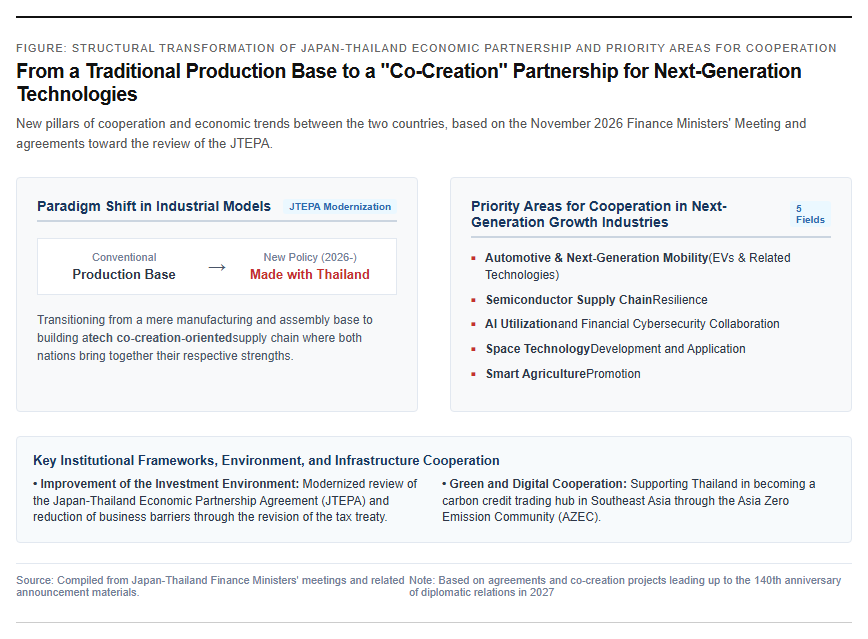
In November 2026, Thai Deputy Prime Minister and Minister of Finance Ekniti led a public-private delegation to Tokyo for a meeting with Japanese Finance Minister Satsuki Katayama. The meeting aimed to further deepen cooperation between the two countries in economy, trade, investment, and future industries. Proposals were made to modernize the Japan-Thailand Economic Partnership Agreement (JTEPA) and revise the tax treaty, signaling an intent to lower business barriers and attract private investment. In addition, next-generation growth industries—such as automobiles, semiconductors, AI supply chains, space technology, and smart agriculture—were identified as priority areas for cooperation. Japan was also asked to provide support, leveraging the Asia Zero Emission Community (AZEC) framework, to help develop Thailand into a hub for carbon credit trading in Southeast Asia. Furthermore, the two sides agreed to strengthen cooperation on security measures to counter the threat of AI-driven cyberattacks on financial systems. The two nations share a vision of promoting concrete co-creation projects leading up to the 140th anniversary of diplomatic relations in 2027, supporting a new leap forward for the Thai economy. The figure below illustrates the trends in trade and investment between the two countries.
Improving the Investment Environment through JTEPA Modernization and Tax Treaty Revision
Since its entry into force in 2007, the Japan-Thailand Economic Partnership Agreement (JTEPA) has served as the foundation for trade and investment between the two countries, but modernizing it to respond to rapid structural changes in the global economy has become an urgent task. Currently, less than 30% of Thai imports into Japan utilize JTEPA, creating a need to improve the agreement’s convenience and update its systems. The proposed revision of JTEPA and the bilateral tax treaty discussed in the meeting aim to mitigate double taxation risks and administrative uncertainties for Japanese companies operating locally in Thailand. As of 2024, more than 6,000 Japanese companies have expanded into Thailand, and membership in the Japanese Chamber of Commerce, Bangkok, has reached 1,656 companies. A large number of businesses are concentrated in sectors such as automotive (235 companies), chemicals (99 companies), and various consulting services (100 companies), making revisions to tax systems and legal frameworks directly influential on corporate investment appetite. Japanese investment applications to Thailand exceeded 113.7 billion baht in 2025, more than doubling from the previous year. Streamlining the tax environment and customs procedures is expected to further encourage capital inflows into high-value-added sectors beyond automobiles and electronics.
The Significance of the Co-creation Model Envisioned by “Made with Thailand”
A key concept strongly emphasized by the Thai side during these discussions was the strategic shift toward “Made with Thailand.” This marks a departure from the traditional contract manufacturing model—where products are simply assembled in Thailand for export—and moves toward a co-creation framework that integrates Thai companies, talent, and technology into international supply chains to jointly create new added value with Japanese firms. The Thai government has proposed the introduction of “Thailand FastPass,” a system designed to dramatically speed up investment licensing procedures, demonstrating its commitment to lowering barriers to entry for Japanese companies. The core pillars of this co-creation are three supply chains: next-generation vehicles, AI infrastructure and advanced electronics, and next-generation power grids. Thailand is advancing nationwide digitalization under its National AI Strategy and Action Plan 2022–2027, yet it continues to face structural challenges such as technology transfer and a shortage of highly skilled talent. By combining Japan’s advanced technology and R&D capabilities with Thailand’s production base and market reach in Southeast Asia, the two countries aim to build an equal partnership that goes far beyond simple factory relocation.
Concrete Collaborative Developments in the Private Sector and Advanced Technology Fields
Leveraging Digital Technology and Enhancing Disaster Prevention and Crime Countermeasures through the LINE Yahoo Partnership
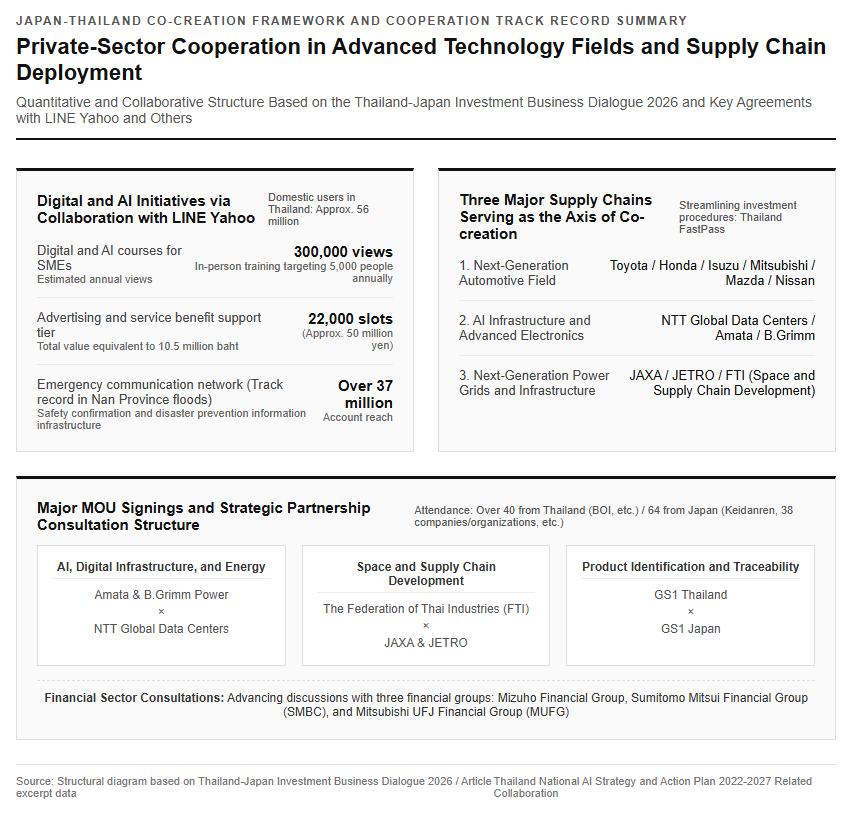
During their itinerary in Japan, the Thai delegation visited the headquarters of LY Corporation (LINE Yahoo), which operates a platform with approximately 56 million users nationwide. The Thai Ministry of Finance, Royal Thai Police, and Securities and Exchange Commission (SEC) collaborated with the company to announce three concrete cooperation plans in the digital and AI domains. First, as a measure to support small and medium-sized enterprises, they will launch digital and AI utilization courses expected to garner a total of 300,000 views over one year, and conduct in-person training targeting 5,000 people annually. In addition, a support measure consisting of 22,000 slots offering advertising and service benefits equivalent to a total of 10.5 million baht (approx. 50 million yen) will be introduced. Second, cooperation with police and financial authorities will be strengthened to counter increasingly sophisticated online scams and cybercrimes. Third, to develop a communication network for disasters, it was decided to strengthen the infrastructure for emergency information transmission by utilizing technologies such as the “LINE Safety Check” safety confirmation function—which reached over 37 million accounts during floods in Thailand’s northern Nan province—and the disaster prevention information service “LINE ALERT.” This public-private co-creation utilizing the LINE infrastructure as a living utility will greatly contribute to the efficiency of administrative services and the improvement of public safety.
Memorandum of Understanding with JAXA, NTT, etc., and the Construction of a Next-Generation Industrial Supply Chain
In addition to inter-governmental dialogue, this visit to Japan saw a series of substantive memorandums of understanding (MOUs) concluded by private and specialized organizations during the “Thailand-Japan Investment Business Dialogue 2026” held at the Imperial Hotel. More than 40 executives from the Thai side—including representatives from the BOI and the Joint Standing Committee on Commerce, Industry and Banking—and 64 individuals from 38 companies and organizations on the Japanese side, led by the Keidanren Japan-Thailand Trade and Economic Committee, were in attendance. Three important agreements were reached at the venue. First, major Thai industrial estate developer Amata and B.Grimm Power partnered with NTT Global Data Centers to sign an MOU concerning the establishment of AI and digital infrastructure and the development of a sustainable energy supply system. Next, the Federation of Thai Industries (FTI) exchanged a letter of intent for supply chain development with the Japan Aerospace Exploration Agency (JAXA) and the Japan External Trade Organization (JETRO). Furthermore, GS1 Thailand and GS1 Japan concluded an MOU on promoting product identification and traceability based on international standards. In the automotive sector, discussions were advanced with six companies—Toyota, Honda, Isuzu, Mitsubishi Motors, Mazda, and Nissan—and in the financial sector with three groups—Mizuho, SMBC, and MUFG. Strategic partnership meetings have also been established in the fields of semiconductors and electric power infrastructure. The conceptual diagram below illustrates the collaborative structure in advanced technology domains.
Challenges and Future Outlook for the Thai Economy
Acceleration of AI and Data Center Investment and Challenges in Power and Infrastructure
Against the backdrop of surging AI demand across Southeast Asia, investments in data centers are rapidly increasing, and Thailand is also in the spotlight as a major investment recipient alongside Malaysia and Indonesia. The Thai government is promoting the attraction of foreign IT companies through tax incentives and infrastructure development, with large-scale cloud service and data center projects receiving investment approval one after another. However, the rapid expansion of data center investment is placing a heavy burden on domestic power and water resource supplies. According to International Energy Agency (IEA) estimates, power demand for data centers in Southeast Asia is projected to roughly double by 2030 compared to 2024. If the pace of renewable energy adoption and the development of power grids fail to keep up with expanding demand, there are concerns about the risk of power shortages and friction with decarbonization targets. Thailand’s potential growth rate has fallen to below 3% due to a declining working-age population and sluggish productivity growth, and achieving a growth rate of 5% is required to attain high-income country status by 2037. Whether the country can foster high-tech industries such as data centers and semiconductors while building a stable supply system for clean energy will largely determine the sustainability of its economic growth.
Medium-to-Long-Term Outlook and Key Points Toward the 140th Anniversary of Diplomatic Relations in 2027
Japan and Thailand will reach a major milestone in 2027: the 140th anniversary of the establishment of diplomatic relations. The recent finance ministers’ meeting and series of public-private dialogues served as crucial stepping stones for elevating the bilateral relationship—traditionally built around manufacturing over many years—into high-value-added domains such as AI, advanced electronics, next-generation vehicles, and decarbonization. The first medium-to-long-term point of attention is the concrete progress schedule for the JTEPA revision negotiations and tax treaty review. The focus will be on whether the development of legal systems directly linked to reducing corporate operating costs progresses smoothly. The second is the extent to which Japanese SMEs and startups can enter Thailand’s supply chain through the “Thailand FastPass” and “Made with Thailand” initiatives promoted by the Thai government. The third is the progress made in establishing a carbon credit trading market through the AZEC framework and building a cybersecurity defense network in the financial sector. There is significant interest in future concrete project developments regarding whether both countries can transcend a mere investor-and-host-country relationship to forge a new era as challenge-solving co-creation partners.
Reference Pages
- [Ministry of Finance of Thailand Official Announcement (November 17, 2026)] https://www.mof.go.th/news/119061/
- [Thai Government Official Announcement (November 4, 2026)] https://www.thaigov.go.th/th/news/170869
- [METI Japan-Thailand “Energy and Industry Dialogue” Joint Statement] https://www.meti.go.jp/press/2025/04/20250429002/20250429002-b.pdf
[#Thailand #EconomicPartnership #AIUse #JTEPA #JapanThailandRelations #MadeWithThailand]


コメント