Outstanding loans at domestic banks have maintained a high growth rate in the 5% range for the sixth consecutive month, and long-term lending rates have also topped 2% for the first time in about 25 years. The backdrop to this includes active corporate demand for funds, in addition to the Bank of Japan’s gradual additional interest rate hikes and the entrenchment of “a world with interest rates.”
- [Key Event Summary] Rapid Surge in Fund Demand Indicated by 6 Consecutive Months of 5% Range Growth and Lending Rates Exceeding 2%
- Reasons for the Rate Hike to 1.25% and the Acceleration of the BOJ’s Rate-Hike Pace
- The Impact of Sluggish Deposit Growth and Rising Loan-to-Deposit Ratios on Funding Conditions
- Latent Risks Lurking in 123 Trillion Yen in Real Estate Loans and 11 Trillion Yen in Structured Loans
- The Intensifying Battle for Deposits and the Risk of a 200 Trillion Yen Outflow Due to Inheritance
- [Future Outlook and Key Points] The Financial Services Agency’s Increased Oversight and Banking Challenges Amid Rate Hikes
[Key Event Summary] Rapid Surge in Fund Demand Indicated by 6 Consecutive Months of 5% Range Growth and Lending Rates Exceeding 2%
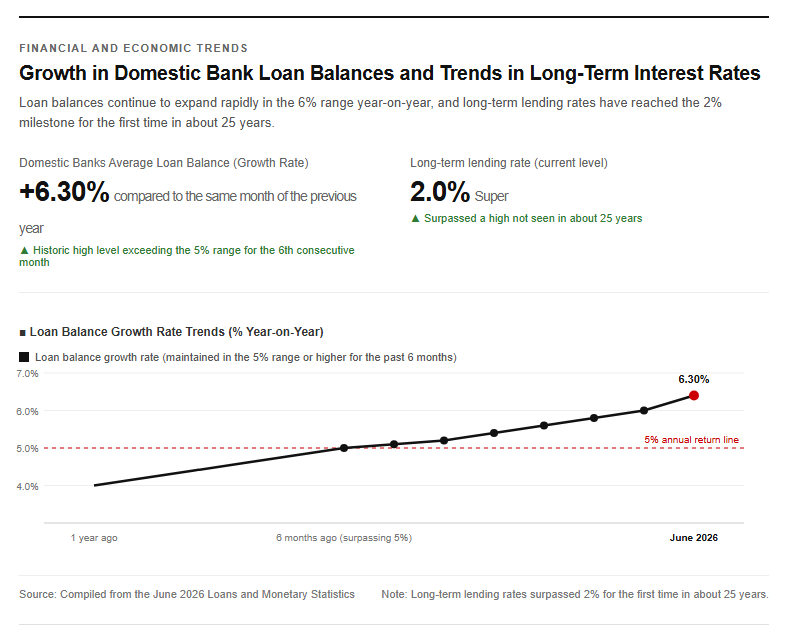
According to the lending and monetary statistics for June 2026, the average loan balance at domestic banks rose 6.30% from the same month last year, marking the 14th consecutive month of accelerating growth. As a result, domestic bank loans are at historic highs, with an annualized growth rate exceeding 5% for the sixth straight month.
Behind this rapid expansion in lending are the resilient performance of the domestic real economy and improving corporate earnings. In addition to active labor-saving and digitalization investments to cope with the intensifying labor shortage, fund demand for successive M&A deals and the booming real estate market has remained solid. Furthermore, an increase in working capital demand driven by soaring raw material and labor costs has also been a factor pushing up loan balances.
Meanwhile, the interest rate environment has also changed significantly. While short-term lending rates remain flat as the effects of the interest rate hikes have run their course, long-term lending rates have broken through the 2% threshold for the first time in about 25 years, driven by the rise in long-term government bond yields. While this provides a tailwind for financial institutions in the form of improved lending margins, they are also facing a new phase characterized by rising funding costs and an increased interest payment burden for borrowing companies. The following figure shows the trends in lending balances and interest rates.
Reasons for the Rate Hike to 1.25% and the Acceleration of the BOJ’s Rate-Hike Pace
The Bank of Japan has been proceeding with the normalization of its monetary policy since it lifted negative interest rates and began raising rates in 2024. Initially, the hikes were implemented at a gradual pace of about 0.25% roughly every six months, but entering 2026, that tempo has clearly accelerated. Successive additional rate hikes were decided at the Monetary Policy Meetings in June and September 2026, raising the policy interest rate to around 1.25%. The interval between rate hikes has been shortened from the previous six months to three months.
Behind the Bank of Japan’s acceleration of its pace of interest rate hikes is the rise in the underlying inflation rate. Driven by soaring energy prices resulting from the situations in Ukraine and the Middle East, along with the widespread adoption of passing on costs, the growth rate of the Consumer Price Index (core CPI) reached the 2% price stability target. To curb the risk of the inflation rate overshooting the target, the Bank of Japan was forced to urgently adjust the degree of monetary easing.
Furthermore, within the Bank of Japan, an indicator known as “financial conditions” is beginning to gain prominence. Even if policy interest rates are raised, under conditions where soaring stock prices, the ongoing depreciation of the yen, and robust bank lending persist, overall financial conditions for the economy are still deemed to be accommodative. The BOJ is proceeding with raising the policy rate toward around 1.75%—considered to be the neutral rate—while simultaneously conducting policy operations to steer overall financial conditions closer toward a tightening stance.
The Impact of Sluggish Deposit Growth and Rising Loan-to-Deposit Ratios on Funding Conditions
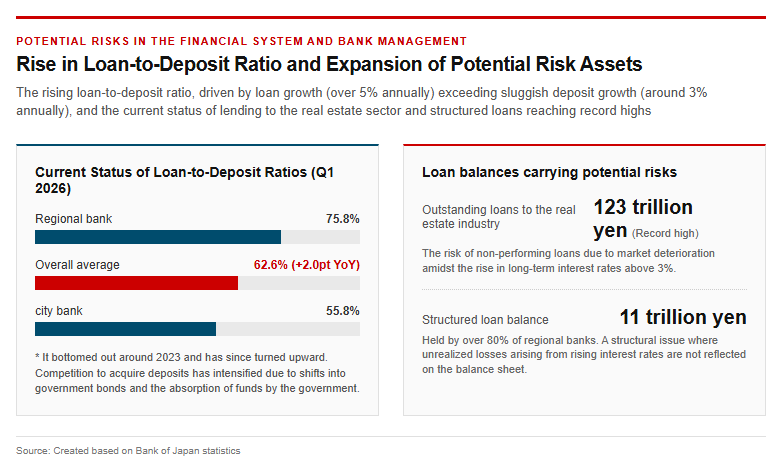
While bank lending is showing high growth exceeding 5% year-on-year, the growth of deposit balances, which serve as the source of funds, remains at around 3% per year. Since July 2022, the situation where deposit growth fails to keep pace with loan growth has continued, and the “loan-to-deposit ratio,” which indicates the ratio of loan balances to deposit balances, has turned upward. The loan-to-deposit ratio, which bottomed out around 2023, rose to 62.6% in the January–March quarter of 2026, an increase of 2.0 percentage points from the same period of the previous year. It has reached 55.8% at city banks and 75.8% at regional banks.
There are several factors behind the sluggish growth in deposits. First, yields on Japanese government bonds (JGBs) for individual investors have risen following the Bank of Japan’s (BOJ) interest rate hikes, prompting household funds to shift from deposits to government bonds. Second, tax revenue increases driven by inflation continue to reach record highs, draining funds from the private sector to the government. Third, the BOJ is gradually reducing its monthly JGB purchases from 5.7 trillion yen to 2.7 trillion yen, leading to a decline in the pressure to supply private deposits from the financial sector.
In the era of ultra-low interest rates, there were even moves to avoid acquiring deposits due to excess liquidity, but recently the situation has completely reversed, with competition to acquire deposits intensifying. Banks that cannot secure a stable deposit base have no choice but to rely on costly corporate bond issuance and market-based funding, and are facing the risk of squeezed earnings.
Underlying Risks in the Financial System and the Structural Transformation of Bank Management
Latent Risks Lurking in 123 Trillion Yen in Real Estate Loans and 11 Trillion Yen in Structured Loans
Amid the banking industry’s celebration of strong financial results, concerns are growing over the accumulation of risks. According to statistics from the Bank of Japan, outstanding loans to the real estate industry by domestic banks reached approximately 123 trillion yen as of the end of June, hitting a record high. While the size of individual loans is expanding against the backdrop of rising land prices in major metropolitan areas and soaring costs for construction materials and labor, the risk of these loans turning into non-performing assets due to a worsening market climate is simmering as long-term interest rates rise toward levels exceeding 3%.
Another major issue is “structured loans,” which have expanded rapidly, particularly among regional banks. Structured loans are a type of financing that incorporates interest rate swaps or derivatives using securities as underlying assets. Over 80% of regional banks hold them, and the outstanding balance amounts to approximately 11 trillion yen. Due to recent interest rate hikes, the prices of the underlying government and corporate bonds have declined, resulting in valuation losses. However, because they are accounted for as “loans,” these valuation losses are not reflected on the balance sheet, presenting a structural problem where fair value information is also not disclosed.
These financial products have often been used as adjustment valves to artificially increase reported loan balances on the surface, which exacerbates information asymmetry with external stakeholders. The Financial Services Agency (FSA) is growing increasingly wary of such opaque risk-taking and the hollowed-out screening systems. The details of the financing scheme are shown in the figure below.
The Intensifying Battle for Deposits and the Risk of a 200 Trillion Yen Outflow Due to Inheritance
With the transition to a “world with interest rates,” acquiring sticky core deposits (such as payroll and settlement accounts) has become the most critical challenge determining corporate value (PBR) for banks. Major banks are rapidly deepening their partnerships with online banks and mobile payment providers. As typified by the alliance among Sumitomo Mitsui Card, SoftBank, and PayPay, they are building payment infrastructure integrated with mobile carriers’ economic ecosystems in an effort to lock in the accounts and funds of younger generations and individual customers.
On the other hand, regional banks and shinkin banks are facing a serious risk of deposit outflows. According to future projections, inheritances are expected to occur involving approximately 202 trillion yen—equivalent to about 20% of all individual deposits and savings—over the next 10 years. As the number of deaths peaks in aging regional cities, funds tend to flow out to major urban banks and highly convenient online banks when inheritances occur. The retention rate of inherited deposits at regional banks remains at a low level of around 42%.
Population decline and the decrease in deposits due to inheritance are directly undermining the funding base of regional financial institutions. To maintain their financial strength and sustain efficient financial intermediary functions, movements toward regional bank restructuring aimed at expanding scale are accelerating further, including integration with regional banks in neighboring prefectures and transformations into “super-regional banks” aiming for a deposit scale of 30 trillion yen.
[Future Outlook and Key Points] The Financial Services Agency’s Increased Oversight and Banking Challenges Amid Rate Hikes
Regulators are stepping up efforts to stabilize the financial system amid rising interest rates. In its financial administration policy for the 2026 business year, the Financial Services Agency (FSA) has outlined plans to strengthen supervision and monitoring of real estate loans, overseas fund loans, and structured lending. It has indicated a policy to utilize artificial intelligence (AI) to streamline monitoring operations and intensively reallocate the freed-up personnel to on-site inspections of financial institutions.
The biggest point of focus for the future is the change in borrowers’ repayment capacity and the increase in credit costs associated with additional interest rate hikes by the Bank of Japan. The terminal rate (endpoint) for the policy interest rate is projected to be 1.75%, but we cannot rule out a risk scenario in which further hikes are implemented if the easing of financial conditions is not resolved. Banks will be tested on how they control the risk of startups and real estate businesses—which have received excessive credit under the long-standing low-interest-rate environment—being driven to bankruptcy as they become unable to withstand rising interest rates.
The era of simply pursuing loan market share expansion or superficial record-high profits has come to an end. Financial institutions are required to set appropriate lending rates commensurate with risk, implement strict ALM (Asset Liability Management) including derivative risks, and provide highly transparent information disclosure to depositors. Building a risk management system that can control latent risks while enjoying the benefits of rising interest rates will determine future success or failure.
Reference Page
- [Financial Services Agency] Monitoring Report on Structured Lending at Regional Banks (2026) March 2026 [suspicious link removed]
- [Japan Research Institute] Two Background Factors Behind the Rise in Banks’ Loan-to-Deposit Ratios (June 2026) [suspicious link removed]
- [NLI Research Institute] Lending and Monetary Statistics (June 2014): Bank Lending Continues to Perform Well, Long-Term Lending Rates Exceed 2% for the First Time in 25 Years https://www.nli-research.co.jp/report/detail/id=86233
[#BankLending #InterestRateHike #BankOfJapan #LoanToDepositRatio #FinancialServicesAgency #RiskManagement #RealEstateFinancing]


コメント