An unauthorized access incident targeting the “Wallet Station” payment infrastructure provided by fintech company Infcurion has led to the leak of up to approximately 250,000 pieces of personal information via services such as the Bank of Kagoshima’s “Paydon,” resulting in a total suspension of all services. In the background lie the rapid expansion of embedded finance (BaaS) and the difficulties of security governance associated with the growing IT supply chain.
- Timeline of the Leak of Over 250,000 Personal Information Records and Total Service Suspension
- Leaked Information Items, Impact on Users, and Precautions
- Immediate Impact on Stock Prices and Credibility Risks in the Market
- Spread to Client Financial Institutions and Expansion of Emergency Inspections
- Reporting and Security Management Based on the Act on the Protection of Personal Information and Financial Services Agency Guidelines
- Future Developments and Points to Watch in the Financial Fintech Industry
Timeline of the Leak of Over 250,000 Personal Information Records and Total Service Suspension
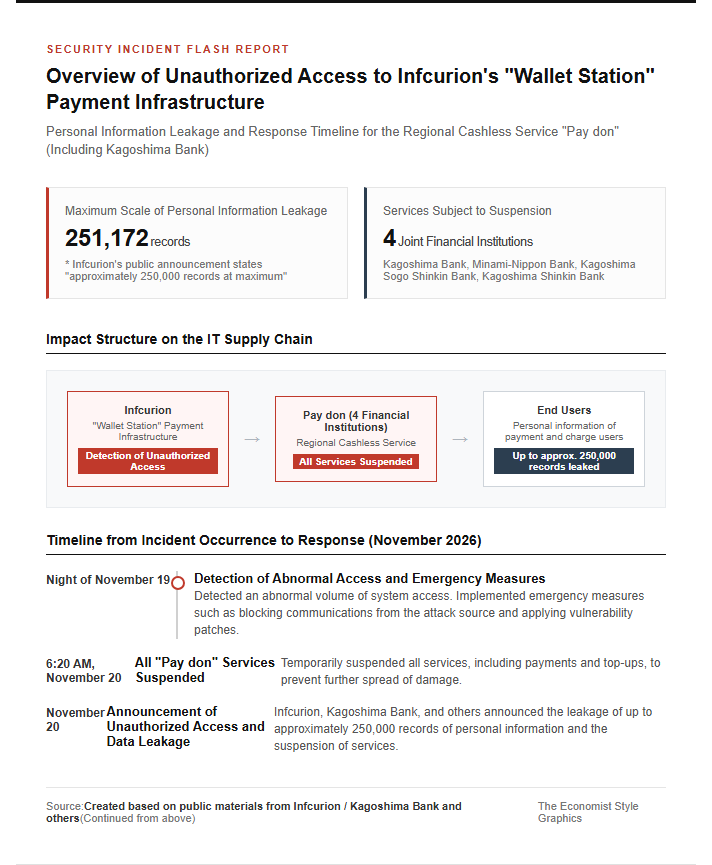
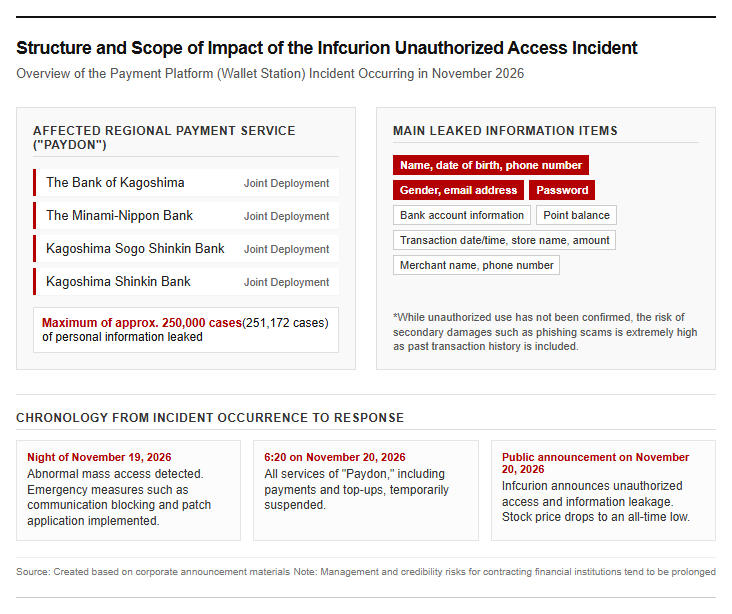
On November 20, 2026, fintech company Infcurion, Inc. announced that unauthorized access by a third party had occurred on “Wallet Station,” a wallet platform developed and provided by the company, resulting in the leakage of user personal information to the outside. The company detected abnormal massive access to the system on the night of November 19, 2026, and implemented emergency measures such as blocking communications from the attack source and urgently applying vulnerability patching. The services directly affected by this incident are “Paydon,” a regional cashless payment service jointly deployed by four financial institutions: the Bank of Kagoshima, the Minami-Nippon Bank, the Kagoshima Sogo Shinkin Bank, and the Kagoshima Shinkin Bank. According to Infcurion’s announcement, the number of leaked records reaches a maximum of approximately 250,000, while announcements by the Bank of Kagoshima and others place the figure at 251,172. To prevent the spread of damage, “Paydon” took measures to temporarily suspend all services, including payments and top-ups, starting at 6:20 a.m. on November 20, 2026. The compromise of a SaaS-type platform supporting payment infrastructure has become a major incident that instantly halts the entire payment service of regional financial institutions.
Leaked Information Items, Impact on Users, and Precautions
The personal information leaked due to this unauthorized access includes basic member information such as the names, dates of birth, phone numbers, genders, email addresses, and passwords of “Paydon” users. Furthermore, it spans a wide range of data, including payment-related information such as linked bank account details and point balances, detailed transaction history including transaction dates, store names, and transaction amounts, as well as merchant store names and phone numbers. Although no unauthorized use of the leaked information has been confirmed as of November 20, 2026, the inclusion of past transaction history creates an extremely high risk of sophisticated phishing emails, SMS messages, and fraudulent activities via suspicious phone calls impersonating actual transactions. Infcurion and the financial institutions are urging caution, stating that they will never ask for passwords or account PINs via email or phone. Users need to take self-defense measures such as ignoring suspicious communications and promptly changing passwords if they are reusing the same passwords on other companies’ services.
Ripple Effects on the IT Supply Chain, Market, and Management
Immediate Impact on Stock Prices and Credibility Risks in the Market
Following the announcement of a large-scale information leak in the payment infrastructure, the stock market reacted immediately. Infcurion’s stock, listed on the TSE Growth Market, was hit with a flood of sell orders right after trading opened on November 20, 2026, when the incident was announced, causing it to hit a record low since listing. The impact of security incidents in the IT supply chain on corporate value has also been examined in detail through event study analyses by research groups such as Kansai University. According to their research, there is a statistically recognized tendency for the stock prices and corporate value of outsourcing principals (such as financial institutions) that provide services to decline more significantly than the vendor companies entrusted with the systems. Moreover, in cases where the cause of the incident is unauthorized access or large-scale cases involving leaks exceeding 5,000 records, it has been demonstrated that the decline in corporate value continues for about one month after the announcement. This case falls squarely into this typical pattern, bringing about severe management risks that go beyond a mere system failure at a single company and result in a loss of market trust.
Spread to Client Financial Institutions and Expansion of Emergency Inspections
“Wallet Station” is widely deployed as a cloud-based platform that allows financial institutions and corporations to rapidly build their own branded smartphone payment services and digital wallets. Consequently, the impact of this incident is spreading beyond just the four banks and financial cooperatives in Kagoshima Prefecture that operate “Paydon.” With the aim of preventing secondary damage and reconfirming safety, Infcurion has also initiated emergency system inspections, following individual consultations, for other companies utilizing “Wallet Station” where no direct damage has been confirmed. Due to the implementation of these inspections, there is a possibility that periods may arise when payment services provided by other companies will also temporarily become unavailable. Although the application of emergency security patches and measures to block unauthorized access routes have already been completed, it is taking time to detail the vulnerabilities that caused the intrusion and to completely identify the scope of the impact, and tensions remain high regarding ensuring the overall security of financial settlement infrastructure.
Governance, Regulatory Compliance, and Future Industry Outlook
Reporting and Security Management Based on the Act on the Protection of Personal Information and Financial Services Agency Guidelines
This data leakage incident is a serious incident that requires strict responses from both legal and regulatory perspectives. Pursuant to Article 26 of the Act on the Protection of Personal Information, when a leakage due to unauthorized access or a large-scale leakage of personal data affecting more than 1,000 individuals occurs, business operators are obligated to report to the Personal Information Protection Commission and notify the affected individuals. In outsourcing relationships, both the outsourcing entity and the contractor bear reporting obligations, making cooperation essential for the prompt submission of preliminary reports (within 3 to 5 days) and final reports (within 30 days). Furthermore, based on the “Guidelines on Cybersecurity in the Financial Sector,” the Financial Services Agency strongly urges financial institutions to inspect risk management structures regarding third-party service providers and to tighten identity verification for non-face-to-face transactions. Particularly with the amendment of the Act on Prevention of Transfer of Criminal Proceeds, there is a demand to transition as quickly as possible from the submission of identity verification document images in non-face-to-face transactions to IC chip reading methods, making the elevation of security standards an urgent task for the industry as a whole.
Future Developments and Points to Watch in the Financial Fintech Industry
In recent years, “Banking-as-a-Service (BaaS)”—where financial institutions and SaaS providers utilize external platforms to incorporate payment functions—has spread rapidly. However, this incident has once again highlighted the structural risks inherent in IT supply chains, where vulnerabilities in a single payment platform simultaneously and adversely affect multiple financial institutions and numerous users. Moving forward, it will be essential to further clarify communication systems and the scope of responsibility for shutdown decisions in the event of an incident between outsourcing entities and contractors. Additionally, as technical measures, the automatic detection of massive access at the pre-API stage, the implementation of rate limiting, and the mandatory requirement for regular third-party vulnerability assessments are projected to be strongly promoted. Whether a robust system configuration that balances convenience and security can be rebuilt against increasingly sophisticated cyberattacks will be the most critical challenge for the financial fintech industry going forward.
References
- [Infcurion, Inc. Press Release] https://infcurion.com/news/news-20261120_001/
- [The Bank of Kagoshima Important Notice] https://www.kagin.co.jp/important.html
- [Kansai University Research Institute for Socionetwork Strategies (RISS)] http://www.kansai-u.ac.jp/riss/index.html
- [Financial Services Agency Press Releases] https://www.fsa.go.jp/news/r8/sonota/20261009/20261009.html
- [Personal Information Protection Commission Report on Leakages, etc.] https://www.ppc.go.jp/personalinfo/legal/leakAction/
[#Infcurion #WalletStation #Paydon #DataLeak #Cybersecurity #ITSupplyChain #Cashless]

コメント