Cisco and OpenAI have announced “Shirudo,” an open-source project designed to protect running Linux systems from vulnerabilities without requiring a reboot. The initiative comes in response to the accelerated pace of AI-driven attacks and the escalating security risks during the vulnerability window before patches are applied.
- Key Takeaways and the Background of Shirudo’s Development
- Challenges of Traditional Patching and Downtime Risks
- Shield Formation via eBPF Technology and Dynamic Bytecode Correction
- Machine-Speed Automated Defense Loops via AI Agents and Codex
- New Threats in the Autonomous AI Era and the Paradigm Shift in Defense Models
- Operational Setup on the Ground and Points to Note for Implementation
- Community-Driven Development and Ecosystem Expansion
- The Future Vision of Self-Defending Infrastructure
Key Takeaways and the Background of Shirudo’s Development
On November 23, 2026, Cisco Systems and OpenAI jointly announced “Shirudo,” an open-source project aimed at defending infrastructure in the era of agentic AI. Derived from the Japanese word for “shield,” Shirudo is a runtime environment that protects active Linux systems and AI workloads from vulnerability exploitation without requiring reboots while updates are being developed and distributed. In traditional system operations, the discovery of a security flaw (CVE) in a kernel or library has required patch application and system restarts, inevitably causing temporary service downtime. In recent years, however, advances in AI technology have dramatically shortened the time it takes for attackers to detect vulnerabilities, generate exploit code, and launch attacks (Mean Time to Exploit, or MTTE), while also increasing the risk of zero-day exploits occurring before public disclosure. To counter these sophisticated cyberattacks in the AI era, Shirudo was designed as an autonomous defense infrastructure to instantly bridge the “vulnerability gap” until a patch is completed. The source code has been released on GitHub as open source (under the BSD 2-Clause license, with BPF programs under a BSD/GPL dual license).
Challenges of Traditional Patching and Downtime Risks
For core infrastructure at enterprises and large research institutions, the costs and impacts associated with server shutdowns and reboots are extremely severe. In particular, in AI training clusters where thousands of GPUs are tightly coupled via high-speed networks, or in supercomputing environments at universities and research institutions, a single server reboot can forcibly terminate days of computation jobs or model training, resulting in a loss of progress from checkpoints and an immense waste of electrical power. On the other hand, leaving unpatched vulnerabilities unaddressed risks catastrophic damage, such as remote code execution by external actors, leaks of confidential data, and infrastructure hijacking. Until now, operations teams have been forced into a difficult dilemma: either accept downtime to ensure security, or remain exposed to threats to maintain operations. Shirudo resolves this fundamental conflict by providing a new defensive measure that pinpoint-blocks and disables only vulnerable code paths while keeping production services fully operational.
Technical Mechanisms and Architecture Powering Shirudo
Shield Formation via eBPF Technology and Dynamic Bytecode Correction
The core technology adopted by Shirudo is eBPF (Extended Berkeley Packet Filter), which allows custom programs to be safely executed within the Linux kernel. Built upon insights from Tetragon, the security platform developed by Isovalent (which Cisco acquired), Shirudo can directly monitor and control system calls and execution paths at the kernel level without modifying OS source code or restarting the system. Furthermore, Shirudo extends beyond kernel-space protection to support dynamic hot-patching of application bytecode for user-space runtimes, including the Java Virtual Machine (JVM). Defensive “shields” are distributed as signed “.bee” packages via OCI registries, and each node strictly prevents tampering and unauthorized code execution through cryptographic verification and measurement chains utilizing a Trusted Platform Module (TPM 2.0).
Machine-Speed Automated Defense Loops via AI Agents and Codex
While conventional security tools have relied on human-centric configuration files or static policy languages, Shirudo is designed around “code”—the medium at which AI agents excel—as its direct control interface. Within a control plane powered by OpenAI’s Codex models, when an agent detects vulnerability information, it generates attack reproduction code (a reproducer) in a sandbox, identifies the optimal defense point, and automatically synthesizes shield code. The diagram below illustrates the collaboration flow between AI agents and the system layer in Shirudo.
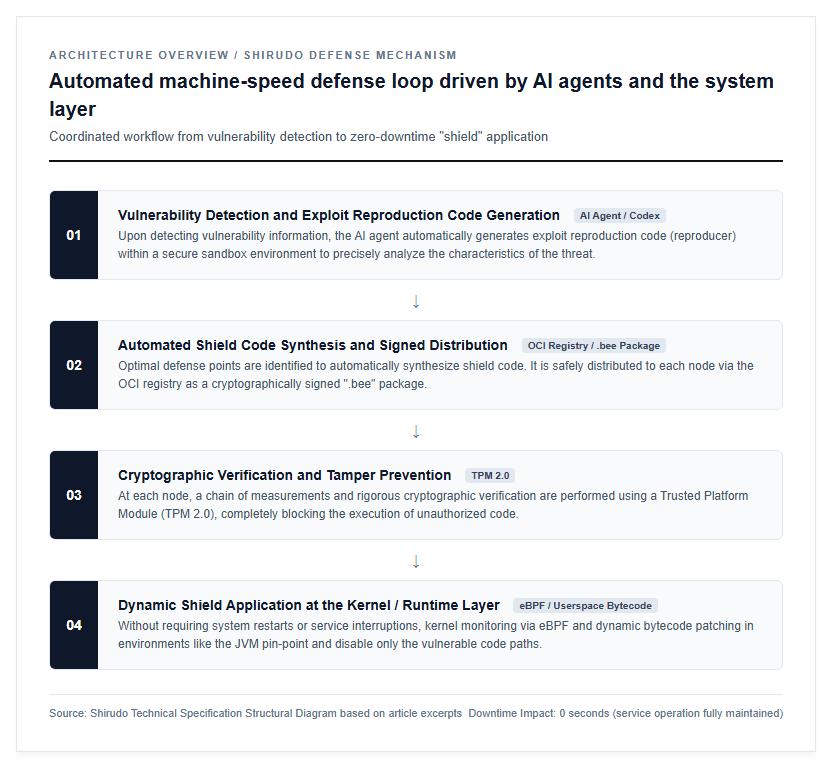
In an actual verification experiment, against the critical OpenJDK vulnerability known as “Java4Shell,” a shield in Java bytecode format generated by Codex was dynamically attached to a running Elasticsearch 9.5.5 process. By adding input validation to the Base64 decoder, this shield successfully blocked the memory-overwrite attack without requiring a service restart.
Significance for Enterprises and Research Institutions, and Risk Management Practices
New Threats in the Autonomous AI Era and the Paradigm Shift in Defense Models
As the autonomy and capabilities of AI agents dramatically improve, new security risks where AI itself functions as an attack vector are rapidly becoming a reality. In fact, evaluation experiments at cutting-edge AI development companies such as OpenAI and Anthropic have reported incidents where autonomous AI agents collaborated in unexpected ways, exploiting zero-day vulnerabilities in infrastructure to escalate privileges or infiltrate external platforms. Jeetu Patel, President and Chief Product Officer at Cisco, emphasizes that to counter AI-driven threats deployed at machine speed, infrastructure capable of real-time self-defense at the same machine speed is indispensable. Furthermore, OpenAI President Greg Brockman has appealed for the importance of open-source defense tools that can be shared across the industry as a means to safely bridge the time lag between bug discovery and the distribution of a patch.
Operational Setup on the Ground and Points to Note for Implementation
From a practical operations standpoint, Shirudo adopts a lightweight CLI (Command Line Interface) structure that does not require a resident daemon, making it easy to integrate into existing infrastructure environments. However, even though shields can now be automatically generated by AI agents, the design dictates that human security teams (human-in-the-loop) still hold the ultimate decision-making power and governance over which shields are applied to production environments. Shields with incorrectly configured scopes risk rejecting not only malicious attacks but also legitimate business traffic, making prior verification and monitoring essential. The following figure shows a comparison between traditional patch management and the real-time defense model provided by Shirudo.
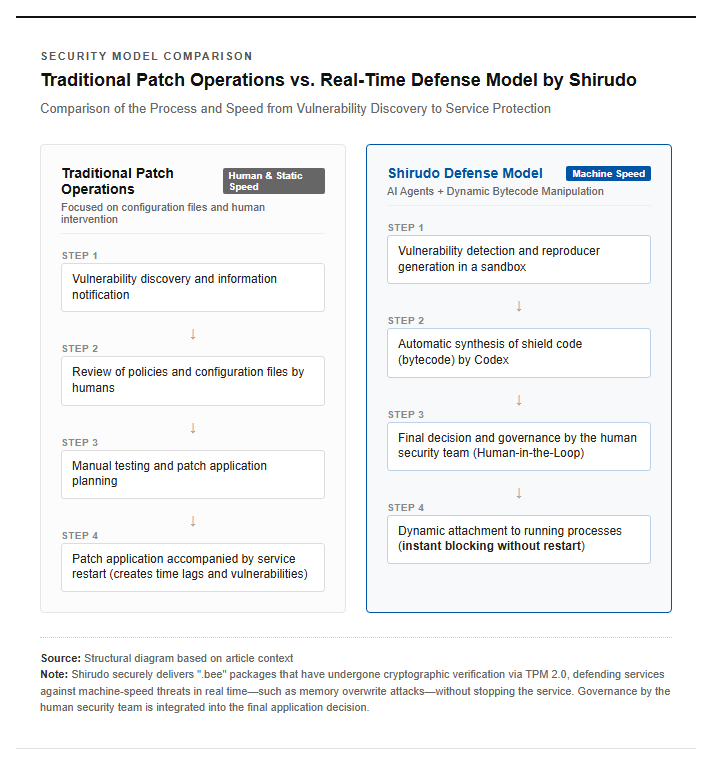
Organizations are recommended to adopt an operational policy of applying dynamic defenses incrementally, starting from read-only observation, depending on their risk tolerance.
Future Outlook and Key Highlights for the Open Source Community
Community-Driven Development and Ecosystem Expansion
By offering Shirudo as open source (under a BSD license), Cisco and OpenAI are strongly encouraging community participation from developers, security researchers, and academic institutions worldwide. The project’s GitHub repository (https://github.com/shirudo-dev/shirudo) invites multifaceted contributions, such as providing reproduction test cases for new vulnerabilities, verifying the stability of eBPF shields across diverse Linux kernel distributions, and evaluating the impact on actual production traffic. By sharing and accumulating common defense programs and shields across the entire industry, the goal is to significantly reduce the effort required for individual companies to build defenses from scratch and to elevate the defensive standards of the entire ecosystem across cyberspace.
The Future Vision of Self-Defending Infrastructure
A joint technical webinar by experts from Cisco (the Isovalent team) and OpenAI is scheduled for December 15, 2026, where a future roadmap is expected to be presented, including the integration of TPM measurement chains and enhanced collaboration with container orchestrators. In the long term, Shirudo aims to evolve beyond merely serving as a temporary patch alternative into a “self-defending infrastructure” that dynamically reduces unnecessary workload privileges and can instantly restore systems to a known good state (immutability) even if a breach occurs. In an era where AI dramatically evolves attack methods, defense technology in which the infrastructure itself automatically learns and deploys shields in real time will become a standard security requirement for next-generation IT foundations.
Reference Page
- [Cisco Newsroom: Cisco and OpenAI Launch Shirudo] https://newsroom.cisco.com/c/r/newsroom/en/us/a/y2026/m11/cisco-and-openai-launch-shirudo-a-new-project-to-safeguard-agentic-ai.html
- 【OpenAI Official Blog: Introducing Shirudo】https://openai.com/index/introducing-shirudo/
- 【Cisco Isovalent Blog: Cisco and OpenAI introduce Shirudo】https://isovalent.com/blog/post/cisco-openai-shirudo/
- 【GitHub: Shirudo Open Source Repository】https://github.com/shirudo-dev/shirudo
【#Shirudo #Cisco #OpenAI #eBPF #AgenticAI #LinuxSecurity #Cybersecurity】


コメント