ASRock Industrial has announced “RBK-100,” a physical AI development kit co-developed with Intel. This is driven by the goal of accelerating the adoption of AI-native robots by reducing the complexity of system integration in robotics development and providing an environment that seamlessly supports everything from data collection and model training to physical verification.
- Key points of ASRock Industrial’s announcement of the “RBK-100”
- Robust hardware architecture through collaboration with Intel
- The mechanism of “AiRoboStarter,” which unifies everything from training to physical robot control
- Multimodal Agent Capabilities with “AiRoboStarter Advanced”
- Market Trends and Industrial Impact Accelerating in 2026
- Ensuring Safety and Security, and Future Prospects and Key Points
Key points of ASRock Industrial’s announcement of the “RBK-100”
On November 24, 2026, ASRock Industrial announced the “RBK-100 Robotics-in-a-Box,” an integrated physical AI development platform designed for researchers, educators, and robotics developers. In conventional robot AI development, the tasks of individually selecting and integrating PCs, image processing cameras, mechanical arms, and control software are extremely complex, posing a serious challenge where R&D personnel spend a massive amount of time and effort before they can even immerse themselves in evaluating AI models and executing training tasks. This kit was designed to dramatically eliminate the heavy burden associated with this integration. The development utilized a joint development framework with semiconductor giant Intel. As John Healy, Vice President and General Manager of Intel’s Industrial and Robotics Division, emphasizes, building and deploying increasingly complex robotics systems more quickly and easily requires not only providing powerful AI processing capabilities, but also an open and standardized technology foundation. Please refer to the product architecture conceptual diagram below.
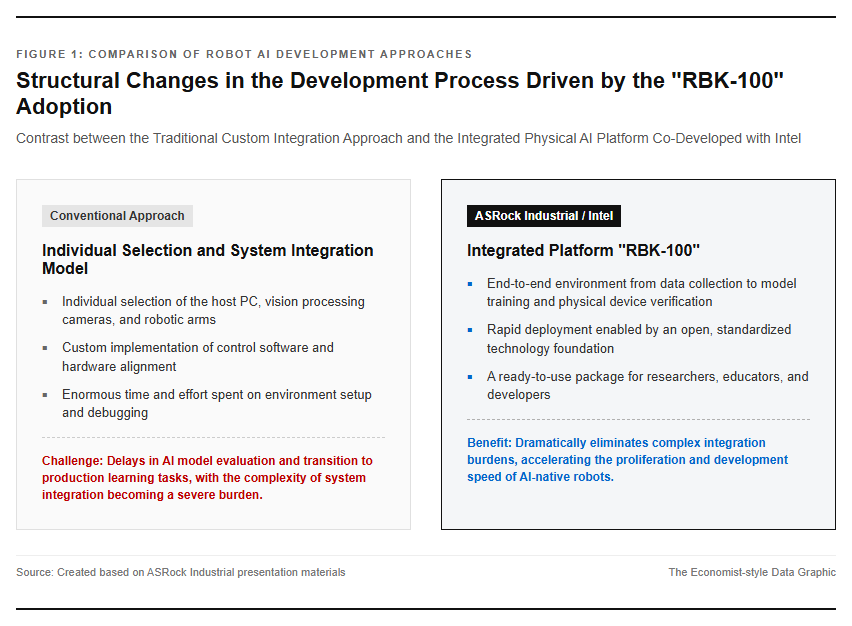
With the arrival of this development kit, the entire process from demonstration data collection and model training to physical skill verification has been centralized, making the effective utilization of advanced AI technology even easier.
Robust hardware architecture through collaboration with Intel
The hardware configuration of the RBK-100 is carefully designed to balance advanced local AI computation and high-precision operability in the physical space. The core computing foundation employs ASRock Industrial’s compact yet high-performance “NUC BOX-358H,” equipped with the latest “Intel Core Ultra X7 Processor 358H” CPU. Two configurations are available depending on memory capacity and software specifications: the standard configuration model features 32GB of high-speed DDR5-5600MHz memory, while the higher-end Advanced configuration model is equipped with 64GB of high-speed DDR5-5600MHz memory. Both models adopt a 512GB M.2 2280 PCIe Gen4 SSD for storage, enabling smooth read and write operations for large volumes of training data and sensor logs. An RGB-D depth camera is included as a sensor system for spatial recognition and object grasping, allowing precise acquisition of 3D depth data simultaneously with color image information. The operation system includes a complete set of 6-degree-of-freedom (6-DOF) leader-follower robotic arms, structured to collect motion data by having a human manually move the arm to perform demo operations. In addition, the package includes six test cubes to be manipulated, dedicated mounting accessories for the camera and arms, and a 4-port USB hub with auxiliary power input (5V).
AI development workflow enabled by “AiRoboStarter”
The mechanism of “AiRoboStarter,” which unifies everything from training to physical robot control
The proprietary development software “AiRoboStarter,” pre-installed as standard on the RBK-100, integrates the development cycle from robot motion learning to physical task execution into a single pipeline. The specific workflow covers all steps: data collection through remote arm operation, review and filtering of recorded data, AI model training, and execution of robot motion skills upon completion of training. This allows development from training to verification to be completed seamlessly on a single platform, eliminating the need to switch between multiple development environments and tools as was done conventionally. As supported algorithm configurations, cutting-edge foundation models highly regarded in the field of robot manipulation, such as ACT (Action Chunking Transformer) and Pi0.5, are supported out of the box. Additionally, support for SmolVLA, a lightweight and powerful VLA model, is planned through future software updates. By having a human move the Leader arm to demonstrate manual work such as pick-and-place tasks and having the system learn that behavior and visual data, the Follower arm is designed to autonomously acquire high-precision manipulation skills.
Multimodal Agent Capabilities with “AiRoboStarter Advanced”
Offered in a high-end configuration model equipped with 64GB of memory, “AiRoboStarter Advanced” goes beyond standard motion-learning environments to realize agent-type workflows integrated with generative AI and LLMs. This environment makes it possible to directly link natural language voice commands, visual spatial recognition, and advanced reasoning functions with the robot’s action skills. Specifically, it integrates voice recognition and speech synthesis engines, large language models (LLMs), object detection algorithms, web search interfaces, and custom APIs. As a result, even for ambiguous human instructions such as “move the blue cube into the red box,” the AI can infer background context and surrounding object layouts in real-time, select the optimal operating motion from learned robot skills, and automatically execute it. Unlike conventional routine teaching programs, this enables experimentation with multimodal dialogue and behavioral models that can flexibly adapt to changing situations, which is expected to significantly shorten the verification period for advanced physical AI at research institutions and enterprises.
Market Trends and Safety Challenges in the Era of Physical AI
Market Trends and Industrial Impact Accelerating in 2026
In the 2026 industrial sector, as Deloitte Tohmatsu’s research shows, three major trends—”physical AI,” “multi-AI agents,” and “next-generation robot platforms”—are mutually interlinked, strongly promoting the AI-native transformation of robots. Initiatives to seamlessly combine simulations in virtual spaces with physical data from the real world are gaining momentum, advancing a qualitative shift in automation at manufacturing and logistics sites. According to a market research report published by Global Reports, the global robotics AI computer market size is expected to grow from approximately 580 million USD in 2025 to about 700 million USD in 2026, with projections of a rapid expansion to approximately 2.09 billion USD by 2032. A high compound annual growth rate (CAGR) of roughly 20.0% is anticipated from 2026 to 2032. This backdrop features the mass deployment of autonomous mobile robots (AMRs), the intelligent upgrading of industrial robots, and the full-scale commercialization of pilot tests for humanoid robots. Please refer to the following market forecast data model.
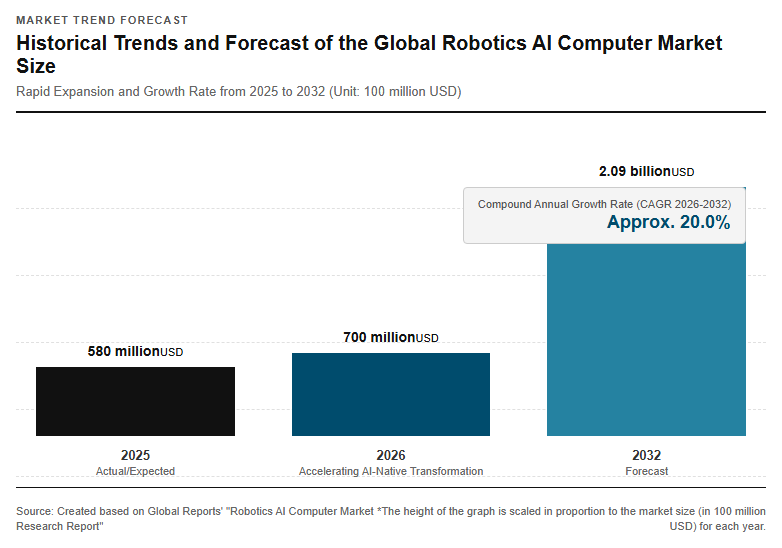
Integrated development environments like the “RBK-100” play a role as catalysts that absorb this wave of market expansion and significantly lower development hurdles.
Ensuring Safety and Security, and Future Prospects and Key Points
While the practical application and social implementation of physical AI progress, ensuring safety and strengthening cybersecurity have emerged as critical issues. Because AI robots autonomously infer operational policies, they carry inherent risks of malfunction in the physical environment caused by biases in training data, overfitting, or inference errors due to unexpected environmental factors. Furthermore, concerns remain regarding the tampering of training data from the cloud, backdoor attacks embedded during the development stage, and the risk of leakage of manufacturing data, which constitutes corporate know-how. As for regulatory trends in Europe, compliance with multifaceted regulatory frameworks is required, including the EU AI Act, the Machinery Regulation (EU 2023/1230), the Product Liability Directive, and the General Data Protection Regulation (GDPR). Therefore, it is essential to move away from the reliance on physical safety fences used in conventional industrial robots, and instead integrate fail-safe designs and advanced cybersecurity that prioritize safety functions over inference processing. Moving forward, the focal point will be whether companies can seamlessly integrate on-site actual data, safety design, and operational processes, going beyond a mere competition of AI model accuracy. The widespread adoption of standard platforms like the RBK-100 is expected to accelerate the transition from the PoC phase to mass production and on-site implementation, significantly contributing to the resolution of labor shortages and the automation of hazardous work.
Reference Page
- [ASRock Industrial RBK-100 Product Official Page] https://www.asrockind.com/en-gb/RBK-100%20/%20Robotics-in-a-Box
- [ASRock Industrial RBK-100 Official Announcement Release] https://www.asrockind.com/en-gb/article/326
[#ASRock #PhysicalAI #RBK100 #Robotics #EdgeAI #Intel]


コメント