
Nikkei 225 futures temporarily plummeted by 1,140 yen at 22:00 during night trading. This was driven by selling pressure on semiconductor and AI-related stocks in the U.S. market, as well as a sharp increase in risk-aversion sentiment tied to interest rate and currency trends.
- Key points of the 1,140-yen drop in night trading
- Selling pressure driven by the U.S. stock decline and the ripple effect on AI-related stocks
- Liquidity risk generated by the concentration of market orders and a thin order book
- Circuit breaker activation and mechanisms for temporarily halting trading
- Impact on Foreign Exchange Markets and Risk-Aversion Yen-Buying Trends
- Future Developments, Key Points to Watch, and Risks Investors Should Guard Against
Key points of the 1,140-yen drop in night trading
In the Nikkei 225 futures market at the Osaka Exchange, a massive price drop of 1,140 yen was observed around 22:00 during night trading. Selling dominated from the outset compared to the daytime trading settlement price, causing a temporary plunge unique to the night session’s trading environment. During nighttime hours when the cash market is closed, futures prices tend to react in advance to overseas market trends and sudden currency fluctuations. In particular, 22:00 coincides with the time around the opening of the U.S. stock market, making it a period when orders from overseas tend to concentrate. In night trading, where the order book depth is limited compared to daytime trading, the entry of substantial sell orders tends to push prices sharply downward. This sudden 1,140-yen drop occurred as investors simultaneously advanced risk-off position adjustments against the backdrop of U.S. and Japanese financial conditions and sell signals for major stocks. With market participant psychology tilting in a single direction, a vicious cycle formed in a short period where selling begat more selling, resulting in a temporary expansion of the drop.
Selling pressure driven by the U.S. stock decline and the ripple effect on AI-related stocks
The direct catalyst for the plunge was intense selling pressure on tech and semiconductor-related stocks in the U.S. stock market. The Nasdaq Composite Index fell significantly by 5.28%, the S&P 500 Index dropped 3.70%, and the Philadelphia Semiconductor Index (SOX) recorded a sharp decline of 10.73% in a single day. Among individual major stocks, NVIDIA plunged 14.01%, while major semiconductor firms such as Micron Technology, Broadcom, and AMD suffered steep declines ranging from 12% to over 14%. Please refer to the figure below.
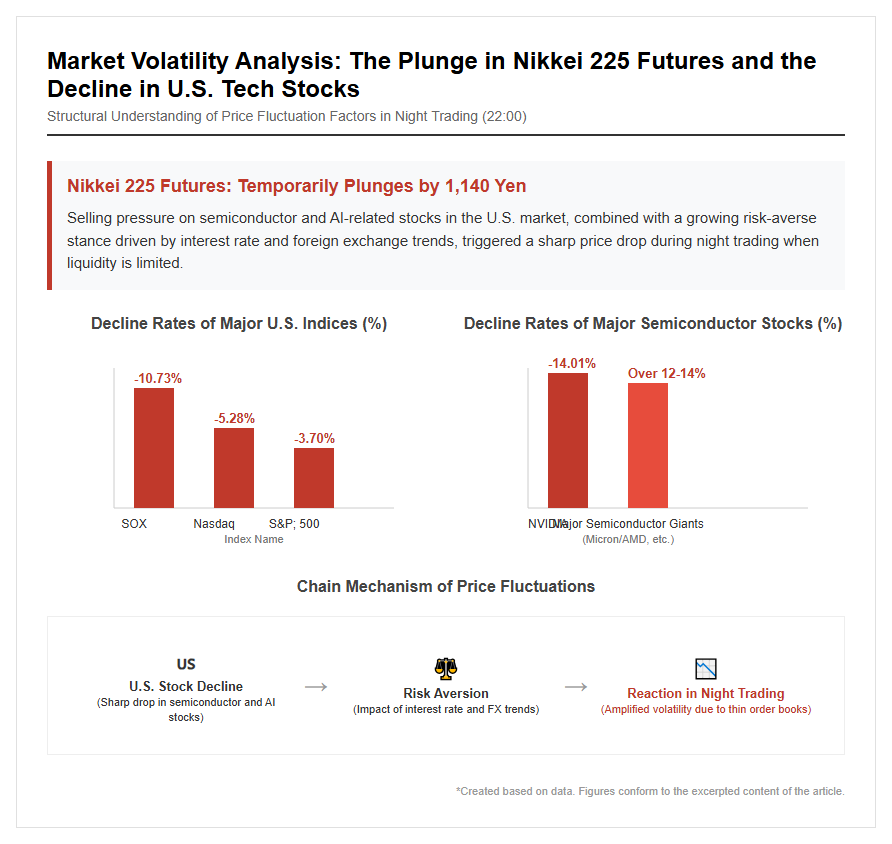
This widespread sell-off in major semiconductor stocks caused the Volatility Index (VIX) to surge to 35.89, rapidly heightening market-wide fear. Furthermore, U.S. President Trump’s hint at taxation on companies building overseas data centers and speculation that the probability of an additional rate hike by the Federal Reserve (FRB) in December had reached 88.6% also served as factors dampening investor sentiment. As a reassessment of the profitability of AI-related investments progressed, the unwinding of previously accumulated long positions spread globally, striking the Nikkei 225 futures with strong direct selling pressure.
Futures market structure and the mechanism that amplified the plunge
Liquidity risk generated by the concentration of market orders and a thin order book
Behind the rapid price fluctuations in the futures market are the market’s liquidity structure and order bias. According to an analysis by the Financial Services Agency, when market orders seeking immediate execution and limit take orders concentrate in a specific direction, the liquidity supplied to the limit order book is rapidly consumed. When the number of limit orders (order book depth) around the best bid/ask price thins out, the market’s shock-absorbing capacity declines, creating a phenomenon where “price impact” increases, causing prices to move significantly even with small trading amounts. During night trading hours, liquidity supply by market makers and high-frequency trading (HFT) firms tends to be suppressed compared to normal daytime trading, and limit order books tend to be thinner than usual. When large take-sell orders arrive in this state, buy limits in the book are digested in an instant, easily causing slippage where prices gap downward. In this 1,140-yen drop as well, it is inferred that the shortage of market liquidity supplied by buyers against excess selling demand was a factor that amplified the downward price deviation.
Circuit breaker activation and mechanisms for temporarily halting trading
Financial exchanges are equipped with circuit breaker systems to prevent market runs and give investors time for calm judgment. For index futures trading at the Osaka Exchange, trading suspension measures are defined based on the degree of price fluctuation. As a primary mechanism, a “Static Circuit Breaker” exists, which suspends trading across all contract months for 10 minutes if prices fluctuate beyond a certain range from the benchmark price. Additionally, a “Dynamic Circuit Breaker” system is operated, which suspends trading for 30 seconds when a sudden change exceeding the allowable instantaneous execution price range (DCB price range) from the immediately preceding price occurs due to the arrival of a single order. Please refer to the figure below.
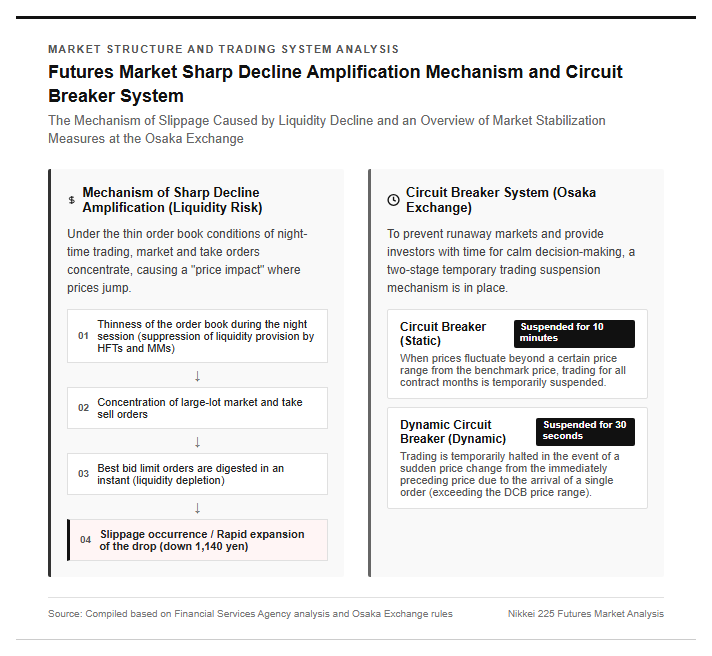
These systems act like electrical circuit breakers, preventing trades from being executed at prices that deviate from fair value due to a succession of panic market orders. Even when sudden price movements occur, such as the 1,140 yen drop in overnight trading, these automatic stop functions act to halt excessive price collapses, creating a buffer period that allows market participants to re-examine the latest information and quotes.
Expansion into Foreign Exchange Markets/Economy and Future Outlook
Impact on Foreign Exchange Markets and Risk-Aversion Yen-Buying Trends
The sharp decline in Nikkei 225 futures immediately spilled over from the equity market into the foreign exchange market. As the global stock market downturn intensified investor risk aversion, “risk-off yen buying”—the purchase of the Japanese yen as a safe-haven asset—gained momentum. Simultaneously, as US stocks fell, US Treasuries were bought, driving the 10-year US Treasury yield down toward 4.932%, which further supported dollar selling and yen buying in anticipation of a narrowing interest rate differential between Japan and the US. In the USD/JPY market, the yen rapidly appreciated against the dollar, moving from around the 160 level to the 158 range. The simultaneous unwinding of previously accumulated yen-selling/foreign-currency-buying carry trade positions also acted as a factor that intensified yen-appreciation pressure. When a synergistic effect is created between falling stocks and a strengthening yen, it can easily trigger a negative loop where selling pressure on futures increases due to earnings concerns among export-oriented companies. The 1,140 yen drop in overnight futures trading symbolizes the process in which multiple financial markets—equities and foreign exchange—interconnected in a complex manner to intensify risk-off movements.
Future Developments, Key Points to Watch, and Risks Investors Should Guard Against
To forecast future trends in the equity and futures markets, there are three major points to monitor. First is the direction of key US economic indicators and central bank monetary policies. Trends in the US Personal Consumption Expenditures (PCE) deflator, the FRB’s interest rate decisions, as well as the timing of additional interest rate hikes by the Bank of Japan and the content of Governor Ueda’s remarks, serve as core variables that influence interest rate and exchange rate levels in both Japan and the US. Second is the process of fundamental and stock price valuation adjustments in the AI and semiconductor industries. While the strong earnings of companies like NVIDIA and AI demand itself remain robust, there is ongoing scrutiny regarding the return efficiency of massive capital expenditures and whether current high stock valuations are appropriate. Third is geopolitical risk and volatility in commodity markets, such as crude oil. Because sharp declines in overnight trading are prone to occurring in low-liquidity environments, individual investors are required to practice thorough leverage management and cautious risk management to avoid being caught in temporary, discontinuous price movements.
Reference Pages
- 【Analysis regarding the sharp market fluctuations in the Japanese stock market in early August 2024 – Financial Services Agency】https://www.fsa.go.jp/common/about/kaikaku/fsaanalyticalnotes/20240709/20240709.html
- 【Price Limits, Circuit Breaker System – Japan Exchange Group】https://www.jpx.co.jp/derivatives/rules/price-limit-cb/index.html
【#Nikkei225Futures #StockMarket #Crash #CircuitBreaker #AIStocks #USDJPY】


コメント