The Ministry of Economy, Trade and Industry (METI) has selected a total of 11 supported projects in the first public call for proposals for the “GX Regional Co-Creation Subsidy.” This is backed by the goal of supporting large-scale investments of up to 25 billion yen, conditional on the 100% utilization of decarbonized power sources and contribution to power-siting regions.
- Overview of Selection Results and the Structure Targeted by the Scheme
- Two Business Categories and Requirements Eligible for Support
- Mechanism of the 5-Tier Support Intensity and a Maximum Subsidy Cap of 25 Billion Yen
- Contributions to Power-Siting Regions and Conditions for Procuring 100% Decarbonized Electricity
- Collaboration with the GX Strategic Region System and Ripple Effects on the Regional Economy
- Stricter Screening in System Operations and Future Points of Focus for Businesses
Overview of Selection Results and the Structure Targeted by the Scheme
On October 30, 2026, the Ministry of Economy, Trade and Industry (METI) announced that it has selected a total of 11 projects under the first public call for proposals for the “Decarbonized Power Source Regional Contribution Type (GX Regional Co-Creation Subsidy)” within the GX Strategic Region System. Formally titled the “FY2026 Decarbonized Power Source Regional Contribution Type Investment Promotion Project,” this system was established to support large-scale capital investments by companies that utilize 100% decarbonized electricity while contributing to power-siting regions. The budget scale is approximately 206 billion yen (including national debt obligations through FY2030), possessing an exceptional scale compared to conventional capital investment support measures. The breakdown of selections in this first public call consists of 7 manufacturing equipment investment projects and 4 data center equipment investment projects. The figure below shows the overall public call scheme and flow.
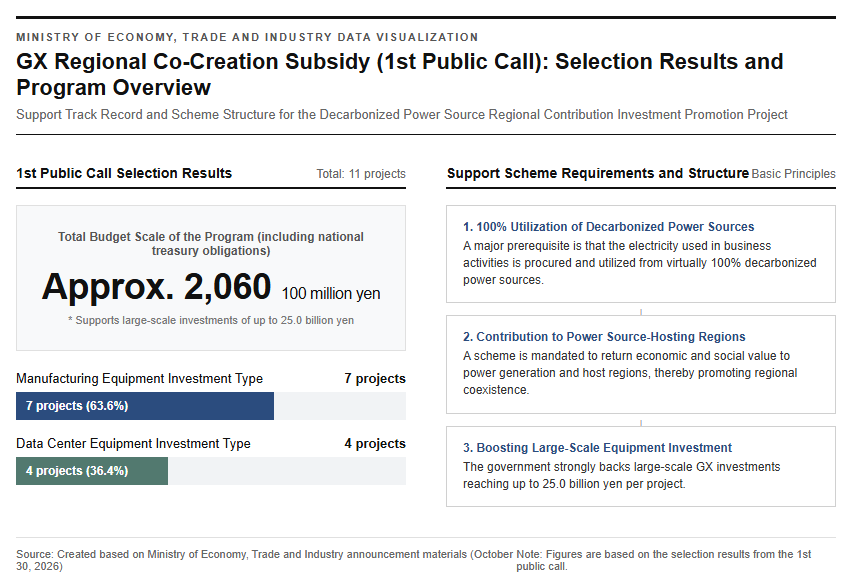
The backdrop behind the creation of this subsidy includes the rapid expansion of decarbonized electricity demand centered around global companies and the urgent issue of strengthening the domestic supply capacity of decarbonized power sources. A major feature of its design is that it goes beyond mere corporate cost subsidies, functioning as a dual-pillar policy that simultaneously promotes the “demand side of corporate capital investments” and the “supply side of stable supply and expansion of decarbonized power sources.”
Two Business Categories and Requirements Eligible for Support
Eligible projects for the GX Regional Co-Creation Subsidy are classified into two categories depending on the investment content: “Manufacturing Equipment Investment Type (Category A)” and “Data Center Equipment Investment Type (Category B).”
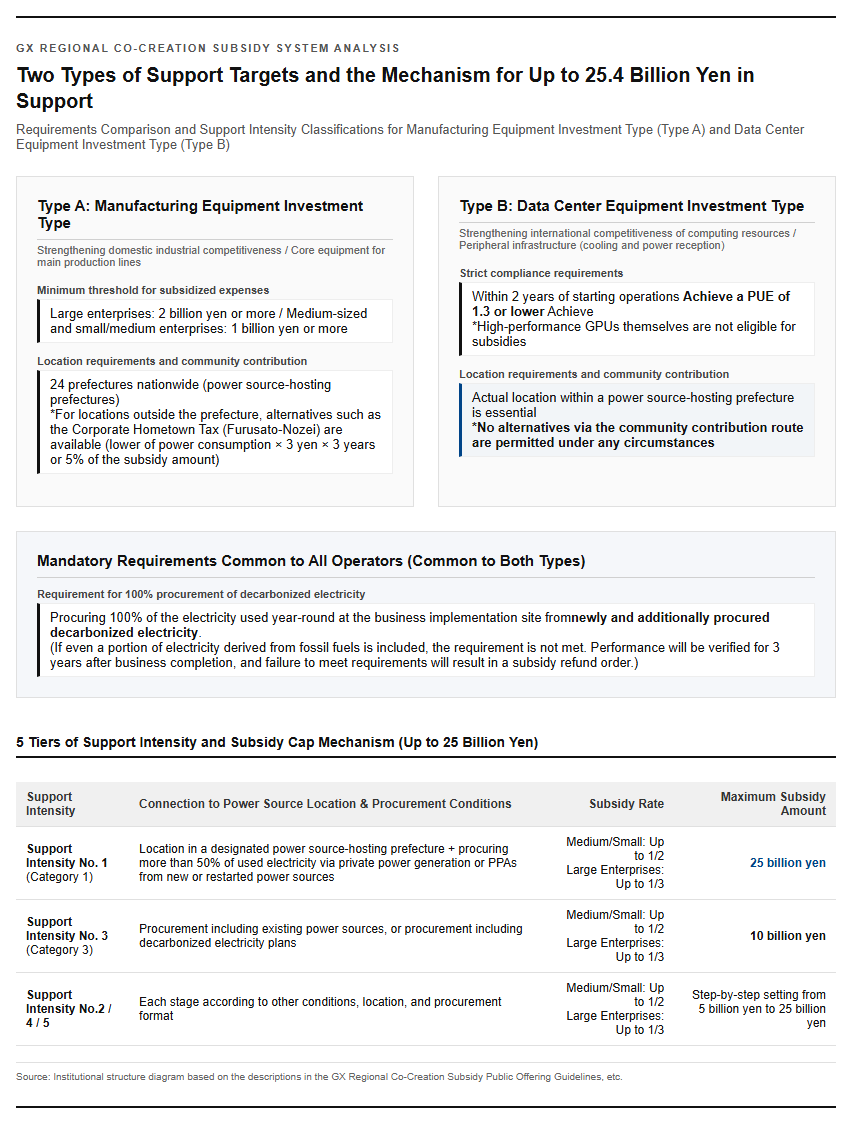
Category A (Manufacturing Equipment Investment Type) targets projects whose products or manufacturing processes possess technological or business innovativeness, directly linked to strengthening domestic industrial competitiveness. The lower limit for subsidizable expenses is set at 2 billion yen or more for large enterprises, and 1 billion yen or more for medium-sized and small/medium enterprises (SMEs), with large-scale investment in core equipment of main production lines being a mandatory requirement.
Category B (Data Center Equipment Investment Type) targets projects aiming to strengthen international competitiveness in Japan’s computing resource sector. Achieving a PUE (Power Usage Effectiveness) of 1.3 or lower within two years of commencement of operations is imposed as a strict requirement. Note that under Category B, high-performance GPUs themselves, which handle arithmetic processing, are excluded from subsidy eligibility, and investments will focus on surrounding infrastructure that contributes to PUE improvement, such as cooling equipment and power receiving facilities.
Strengths of the System Design and Support Classifications Operators Must Understand
Mechanism of the 5-Tier Support Intensity and a Maximum Subsidy Cap of 25 Billion Yen
The subsidy rates and maximum subsidy caps under this system are finely regulated by 5 tiers of support intensity (Classification 1 to No. 5) according to how the project ties into decarbonized power sources and its location conditions. Subsidy rates are up to 1/2 for medium-sized and small/medium enterprises, and up to 1/3 for large enterprises, with maximum subsidy caps ranging from 5 billion yen up to 25 billion yen depending on the support intensity.
Under Support Intensity No. 1 (Classification 1), which receives the most generous support, the conditions are that a company locates in a designated power-siting prefecture and procures the portion exceeding 50% of its electricity consumption from newly established or restarted power sources via self-generation or corporate PPAs (Power Purchase Agreements). The maximum subsidy cap in this case is the highest amount at 25 billion yen. On the other hand, if a company selects procurement involving existing power sources or procurement including decarbonized electricity menus (Support Intensity No. 3 / Classification 3), the maximum subsidy cap is reduced to 10 billion yen.
Contributions to Power-Siting Regions and Conditions for Procuring 100% Decarbonized Electricity
A critical requirement commonly imposed on applicant businesses is that the entire amount of electricity consumed year-round at the project implementation site must be newly and additionally procured decarbonized electricity. If even a portion of fossil fuel-derived electricity is included, the requirements will not be met. Target power-siting prefectures are limited to 24 prefectures nationwide specified in the public call guidelines, and major metropolitan areas are excluded.
In the Manufacturing Equipment Investment Type (Category A), even if located outside the power-siting prefectures, location requirements can be substituted by making regional contributions such as paying into the Corporate version of the Hometown Tax (Furusato納税) or contributing to a regional symbiosis fund. The benchmark amount for regional contributions is considered to be the lower of either 3 years’ worth calculated by multiplying electricity consumption by 3 yen/kWh, or 5% of the subsidy amount. However, the Data Center Equipment Investment Type (Category B) does not allow the use of this regional contribution route under any circumstances, making actual location within a power-siting prefecture indispensable. Performance verification of electricity and location requirements will be conducted for 3 years following the completion of the subsidized project, and there is a risk of a subsidy refund order being issued if requirements are not met. The block diagram below shows the check flow for requirement compliance.
Promotion of GX Industrial Locations and Cautions for Future Business Development
Collaboration with the GX Strategic Region System and Ripple Effects on the Regional Economy
The GX Regional Co-Creation Subsidy is the concrete implementation of the “Decarbonized Power Source Regional Contribution Type,” which is one of the pillars of the “GX Strategic Region System” established based on the government’s “GX 2040 Vision.” On September 11, 2026, the Ministry of Economy, Trade and Industry (METI) officially certified a total of 18 regions as “GX Strategic Regions (Phase 1),” comprising 1 complex-regeneration region, 9 data-center-concentration regions, and 8 decarbonized-power-source-utilization regions.
While conventional industrial location policies relied on companies securing their own land and power sources, this system shifts to a structure where the government designates strategic regions as a whole, providing an integrated package of proactive power grid development, capital investment support, and regulatory reform. By directly guiding massive power demand—such as from data centers—to regional decarbonized power source areas, the initiative aims to simultaneously alleviate grid constraints and achieve industrial concentration in regional areas.
Stricter Screening in System Operations and Future Points of Focus for Businesses
In recent years, grant administration has been rapidly shifting from “ex-post crackdowns” to “ex-ante and continuous controls.” To prevent fraudulent grant claims, the government has introduced a comprehensive inspection system that expands inspection targets to more than 10 times the previous level, and has raised the upper limit of penalty surcharges to up to 8 times the fraudulently received amount. Furthermore, all procedures require that no orders or contracts be placed prior to the grant decision; undertaking any actions beforehand will result in the revocation of the subsidy, thus requiring strict adherence to operational rules.
According to guidance from the METI secretariat, a “second public call for applications” is scheduled, with applications expected to open around the fall of 2026 and close around the winter. For businesses considering investment plans on the scale of billions to tens of billions of yen, starting preliminary negotiations for power procurement contracts and consultations with local governments early, and formulating a meticulous business plan, will be the key factors for selection.
Reference Page
- [METI] GX Strategic Regions (Phase 1) Certified
https://www.meti.go.jp/press/2026/09/20260911006.html
[#GXRegionalCoCreationSubsidy #METI #Decarbonization #CapitalInvestment #DataCenters #RegionalRevitalization #RenewableEnergy]


コメント