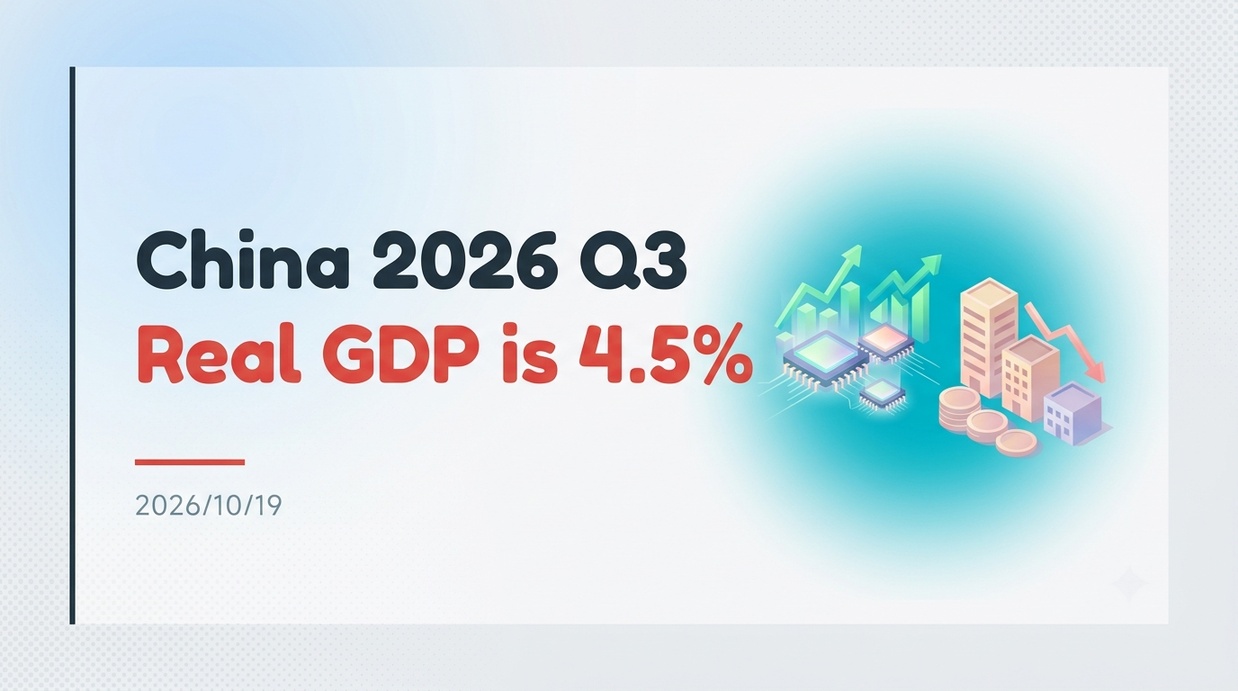
Real GDP growth for the third quarter of 2026, released by the National Bureau of Statistics of China, came in at 4.5% year-on-year, slightly exceeding the market expectation of 4.4%. While strong exports of electronics and semiconductor-related products, driven by global AI demand, provided support, the real estate slump and sluggish domestic demand remain serious challenges.
- Achieving a Better-Than-Expected 4.5% GDP Growth Rate and Its Background
- The Reality of the “Two-Speed Economy” Driven by High-Tech and AI Exports
- Sharp decline in real estate development investment and cooling consumer sentiment
- Persistent High Youth Unemployment Rates and the Decline in Purchasing Power Caused by the “Involution” Phenomenon
- Counter-cyclical Adjustments and Fiscal Support Measures by the People’s Bank of China and the Government
- Perspectives of International Organizations and Medium- and Long-Term Challenges Toward Transforming the Growth Model
Achieving a Better-Than-Expected 4.5% GDP Growth Rate and Its Background
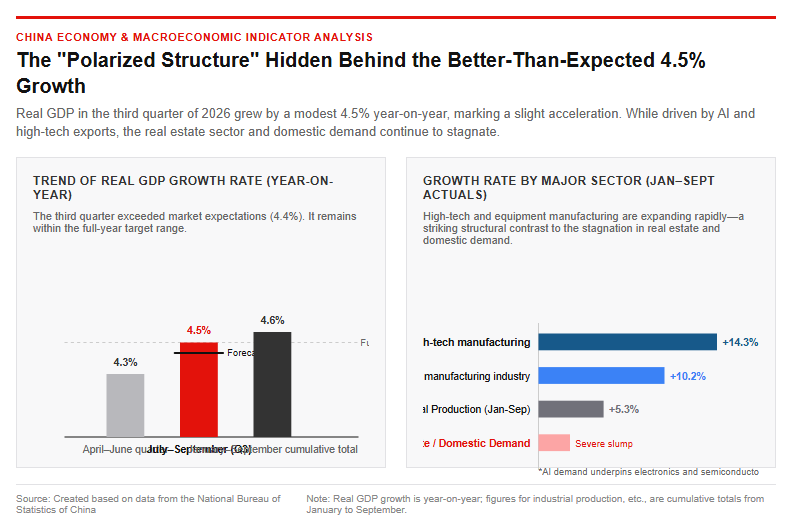
The preliminary gross domestic product (GDP) figures for the July-September period (third quarter) of 2026, released by the National Bureau of Statistics of China on October 19, 2026, showed a real increase of 4.5% year-on-year, excluding the effects of price fluctuations. This slightly exceeded market expectations of a 4.4% increase and accelerated modestly from the 4.3% growth in the April-June quarter. Furthermore, the quarter-on-quarter growth rate came in at 1.2%, an improvement from 0.9% in the preceding three months. As a result, the real GDP growth rate for the January-September period of 2026 (cumulative for the first three quarters) reached 4.6% year-on-year, keeping it within the Chinese government’s full-year target range of “around 4.5% to 5.0%.”
Factory production and overseas demand continue to drive this economic growth. Industrial production for the January–September period of 2026 increased by 5.3% year-on-year, expanding steadily with a 5.5% increase for the month of September alone. In particular, equipment manufacturing showed strong growth of 10.2% and high-tech manufacturing grew by 14.3%, indicating that the high-tech sector is serving to underpin the economy. The following chart shows the trends in growth rates and structural factors.
However, while this figure is within the government’s target range, it sits near the lower bound, suggesting that the underlying economic trend does not warrant unreserved optimism.
The Reality of the “Two-Speed Economy” Driven by High-Tech and AI Exports
The current Chinese economy is increasingly exhibiting a “two-speed economy” characterized by a striking divergence between strong external demand and manufacturing, and sluggish domestic demand and services.
On the external demand front, fueled by accelerating global artificial intelligence (AI)-related investment and surging demand for data centers, exports of electronic devices, semiconductors, and specialized materials jumped significantly. Total merchandise exports for the January–September 2026 period reached 23.1979 trillion yuan, recording a 16.4% year-on-year increase, with electrical and mechanical products acting as a major driver, accounting for 64.3% of total exports. The export value for the single month of September showed exceptionally strong growth, up 29.6% year-on-year. By product category, production and exports in so-called new industrial sectors surged rapidly, with 3D printing equipment up 62.5%, lithium-ion batteries up 39.5%, and industrial robots up 29.1% compared to the same period of the previous year.
Meanwhile, in stark contrast to the strength of this external demand, domestic consumption and private investment are lagging behind. While export-driven manufacturing is lifting overall economic indicators, an asymmetric structure is becoming entrenched in which domestic purchasing power fails to keep pace.
Structural Pressure Caused by Sluggish Domestic Demand and the Real Estate Slump
Sharp decline in real estate development investment and cooling consumer sentiment
While external demand shows resilience, the biggest drag on the Chinese economy is the prolonged real estate slump and the cooling of personal consumption.
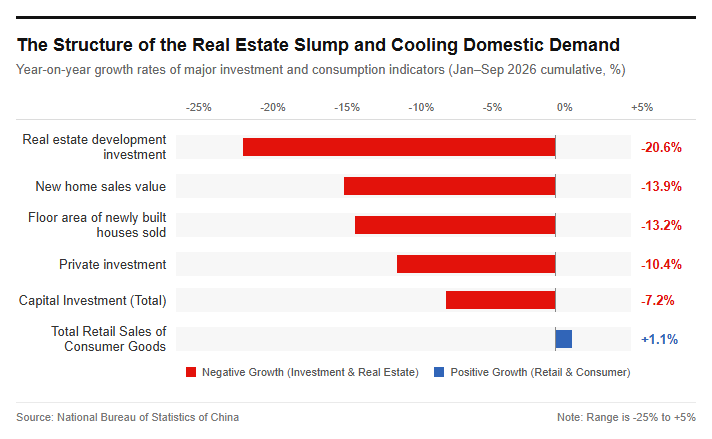
Total retail sales of consumer goods from January to September 2026 stood at 37 trillion and 1 yuan, remaining at a mere 1.1% increase year-on-year. For September alone, the figure was up 1.1% year-on-year, marking a significant slowdown from the 3.0% growth recorded in the same month of the previous year. The effects of the government’s trade-in support measures for automobiles and home appliances (Yi Jiu Huan Xin), promoted as a domestic demand stimulus policy, have also been limited, and a notable stagnation in purchasing appetite, centered on durable goods, is evident.
Even more serious is the slowdown in the investment sector. Fixed asset investment for the January–September period decreased by 7.2% year-on-year. In particular, real estate development investment saw a significant drop of 20.6%, with the floor area of newly built housing sales falling by 13.2% and sales value dropping by 13.9%. Overall private investment also remained in negative territory, down 10.4%. A vicious cycle continues in which falling real estate prices damage the household wealth effect, creating a negative wealth effect that further dampens consumption. The following chart shows the trends in real estate investment and personal consumption.
Persistent High Youth Unemployment Rates and the Decline in Purchasing Power Caused by the “Involution” Phenomenon
Behind the sluggishness of household consumption lie deep structural problems: a severe employment environment and anxieties about the future.
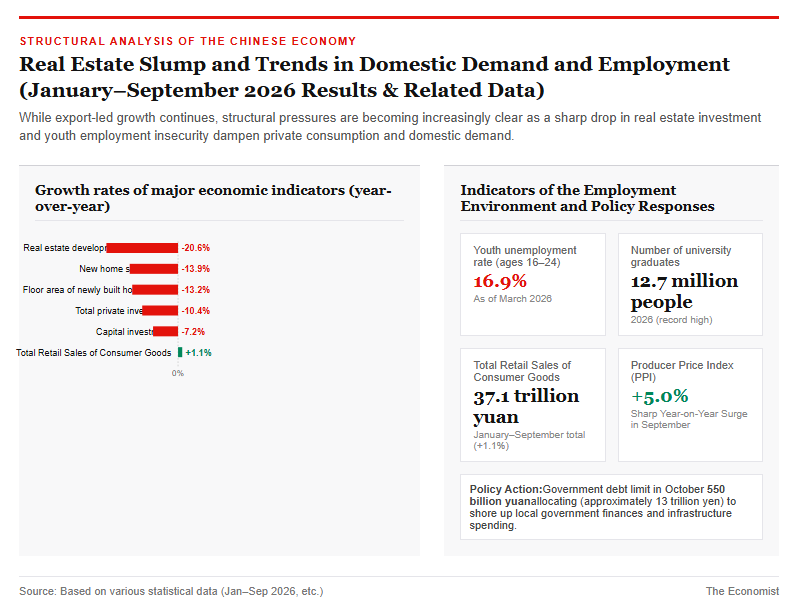
According to data as of March 2026, the youth unemployment rate for 16-to-24-year-olds, excluding students, has reached 16.9%. In 2026, a record-breaking 12.7 million college graduates are projected to enter the labor market, further exacerbating the employment crisis for the younger generation. Against this backdrop, terms such as “neijuan” (involution), which refers to excessive cutthroat competition, and “tangping” (lying flat), which means giving up on competition to live on the bare minimum, have taken root among young people in Chinese society. The prevailing sentiment that hard work does not pay off and that one cannot envision a future of buying a home or planning a life has made purchasing behavior extremely cautious.
In addition, in the manufacturing sector, capital deepening has progressed to cope with rising labor costs, and the accelerated substitution of labor with capital and automation has narrowed employment opportunities. Furthermore, affected by the contraction of small and medium-sized enterprises and intense competition in the service industry, an environment where incomes struggle to grow has been created. Combined with this employment anxiety and a low-yield asset management environment, the household savings rate continues to remain high.
Monetary and Fiscal Policy Responses and the Medium- to Long-Term Economic Outlook
Counter-cyclical Adjustments and Fiscal Support Measures by the People’s Bank of China and the Government
To address downside economic risks, Chinese authorities are implementing moderately loose monetary policy and targeted fiscal support.
The People’s Bank of China (the central bank) held its third-quarter monetary policy committee regular meeting on September 19, 2026, and confirmed its policy of strengthening counter-cyclical adjustments (economic stimulus) and maintaining ample liquidity. In October, it allocated 550 billion yuan (approx. 13 trillion yen) in unused government debt limits, taking measures to ease local governments’ financial difficulties while supporting infrastructure spending. In addition, it rolled out mortgage interest subsidies for first-time homebuyers and selective rate cuts, aiming to put a floor under the real estate market.
Meanwhile, a cautious stance is being maintained regarding large-scale, blanket monetary easing. This is due to concerns over inflationary pressure—such as the Producer Price Index (PPI) surging 5.0% year-on-year in September—as well as the interest rate differential between the US and China and the deterioration of bank profit margins. The market anticipates that targeted incremental policies centered on quantitative easing and fiscal stimulus will take precedence over large-scale interest rate cuts. The chart below illustrates the relationship between policy deployment and exchange rate forecasts.
Perspectives of International Organizations and Medium- and Long-Term Challenges Toward Transforming the Growth Model
Regarding the medium-to-long-term outlook for China’s economy, domestic and international financial institutions and international organizations have pointed out the need for structural reforms.
In October 2026, the International Monetary Fund (IMF), citing persistently weak domestic demand in China, revised its full-year growth forecast for 2026 down from 4.6% to 4.5%, and for 2027 from 4.1% to 4.0%. The IMF analyzes that while excess capital is disproportionately allocated to certain manufacturing and heavy industries, there is a lack of redistribution to consumption, and this misallocation of capital is suppressing total factor productivity (TFP) growth.
Private institutions such as Goldman Sachs project that real GDP growth for the full year of 2026 will reach 4.8%, driven by a decrease in trade dependency on the U.S. and progress in diversifying trade toward ASEAN and other regions. However, to achieve sustainable growth, rebalancing from the conventional investment- and export-dependent model to a domestic demand- and consumption-led model is essential. Moving forward, key points to watch will be the elimination of excess production capacity, the alleviation of anxieties about the future through the expansion of social security, and the establishment of a market environment that does not hinder private sector innovation.
Reference Page
- [Investing.com China Q3 2026 GDP Flash] https://jp.investing.com/news/economic-indicators/article-1715380
[#ChinaEconomy #GDP #Deflation #RealEstateSlump #Semiconductors #SluggishDomesticDemand #PeoplesBankOfChina #EconomicTrends]
コメント