
On the Tokyo Stock Exchange, the Nikkei Stock Average experienced a sharp rebound decline, dropping by more than 1,900 yen from the previous day (and plummeting by over 3,000 yen during trading hours). The background factors include the decline in U.S. semiconductor stocks, concerns over the profitability of AI investments, and the steep downward pull exerted by Advantest alone, which carries a high weighting in the Nikkei average.
- Key points of the Nikkei average’s sharp rebound decline
- Decline in U.S. tech stocks and growing concerns over AI investment
- Record-high earnings performance and strengths in testing equipment
- Reasons for the stock price plunge amid strong earnings and the risk structure
- The AI megacycle and the evolution of IP and technology strategies
- Future Stock Market Trends and Key Points for Investors to Watch
Key points of the Nikkei average’s sharp rebound decline
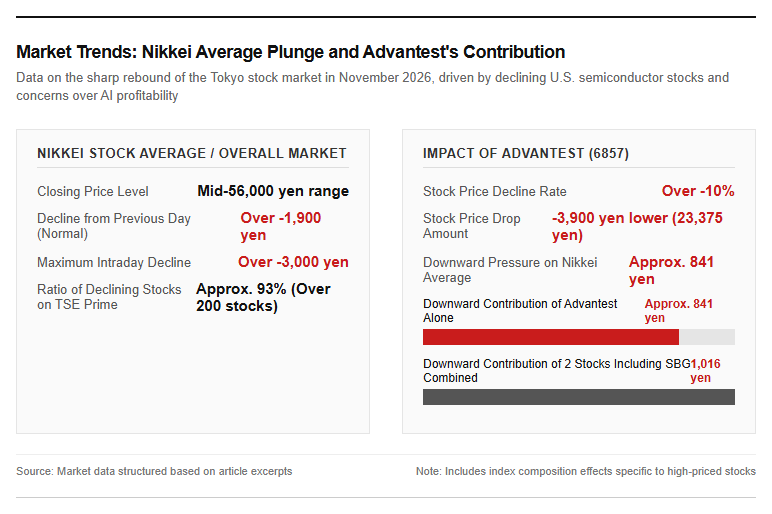
In the Tokyo stock market in November 2026, the Nikkei Stock Average saw volatile trading, plunging temporarily by over 1,900 to more than 3,000 yen before closing sharply lower in the 56,000 yen range. A market-wide downturn unfolded, with more than 200 stocks—accounting for about 93% of all issues on the TSE Prime Market—declining in price. The primary catalyst for this historic drop was the plunge in the share price of semiconductor testing equipment giant Advantest (securities code: 6857). Advantest’s stock suffered a massive decline of over 10% from the previous day, tumbling 3,900 yen to 23,375 yen. The Nikkei Stock Average has an index structure that is easily influenced by high-priced stocks, and Advantest alone pushed the Nikkei down by approximately 841 yen (or 1,016 yen combined with SoftBank Group depending on the phase), exerting an outsized impact. In the market, profit-taking merged with a strong risk-off sentiment, creating a vicious cycle where selling begat selling, particularly among high-tech stocks. The chart below illustrates market conditions at the time of the plunge.
Decline in U.S. tech stocks and growing concerns over AI investment
The direct trigger for this sharp decline in the Nikkei average and Advantest was the sell-off in high-tech stocks in the U.S. stock market the previous day. Following a 7.88% plunge (at one point dropping 10.73%) in the U.S. Philadelphia Semiconductor Index (SOX Index), selling pressure on semiconductor and AI-related stocks mounted all at once in the Tokyo market as well. In the U.S. market, headwinds piled up, including a sharp drop in Advanced Micro Devices (AMD) shares triggered by a short-seller report, sluggish share price growth at newly public AI firm Anthropic, and prospects of tariff hikes by the Trump administration. Furthermore, market doubts spread regarding the “profitability of AI investments”—namely, whether the massive capital expenditures on AI data centers by mega-caps (hyperscalers) would be matched by sufficient monetization (returns). Combined with days of caution over an AI bubble and expectations of additional rate hikes by the U.S. Federal Reserve (FRB), this resulted in investment capital flowing out of growth stocks in both the U.S. and Japan simultaneously.
Advantest’s business structure and the factors behind its stock price plunge
Record-high earnings performance and strengths in testing equipment
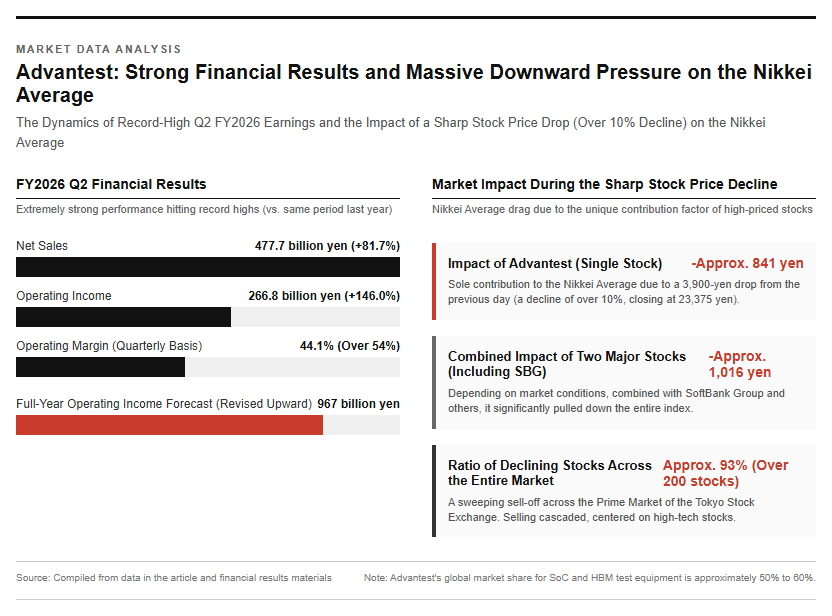
Despite the plunge in its stock price, Advantest’s recent financial performance itself is in an extremely favorable state, updating record-high earnings. In its second-quarter earnings for fiscal 2026, net sales increased 81.7% year-on-year to 477.7 billion yen, operating income surged 146.0% year-on-year to 266.8 billion yen, and the operating profit margin reached an unusual 44.1% for a manufacturer (exceeding 54% on a quarterly basis). Along with this, the full-year operating profit forecast was revised upward from the previous 8460 billion yen to 9670 billion yen. The company is the world’s largest manufacturer of “semiconductor testers,” which test whether semiconductors operate correctly before shipment, and holds about 50% to 60% of the global market share in cutting-edge SoC (System on a Chip) testers and testing equipment for HBM (High Bandwidth Memory). Because generative AI GPUs (graphics processing units) and CPUs have extremely complex structures, the testing time per unit is longer, increasing the number of high-priced testers required. With a structure that monopolizes the global market alongside Teradyne of the U.S., the company avoids the success-or-failure risk of specific chipmakers and reaps high profits from the expansion of the overall AI market. An overview of the earnings trajectory is as follows.
Reasons for the stock price plunge amid strong earnings and the risk structure
Despite reporting record-high and booming earnings, why did Advantest’s shares plunge? Several structural reasons lie behind this. First, expectations for stock price growth had been excessively priced in beforehand. The company’s stock had hit a high of 41,990 yen in October, and its price-to-earnings ratio (PER) stood at a high level of around 25x, causing profit-taking sales from the highs to concentrate whenever overall market sentiment deteriorated. Second is the cyclical risk inherent to the semiconductor manufacturing equipment industry. Semiconductor capital expenditures experience sharp waves, and caution regarding future demand troughs (air pockets) is a constant companion. Third are customer concentration risks and geopolitical risks. Much of the sales depend on specific giant customers such as Nvidia, TSMC, and SK Hynix, and tightened U.S. export controls on semiconductors to China as well as restrictions on shipments to the Chinese market emerged as direct earnings concerns. Furthermore, as “concerns over the collapse of the AI capital expenditure bubble” blanketed the entire stock market, the company’s stock—possessing high profitability—ended up being among the first to be sold off.
Technological innovation in the semiconductor market and medium- to long-term prospects
The AI megacycle and the evolution of IP and technology strategies
Despite short-term volatility in stock prices, Advantest’s management positions the current market environment as a “mega-cycle phase that transcends a super-cycle.” Beyond AI-related GPUs, rapidly expanding demand for AI CPUs, next-generation optoelectronic fusion technology, and advances in 3D packaging technology are serving as the company’s new growth engines. On the technological front, Advantest has built a robust patent network for Active Thermal Control (ATC) thermal control technology, which is essential for testing High Bandwidth Memory (HBM), thereby establishing high barriers to entry against competitors. Furthermore, rather than simply selling hardware devices outright, the company is advancing a business model transformation to increase the proportion of recurring revenue by providing real-time data analysis and yield-enhancement software through Advantest Cloud Solutions (ACS). In addition to in-house development, Advantest is promoting the vertical integration of entire test cells through M&A and a partnership with U.S.-based Emerson, thereby solidifying its dominance over data interfaces.
Future Stock Market Trends and Key Points for Investors to Watch
Moving forward, whether the Nikkei Stock Average and semiconductor-related stocks such as Advantest will rebound depends on several decisive factors. The most critical points are the continuity of capital expenditure plans by mega-cap tech companies such as NVIDIA, Amazon, Microsoft, Alphabet, and Meta, as well as the actual demand for AI servers and AI GPUs. In addition, trends in the Federal Reserve’s monetary policy, U.S. inflation indicators (such as the PCE deflator), and the Bank of Japan’s policy rate hikes (with speculation of an additional rate hike from 1.25% to 1.50%) are directly linked to capital inflows and outflows in the stock market. Careful attention must also be paid to the movement of the dollar-yen exchange rate in the 158 to 160 yen range, as well as the tightening of export controls against China. For investors, it is important to avoid impulsive bargain hunting immediately after sharp drops in the short term, confirm that the overall market has stopped falling, and thoroughly practice portfolio diversification—including defensive stocks such as pharmaceuticals and foodstuffs—along with appropriate position management.
Reference Page
- [Advantest Official IR & Financial Forecast] https://www.advantest.com/en/investors/financial-highlights/forecast/
[#NikkeiAverage #Advantest #SemiconductorStocks #AIRevolution #StockInvestment #JapaneseEconomy]


コメント