AAEON has launched the “UP XTREME PTL EDGE,” a compact edge PC powered by Intel Core Ultra Series 3, for the Japanese market. Equipped with exceptional AI processing performance of up to 180 TOPS and a rich set of interfaces, this release is underpinned by the company’s nine years of upfront investment since 2017 and the rapid full-scale emergence of edge AI demand.
- The Arrival of the Latest CPU and Up to 180 TOPS Performance
- Compact Chassis and Diverse Connectivity Features
- Integrated Computing Mechanism via Heterogeneous Accelerators
- Deployment in Industrial Sites and Smart Infrastructure
- Nine Years of Upfront Investment and the Turning Point Toward Mass Production
- Future Outlook in the Global Edge AI Market
The Arrival of the Latest CPU and Up to 180 TOPS Performance
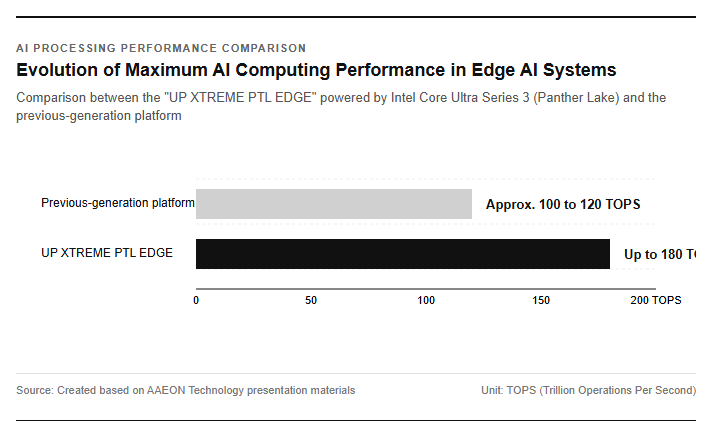
On November 26, 2026, Taiwanese industrial computer leader AAEON Technology Inc. commenced domestic sales of the “UP XTREME PTL EDGE,” a compact edge AI system powered by Intel’s latest processor (codenamed Panther Lake), the Intel Core Ultra Series 3. This product is a high-performance desktop PC designed for industrial embedded systems and local AI inference processing, with the top-tier model equipped with the Intel Core Ultra X7 358H. Processor configurations including the Core Ultra 7 356H and Core Ultra 5 325 are also available in the lineup. The AI computing power of the entire system reaches up to 180 TOPS, achieving a dramatic performance improvement compared to the approximately 100 to 120 TOPS of the previous-generation platform. In terms of memory, it features two SO-DIMM slots supporting the DDR5-7200 standard, accommodating high-capacity dual-channel memory of up to 128GB. This enables smooth local execution of large-scale AI models and buffering of massive datasets. Please refer to the product exterior image below.
Compact Chassis and Diverse Connectivity Features
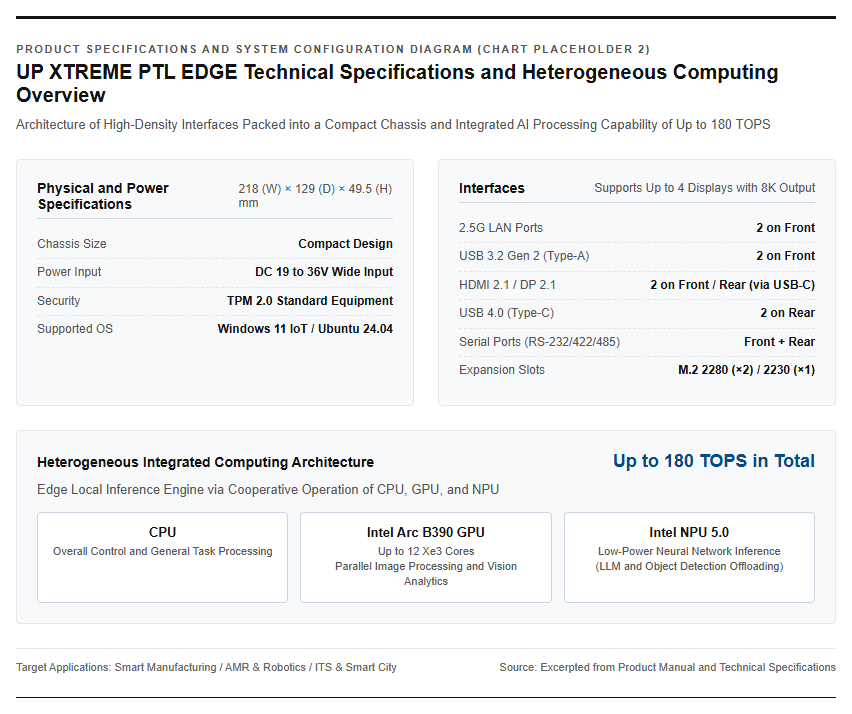
A major feature of the UP XTREME PTL EDGE is that it packs the robust connection ports required in industrial settings into an extremely compact chassis measuring 218 mm in width, 129 mm in depth, and 49.5 mm in height. The front of the main unit is equipped with two 2.5 Gigabit LAN ports for high-speed communication, two USB 3.2 Gen 2 Type-A ports, two HDMI 2.1 ports, and a serial port supporting RS-232/422/485. The rear features two next-generation USB 4.0 Type-C ports, alongside a 40-pin GPIO header and additional serial ports. By combining DisplayPort 2.1 via USB Type-C with HDMI ports, simultaneous output of up to four screens at 8K resolution is possible. For storage, it secures two M.2 2280 M-Key slots, and for Wi-Fi and Bluetooth communication, one M.2 2230 E-Key slot. The power supply supports industrial wide-range DC 19–36V input, and a TPM 2.0 security chip is installed as standard on the board. This configuration strongly supports harsh operational environments and direct connection with diverse sensor equipment.
Advanced Heterogeneous Configuration and Industrial Applications
Integrated Computing Mechanism via Heterogeneous Accelerators
The high AI processing capability of up to 180 TOPS achieved by the UP XTREME PTL EDGE is supported not by a single processor unit, but by a heterogeneous architecture that integrates CPU, GPU, and NPU. The graphics capabilities incorporate an Intel Arc B390 GPU with up to 12 Xe3 cores, handling parallel image processing and accelerating vision analytics. Furthermore, by equipping an Intel NPU 5.0 optimized for low power consumption, it effectively offloads neural network inference workloads from the CPU. This creates an environment where object detection, image classification, and local large language model (LLM) processing can be executed with low latency and low power consumption. While conventional cloud-dependent AI processing has faced challenges with communication latency, bandwidth costs, and data security risks, this product functions as a local inference engine that is completed entirely within the edge device itself. It demonstrates high response stability even when constructing video analysis pipelines for multiple cameras.
Deployment in Industrial Sites and Smart Infrastructure
Leveraging heterogeneous computing performance and advanced connectivity, this product is expected to see practical use across a wide range of industrial fields. In the field of smart manufacturing, it is introduced into real-time visual inspection on production lines and automated quality control systems, accelerating the automation of defect detection. In the robotics field, it contributes to the enhancement of navigation and automatic alignment functions for autonomous mobile robots (AMRs) and robot arms. Furthermore, in the areas of intelligent transport systems (ITS) and smart cities, it is utilized as an edge computing infrastructure that analyzes intersection surveillance camera footage on the spot to perform traffic flow control and anomaly detection. As for operating systems, it supports Windows 11 IoT Enterprise and Linux Ubuntu 24.04 LTS, ensuring high compatibility with existing industrial systems and open-source AI environments. For the overall system configuration that achieves enhanced on-site processing capacity and stable operation, please refer to the conceptual diagram below.
AAEON’s Edge AI Strategy and Trajectory of Upfront Investment
Nine Years of Upfront Investment and the Turning Point Toward Mass Production
AAEON is a long-established Taiwanese industrial computer manufacturer that spun off from Advantech in 1992 and later joined the ASUS Group. Convinced that the AI market would take off following the rise of AlphaGo in 2017, the company established a dedicated team ahead of its competitors and entered the edge AI field. During the first three years after entry, edge AI-related sales remained at around 3% due to a lack of in-house know-how and stalled PoCs (Proof of Concepts). Although the company faced difficulties with more than half of its projects remaining in the prototype stage without reaching mass production, it built a foundation by thoroughly implementing in-house training and strengthening collaboration with independent software vendors (ISVs). The turning point came in 2024, driven by a surge in demand for edge inference due to the emergence of open-source AI models like DeepSeek, and a large-scale order worth 1 million USD from an Eastern European transportation system company. As a result, edge AI-related sales rapidly expanded approximately 7.2-fold, from 170 million New Taiwan Dollars in 2022 to 1.22 billion New Taiwan Dollars in 2025.
Future Outlook in the Global Edge AI Market
AAEON’s group-wide revenue for 2025 reached a record high of 8.6 billion New Taiwan Dollars, with edge AI-related sales accounting for 20% of the total. The company has set a goal to raise this share to 30% during 2026, showing steady progress with revenue of 5.22 billion New Taiwan Dollars and net income after tax of 896 million New Taiwan Dollars as of the first half of 2026. The global market for edge AI embedded PCs is projected to experience significant growth from 2026 to 2032, with adoption progressing in diverse fields such as manufacturing, healthcare, automotive, and aerospace. AAEON offers a wide-ranging product lineup covering platforms from major AI chip vendors such as NVIDIA, Intel, AMD, and MediaTek, establishing a system to reliably capture diversifying customer needs. The fruition of nine years of continuous upfront investment and strategic partnerships provides a strong competitive advantage in the rapidly expanding global edge AI market.
Reference Pages
- [UP Xtreme PTL Edge | Intel Core Ultra Series 3 Edge AI System – AAEON]https://www.aaeon.com/jp/product/detail/up-systems-up-xtreme-ptl-edge
[#AAEON #EdgeAI #IntelCoreUltra #UPXtreme #CompactPC #IndustrialPC #EmbeddedSystem #AIEdge]


コメント