On November 26, 2026, Bank of Japan Policy Board Member Naoki Tamura emphasized that the policy interest rate should be raised to the neutral interest rate level at an early stage, and that rate hikes should be accelerated swiftly in the event of signs that inflation is overshooting. This stance is underpinned by a strong sense of caution regarding the risk that the underlying inflation rate could exceed 2%, driven by high crude oil prices, a weak yen, and the expansion of AI demand.
- Key Takeaways: Arguments for Achieving a Neutral Interest Rate Early and “Swift Rate Hikes”
- Background and Issues: The Rationale for a Neutral Interest Rate of “Around 2%” and the Risk of Inflation Overshooting
- Impact on Markets, Stock Prices, and Foreign Exchange: Expectations for a December Rate Hike and the Battle Over the Yen Exchange Rate
- Spillover Effects on Corporate Activities and Daily Life: Changes in Funding Costs and Mortgages
- Temperature Among Policy Board Members: The Direction of Discussions Between Hawks and Doves
- Future Outlook and Points of Focus: The December 2026 Policy Meeting and the Interest Rate Normalization Scenario
Key Takeaways: Arguments for Achieving a Neutral Interest Rate Early and “Swift Rate Hikes”
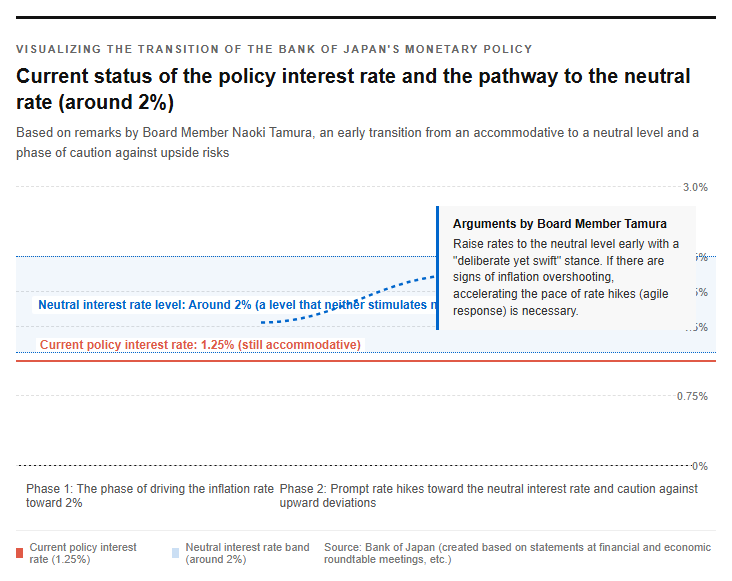
On November 26, 2026, Bank of Japan Policy Board Member Naoki Tamura delivered a speech at a financial and economic meeting held in Kofu City, Yamanashi Prefecture. He stated that domestic financial conditions remain accommodative and strongly advocated for the prompt raising of the policy interest rate to a level neutral to the economy. Tamura pointed out that the phase of monetary policy has shifted from “raising the underlying inflation rate toward 2%” to “stabilizing it at around 2% and preventing it from overshooting.” While aiming to raise the current policy interest rate from 1.25% to the estimated neutral rate of “around 2%” while carefully assessing the evaluation of financial conditions and the impact on corporate activities resulting from policy changes, he noted that “careful” does not mean “slow,” and that the BOJ is required to adopt an attitude of “deliberate haste” (yuyu to shite isogu). Furthermore, he emphasized that in Japan, where the degree of entrenchment of the underlying inflation rate toward the 2% target is still low, if there are signs that inflation is overshooting above 2%, the BOJ should respond swiftly, including accelerating the pace of rate hikes. The conceptual image regarding the direction of monetary policy is as follows.
Background and Issues: The Rationale for a Neutral Interest Rate of “Around 2%” and the Risk of Inflation Overshooting
Behind Tamura’s advocacy for early rate hikes and swift action is a strong sense of caution regarding the structural shift in domestic prices and economic conditions toward a greater tendency to overshoot. The Domestic Corporate Goods Price Index for October 2026 recorded a high level of up 7.1% year-on-year, and rising crude oil prices due to the Middle East situation, currency depreciation, and increasing raw material costs are beginning to be broadly passed on to intermediate and downstream product and service prices. In addition, the spread of global AI-related demand, such as power generation and power supply equipment for semiconductors and data centers (so-called “picks and shovels” companies), is broadly underpinning the Japanese economy. With the output gap remaining in positive territory and severe labor shortages persisting, corporate pricing behavior is exhibiting a level of aggressiveness not seen since the bubble era. While the range of the nominal neutral interest rate estimated by the BOJ is broad, spanning from 1.1% to 2.5%, Tamura reiterated his view, based on his experience as a financial practitioner and interviews with corporations, that “around 2%” is the appropriate level.
Spillover to Financial Markets and Impact on Economic Agents
Impact on Markets, Stock Prices, and Foreign Exchange: Expectations for a December Rate Hike and the Battle Over the Yen Exchange Rate
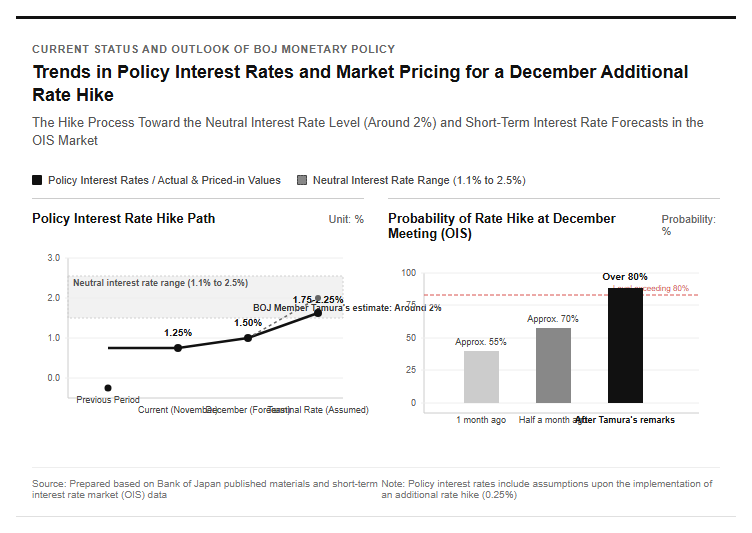
Prompted by Tamura’s remarks, expectations for an additional rate hike at the next Monetary Policy Meeting on December 17-18, 2026, intensified further in financial markets. In the overnight index swap (OIS) market, the probability of a 0.25% rate hike at the December meeting (raising the policy interest rate to 1.50%) is being priced in at over 80%. In the Tokyo foreign exchange market, the US dollar-yen exchange rate continues to be locked in a narrow range centered around the mid-159 yen level. A tug-of-war is playing out between dollar-buying pressure driven by expectations of high interest rates in the US, and BOJ rate-hike expectations coupled with caution regarding potential currency intervention by the government and the BOJ as the rate approaches the 160 yen level. On the other hand, among market participants, views on the terminal rate in the current tightening cycle are split between 1.75% and 2.25%, and it has been pointed out that if ambiguity remains regarding the BOJ’s policy guidance, the risk of a resurgence in yen-selling pressure could emerge. The conceptual image of market reactions and interest rate trends is as follows.
Spillover Effects on Corporate Activities and Daily Life: Changes in Funding Costs and Mortgages
The advancement of rate hikes is also bringing about steady changes in corporate management decisions and household living environments. Examining the corporate funding environment, although funding costs are rising due to increases in lending rates and corporate bond issuance rates, the average interest paid by companies on a stock basis remains at a sufficiently low level compared to profitability (ROA). Many small- and large-scale enterprises are refining their business models and transforming into structures capable of generating profits in a “world with interest rates.” Meanwhile, regarding the impact on households, as of October 2026, the benchmark variable mortgage rates of major banks have risen to levels exceeding 1.0%, and fixed-rate “Flat 35” mortgages have also been raised to the 3.8% range, making the increase in borrowing burdens tangible. The importance of carefully examining on-the-ground feedback and questionnaire surveys is growing, to ensure that the demand-suppressive effects of rate hikes do not excessively chill corporate investment appetite and personal consumption.
Policy Board Discussions and Future Outlook
Temperature Among Policy Board Members: The Direction of Discussions Between Hawks and Doves
Within the Bank of Japan’s Policy Board, diverse views are intersecting regarding the future pace of rate hikes and the ultimate terminal rate. Since it was judged at the October 2026 policy meeting that the underlying inflation rate, excluding temporary fluctuations, had reached the 2% target, hawkish members such as Naoki Tamura and Hajime Takata have advocated for a regime shift to accelerate the pace toward reaching the neutral interest rate. In contrast, cautious arguments against rapid rate hikes have been raised by dovish board members who believe the Bank should gauge stagnation in personal consumption and wage-hike trends in the 2027 Shunto (spring labor-management wage negotiations). Furthermore, as a variable outside of policy, the terms of office for the hawkish members Tamura and Takata are set to expire in July 2027, and it has been pointed out that subsequent appointments could alter the hawkish-dovish balance of the board. In evaluating the financial environment, a stance of comprehensively examining on-the-ground corporate voices, in addition to statistical data such as real interest rates and lending attitudes, is required.
Future Outlook and Points of Focus: The December 2026 Policy Meeting and the Interest Rate Normalization Scenario
The ultimate focus of future monetary policy is the next Monetary Policy Meeting scheduled for December 17–18, 2026. Market interest is concentrated not only on whether an additional 0.25% rate hike will be implemented, but also on whether Governor Kazuo Ueda can present a clear policy path (interest rate trajectory) toward 2027 and a future anchor during his post-meeting press conference. External environmental uncertainties—such as a resurgence in crude oil prices, geopolitical risks surrounding the Middle East situation, and the United States’ new tariff policies and overseas interest rate trends—will also directly impact the BOJ’s future steering. As the Bank of Japan aims for the sustainable and stable entrenchment of the 2% “price stability target,” its process of advancing interest rate normalization while deepening communication with the market and the public, alongside the wage-hike trends of the 2027 Shunto, is being closely watched.
Reference Pages
[#BankOfJapan #MonetaryPolicy #NaokiTamura #NeutralRate #RateHike #PriceTrends #USDJPY]


コメント