
Amid concerns over tariff warnings and trade pressure from former US President Trump, Apple’s stock price entered a correction phase, falling below $350. The backdrop includes rising raw material costs and the restructuring of manufacturing bases across the global supply chain, compounded by the heavy burden of AI investments and worries over a slowdown in the services business.
- The Shock of US Production Demands and the 25% Tariff Warning
- Tariff Costs Scaling Up to .1 Billion and Pressuring Financial Performance
- Evolution from the “China+1” to the “3+3” Strategy
- Rapid Production Shift to India and Vietnam and Upheaval in the US Market
- Morgan Stanley’s Price Target Cut and Revenue Concerns
- Future Outlook and Risk Factors Investors Should Watch
The Shock of US Production Demands and the 25% Tariff Warning
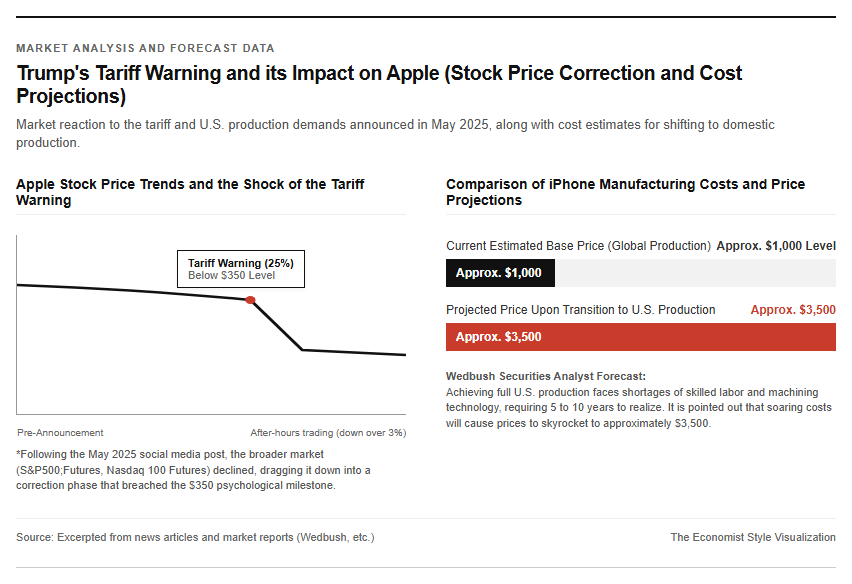
In May 2025, former US President Trump asserted on his social media platform, Truth Social, that iPhones sold in the US should be manufactured and assembled domestically rather than abroad in countries like India. He warned that if Apple failed to comply with domestic production, the company would face a tariff of at least 25%, delivering a major shock to the market. Following these remarks, Apple’s stock price temporarily fell by over 3% in after-hours trading, acting as a drag on the broader US stock market, including S&P 500 and Nasdaq 100 futures. Because Apple has long relied heavily on overseas manufacturing, this was perceived not only as direct pressure on a single corporation but also as a profound concern for the entire global supply chain. Market participants and analysts widely view relocating all iPhone manufacturing to the US as unrealistic. Wedbush Securities analyst Dan Ives projected that producing iPhones in the US would cause retail prices to skyrocket to approximately $3,500 due to a sharp surge in manufacturing costs. Furthermore, due to a shortage of advanced machining technology and skilled labor, building full-scale manufacturing lines in the US would take five to ten years, leading experts to point out that short-term US production is nothing more than a fairy tale. The chart below shows the stock price reaction and the trajectory of tariff-related news.
Tariff Costs Scaling Up to .1 Billion and Pressuring Financial Performance
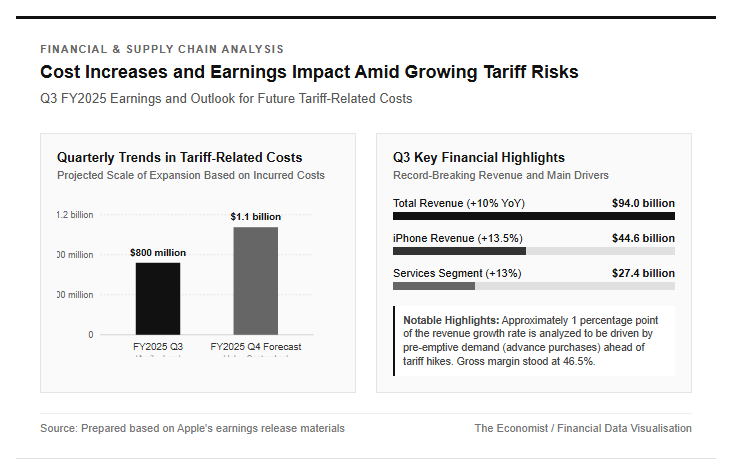
The emergence of tariff risks has also begun to manifest as concrete cost increases in Apple’s financial results. In the company’s third-quarter fiscal results (April–June period), revenue reached $94.0 billion, a 10% increase year-over-year and a record high for the quarter. Growth was driven by strong sales in the flagship iPhone segment, which rose 13.5% to $44.6 billion, alongside an expansion in the services division, which grew 13% to $27.4 billion. However, Chief Financial Officer Kevan Parekh analyzed that about one percentage point of this revenue growth was driven by preemptive buying (advance purchasing) from customers wary of future price hikes stemming from potential tariff increases. Meanwhile, cost burdens associated with trade friction are escalating rapidly. Apple already recorded approximately $800 million in tariff-related costs during the April–June 2025 quarter, and revealed expectations that this impact will expand to the $1.1 billion scale in the subsequent July–September quarter. Additionally, while the gross margin of 46.5% slightly exceeded market expectations, investors are increasingly apprehensive about whether high tariff costs can be passed on to product prices over the medium to long term, or if the company will have to absorb them to maintain profit margins. The graph below illustrates the quarterly cost trends.
Supply Chain Restructuring and the Transition to the “3+3” Strategy
Evolution from the “China+1” to the “3+3” Strategy
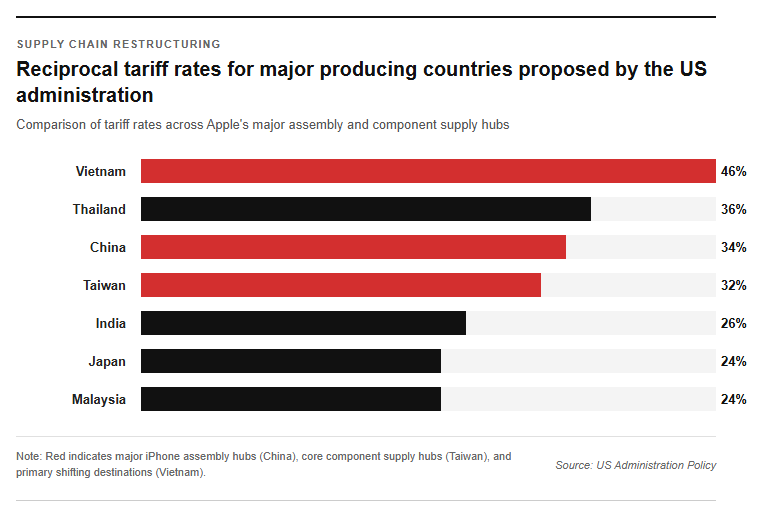
In response to the prolonged trade friction between the US and China and the Trump administration’s policy of reciprocal tariffs, Apple CEO Tim Cook fundamentally overhauled the company’s conventional supply chain strategy. While Apple had previously promoted a “China+1” model—centered on China while diversifying some production—it has now evolved this into a “3+3” strategy. This “3+3” strategy aims to secure and foster a total of six suppliers—at least three within China and at least three outside China—for every major product and component production line, thereby building a manufacturing structure not dependent on any single region. The reciprocal tariff policy proposed by the US administration presented tariff rates of 46% for Vietnam, 36% for Thailand, 34% for China, 32% for Taiwan, 26% for India, and 24% for Japan and Malaysia. High tariffs are particularly severe for Taiwan, which manufactures 100% of Apple Silicon (the core component of the iPhone), and China, the primary assembly hub. According to estimates by major US financial institution Morgan Stanley, if tariff exemptions are denied and import tariffs from China are maintained, Apple would bear an additional cost of up to $8.5 billion annually. The figure below compares tariff rates across major production countries.
Rapid Production Shift to India and Vietnam and Upheaval in the US Market
Efforts to diversify supply chains are driving a historic shift in the import structure of smartphones in the US market. According to a report by research firm Canalys, India and Vietnam surpassed China for the first time in smartphone import volume for the US in the second quarter of 2025. India’s share of US smartphone imports surged from 13% in the same period of 2024 to 44%, while China’s share plummeted from 61% to 25%. Additionally, Vietnam captured a 30% share, emerging as a supplier ahead of China. It is estimated that approximately 80% of iPhones sold in the US in Q2 2025 were manufactured in India. Domestic manufacturing in India takes place across five major hubs, including the Tata Group’s Hosur and Karnataka plants and Foxconn’s Tamil Nadu plant, with major contractor Foxconn investing $1.5 billion in a new display module facility. However, challenges remain: manufacturing costs in India are 5% to 10% higher than those in China, and yields (good product rates) are also lower than in China and Vietnam.
Market Evaluation and Medium-to-Long-Term Outlook
Morgan Stanley’s Price Target Cut and Revenue Concerns
Amidst a phase where the stock price has fallen below $350, changes are also visible in the assessments of major financial institutions. In November 2026, US-based Morgan Stanley lowered its price target for Apple stock from the previous $355 to $350, while maintaining its “Overweight” rating. The primary reasons cited by the firm for the price target reduction are the slowing growth of the high-margin services business and concerns regarding the monetization model amid the proliferation of artificial intelligence (AI). In addition to sluggish trends in App Store revenue and slowing growth in search license revenue from Google, there is growing caution that the rise of generative AI is changing user search behavior and app usage patterns, risking downward pressure on existing platform revenues. Meanwhile, Apple is making aggressive investments to catch up in the AI space, including increasing R&D spending to $8.8 billion, which has become a factor squeezing short-term profit margins. Although revenue for the July–September 2026 quarter came in at $114.5 billion (a 12% increase year-over-year), beating market expectations, the stock traded sluggishly in after-hours trading following the earnings release due to rising component prices and the increasing burden of AI investments.
Future Outlook and Risk Factors Investors Should Watch
For Apple stock to reverse its upward trend and solidify the $350 milestone, it is essential to balance responses to geopolitical risks with profitability. In the short term, the biggest point of focus will be whether the US administration continues its exemption from reciprocal tariffs. Currently, the assembly of standard iPhone models is increasingly being shifted to India and Vietnam, but the manufacturing of high-value-added components—such as optical parts like cameras, OLED panels, and semiconductor packaging—remains concentrated in China. Consequently, tariff measures on core components and the operational status of overseas plants belonging to Chinese suppliers will dictate overall manufacturing costs. Over the medium to long term, the key questions will be how cost-reduction effects from improved manufacturing yields at India’s new factories will materialize, and how the $8.8 billion scale of AI R&D investments will translate into new products and paid services. Whether Apple can present the fruits of global supply chain restructuring alongside a new growth story for the AI era is expected to dictate future stock price trends.
Reference Pages
- [Apple Stock News (AAPL) – Investing.com] https://jp.investing.com/equities/apple-computer-inc-news
[#Apple #USStocks #TrumpTariffs #SupplyChain #MadeInIndia #AIInvestment]


コメント