While the United States announced a new proposed additional tariff targeting several countries including China, the Chinese government indicated it would take necessary measures to retaliate. The Chinese side is harboring a deep sense of distrust and growing resentment toward the new tariff proposal, which was unveiled immediately after the bilateral summit aimed at stabilizing relations.
- The announcement of the new tariff proposal immediately following the summit and the strong backlash from the Chinese side
- An exchange of high-tech and rare earth regulations triggering a resurgence in trade friction
- Diversified domestic support aimed at mitigating the impact on exporting companies
- Changes in corporate behavior and shifts toward emerging markets
- Impact on Third Countries Through Negotiation Scenarios and Trade Diversion Effects
- Risk Management and Supply Chain Resilience Required of Companies
The announcement of the new tariff proposal immediately following the summit and the strong backlash from the Chinese side
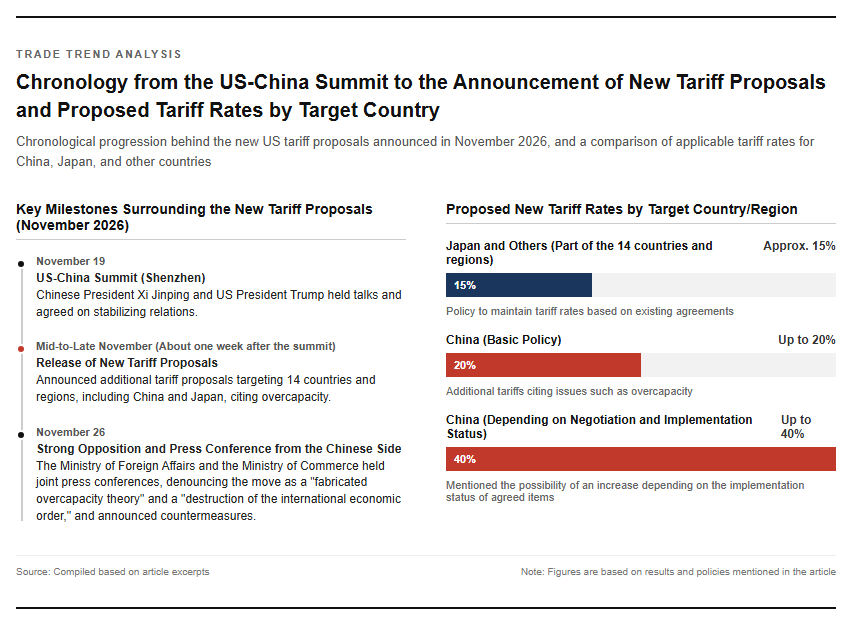
In November 2026, the U.S. government announced a new proposal for additional tariffs targeting 14 countries and regions, including China and Japan, citing issues such as overcapacity. This announcement came just one week after Chinese President Xi Jinping and U.S. President Donald Trump held a summit meeting in Shenzhen, Guangdong Province, China, on November 19, 2026, where they agreed to stabilize relations. The Chinese side has reacted fiercely to this sudden move, significantly intensifying its distrust of the U.S. side.
At a press conference on November 26, 2026, Chinese Foreign Ministry Spokesperson Guo Jiakun stated that China would continue to take necessary measures to safeguard its legitimate rights and interests in response to the U.S. tariff measures. He also condemned the allegations of overcapacity as a fabrication and a political tool. On the same day, Chinese Ministry of Commerce Spokesperson He Yadong also held a press conference, arguing that the U.S. measures seriously undermine the international economic order and severely violate World Trade Organization rules, and demanding correction through dialogue.
The new U.S. tariff proposal indicates a policy of capping tariffs on countries like Japan at around 15% based on existing agreements, while imposing an additional tariff of up to 20% on China. Furthermore, it mentions the possibility of raising the tariff rate to 40% depending on the progress of tariff negotiations and the fulfillment of agreements, raising the risk of a re-escalation of trade frictions between the U.S. and China. Please refer to the figure below.
An exchange of high-tech and rare earth regulations triggering a resurgence in trade friction
The background leading up to this new tariff proposal involves a normalization of tit-for-tat regulatory tightening between the U.S. and China. The U.S. side has successively stepped up measures such as adding Chinese companies to the Entity List, expanding the scope of export controls to subsidiaries 50% or more owned by targeted entities, and further restricting technology exports to China. In response, the Chinese side has also promoted tighter export controls on critical minerals such as rare earths and lithium battery-related components.
It is analyzed that, in particular, the Chinese government’s tightening of export controls on rare earth-related technologies and materials, along with moves to close existing loopholes, stirred up strong alarm on the U.S. side. While the Chinese side positions these regulations as countermeasures and negotiating cards against unfair U.S. economic pressure, the U.S. side remains highly vigilant, which served as a factor prompting the rollout of retaliatory measures in the form of high additional tariffs.
Although economic dialogue efforts between the two countries have partially progressed—such as the holding of an agricultural working group and purchases of passenger planes—a deep-seated structure of confrontation regarding security and technological hegemony remains. As the weaponization of economic dependence—using economic instruments as political pressure—advances, finding common ground between the two sides has become increasingly difficult.
Economic Impact and Domestic Industry Support Measures by the Chinese Government
Diversified domestic support aimed at mitigating the impact on exporting companies
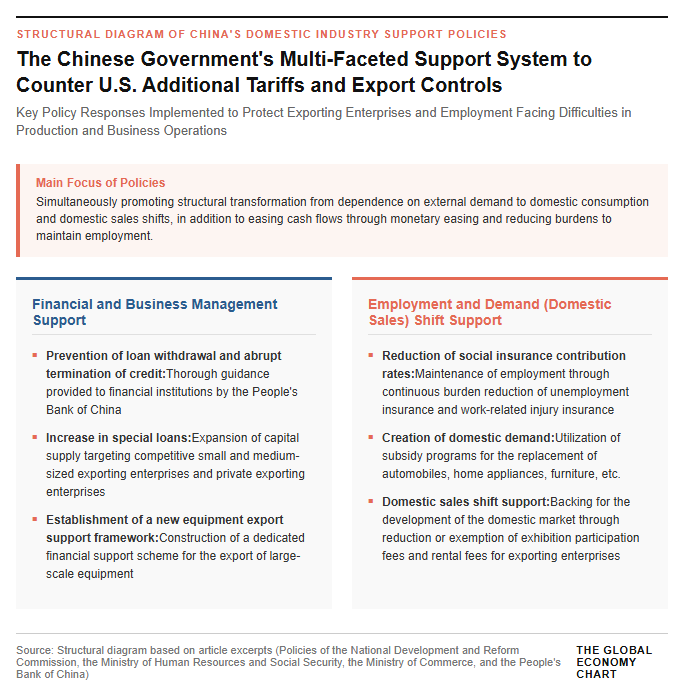
To protect domestic exporting companies and employment directly hit by the U.S. additional tariff measures, the Chinese government is rolling out comprehensive economic and employment stabilization policies. Key agencies such as China’s National Development and Reform Commission, the Ministry of Human Resources and Social Security, the Ministry of Commerce, and the People’s Bank of China have outlined various support policies for companies facing production and operational difficulties due to the tariff hikes.
On the financial front, the People’s Bank of China is strictly instructing financial institutions not to arbitrarily withdraw or cut off loans to competitive small and medium-sized exporting companies facing temporary difficulties. Furthermore, it recommends increasing special loans for private exporting companies and establishing funding support frameworks for large-scale equipment exports. On the employment front, it is continuing measures to lower unemployment insurance and workers’ compensation insurance contribution rates to support business continuity and job retention.
In addition, aiming to break away from dependence on external demand, the expansion of domestic consumption and a shift toward selling export products domestically (domestic sales support) are being promoted. Subsidies for replacing automobiles, home appliances, and furniture are being utilized to generate demand in the domestic market, alongside measures to reduce or exempt exhibition booth fees and rent for exporting companies. Please refer to the figure below.
Changes in corporate behavior and shifts toward emerging markets
The frequent changes in U.S. tariff policies and tightening of regulations have also brought about noticeable changes in the behavioral patterns of Chinese companies conducting business with the United States. According to a survey conducted by the China Council for the Promotion of International Trade targeting over 1,100 exporting companies nationwide, the reality that increasing uncertainty is making it difficult to formulate long-term business plans has been brought to light.
As a concrete response measure, about 50% of the responding companies stated that they plan to downsize their U.S.-related business operations. On the other hand, 75.3% of all responding companies answered that they plan to explore emerging and alternative markets, such as the Association of Southeast Asian Nations and the European Union, with the aim of compensating for the decline in exports to the U.S.
Thus, assuming a prolonged US-China confrontation, Chinese companies are rapidly diversifying their trade routes and restructuring their supply chains. The Chinese government is also comprehensively supporting companies in shifting toward overseas markets by providing assistance with tariff exemption procedures and foreign exchange risk hedging through trade-related legal consultation services such as Maofatong.
Medium-to-Long-Term Outlook and Spillover Effects on the Global Supply Chain
Impact on Third Countries Through Negotiation Scenarios and Trade Diversion Effects
Regarding the future trajectory of US-China relations, multiple scenarios are anticipated. The first scenario is a development where both sides agree on operational flexibility through summit meetings and cabinet-level consultations, temporarily calming the tariff battle. The second scenario is a development where negotiations run out of time, additional tariffs are implemented, and the tariff battle re-escalates. The third scenario is a development leading to reductions in tariff levels through mutual compromise.
While tariff hikes between the two countries deal a blow to the economies of both the US and China, they also have aspects of bringing about trade diversion effects for third countries. As the price competitiveness of Chinese products declines due to rising US tariffs on China, imports from third countries such as Japan and Southeast Asia increase as substitutes, creating a structure where they reap the spoils of conflict.
In fact, according to economic estimates using the GTAP model, while a trade loss effect occurs due to the contraction of bilateral trade, it has been pointed out that the negative impact on the real GDP of Japan and other countries may be mitigated by the trade diversion effect through substitution to other countries. However, attention must be paid to secondary effects such as decreased local production in North America and worsening investment returns.
Risk Management and Supply Chain Resilience Required of Companies
Amid the structuralization and entrenchment of US-China friction, the introduction and strengthening of various regulations by both countries are expected to continue intermittently in the future. In particular, the scope of regulations on dual-use technologies where the boundaries between military and civilian applications are blurred, critical minerals, semiconductors, and data-related infrastructure continues to expand steadily.
Under such circumstances, it has become essential for global companies, including Japanese firms, to constantly monitor the trends of legal regulations and economic security-related laws on both the US and China sides. It is necessary to scrutinize not only direct import/export regulations, but also the risks of transaction relationships with entities designated on the Entity List and indirect transactions routed through subsidiaries and suppliers.
To cope with unexpected tariff hikes or export suspension measures, the diversification of procurement sources and production bases (de-risking) and the formulation of contingency plans are urgent tasks. Responding to an international situation where the weaponization of the economy is advancing, uncovering risks across the entire supply chain, and ensuring structural resilience will be the top priorities in future corporate management.
References
- [Research Institute of Economy, Trade and Industry (RIETI)] https://www.rieti.go.jp/jp/columns/a01_0794.html
- [Japan External Trade Organization (JETRO)] https://www.jetro.go.jp/biznews/2025/05/a8bdff77887666b8.html
- [National Diet Library (NDL) Research Materials] https://dl.ndl.go.jp/
[#USChinaTradeFriction #AdditionalTariffs #EconomicSecurity #SupplyChain #GlobalEconomy]

コメント