
On the Tokyo Stock Exchange on November 26, 2026, the Nikkei Stock Average closed the morning session sharply higher, gaining 875.33 yen from the previous day to 57,886.95 yen. Although buying was triggered by a rebound from the previous day’s massive decline of over 1,600 yen, wariness regarding the future outlook of AI investments has not been fully dispelled in the market.
- Background behind the Nikkei Stock Average surging 875 yen in the morning session
- Buyback movements centered on semiconductor and AI-related stocks
- Trends in US tech stocks and concerns over the profitability of generative AI investments
- The rise in the Nikkei VI and the impact of program trading
- The Mechanism of Market Liquidity Decline Under Rapid Market Fluctuations
- Medium- to Long-Term Stock Price Forecasts and Key Points for Investors to Watch
Background behind the Nikkei Stock Average surging 875 yen in the morning session
In the Tokyo Stock Exchange on November 26, 2026, the Nikkei Stock Average (225 issues) shifted to a significant upward trend. On the previous day, November 25, 2026, the Nikkei Stock Average had experienced a sharp drop of over 1,600 yen, with strong selling pressure spreading throughout the market. However, in trading on the morning of the 26th, buying orders aimed at an autonomous rebound from that plunge became dominant. The morning closing price reached 57,886.95 yen, up 875.33 yen from the previous day’s close, and during trading hours, it temporarily rose by more than 1,100 yen from the previous day to push up into the 58,100-yen range. The background to this price formation includes active position adjustment against the immediately preceding overheated selling and short-term bargain-hunting movements. Although buybacks by major market participants supported the market as a whole, cautious views remain deeply rooted within the market that this is merely a temporary rise driven by the reaction to the previous day’s massive decline. Please refer to the following figure showing the rapid price movements of the stock market.
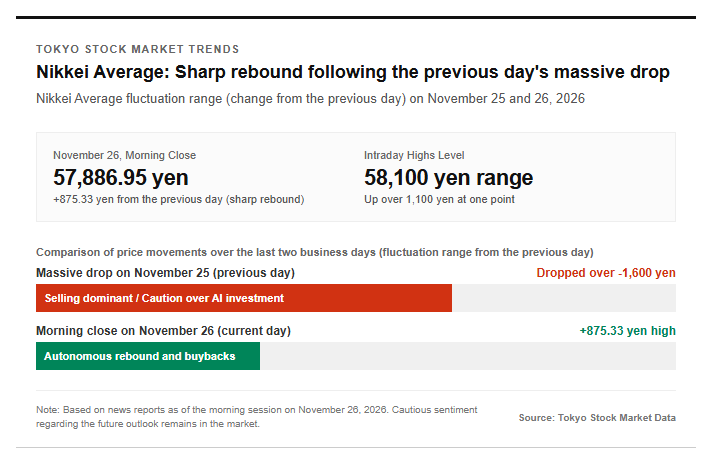
In predicting future stock price trends, whether sustainable buying funds flow into the market, rather than just temporary buybacks, will be a key decision criterion.
Buyback movements centered on semiconductor and AI-related stocks
In this sharp rebound, the main factor driving the overall rise in the index was the buyback movement targeting artificial intelligence-related stocks and semiconductor-related stocks, which have a large contribution to the Nikkei Stock Average. Amid the global tech stock slump during the previous day’s plunge, major semiconductor manufacturing equipment and electronic component maker stocks had continued to be sold off intensively. However, in the trading on the morning of November 26, buying back centered on major stocks that began to look reasonably priced expanded rapidly. Specifically, buying orders spread to heavily influential stocks in the market such as Advantest, Lasertec, and SoftBank Group, serving as the driving force behind the expansion of the market’s overall gains. However, according to views from securities professionals and major brokerage strategists, this buyback is largely due to a short-term, localized improvement in the supply-demand balance, and investors’ wariness regarding the future outlook of AI-related stocks has not been completely dispelled. Therefore, it is pointed out that the stock prices of related stocks may not continue to rise in a straight line, but instead repeat complex back-and-forth price movements.
Cautiousness toward AI investments and the structure of rising market volatility
Trends in US tech stocks and concerns over the profitability of generative AI investments
At the root of the uncertainty in the Tokyo Stock Exchange are concerns over excessive investment in major technology companies, primarily centered on the US market, and market doubts regarding profitability. Giant US IT companies, led by Nvidia, have continued to make massive capital investments toward building the foundational infrastructure for generative AI. However, as of November 2026, market participants are taking a harsher view of the pace at which investment amounts are being converted into earnings and overall profitability. Furthermore, individual warning signs have surfaced one after another at Nvidia, such as the return of the CEO, concerns surrounding corporate governance structures, and reports of rating agencies considering a downgrade. In addition, geopolitical risks such as changes in US government tariff policies and the tightening of trade regulations are also being felt, contributing to the deterioration of investor sentiment. A structure has become established whereby when major US tech stocks shift to a downward trend, the impact immediately spreads to Japan’s semiconductor supply chain and related stocks. Please refer to the following figure regarding the trends of major US stock indices and AI-related stocks.
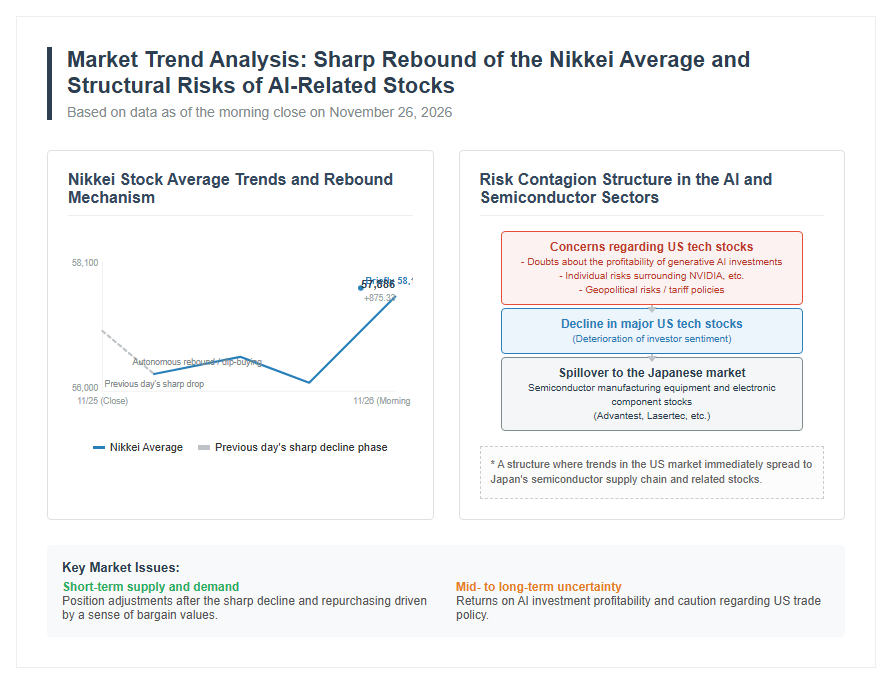
As long as warning signs from the external environment are not dispelled in this manner, Japanese stocks are likely to face heavy topside resistance.
The rise in the Nikkei VI and the impact of program trading
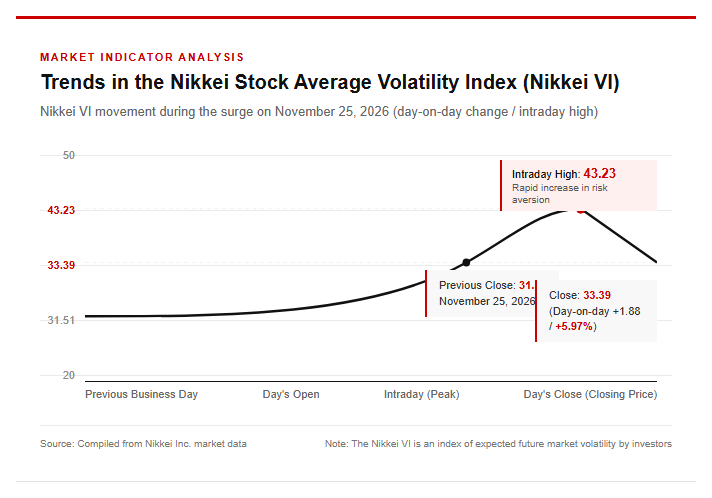
The Nikkei Stock Average Volatility Index (Nikkei VI), which indicates the future market volatility anticipated by investors, rose by 1.88 points (a 5.97% increase) from the previous day to 33.39 on November 25, 2026, and temporarily hit a high of 43.23 during trading hours. The rise in the Nikkei VI clearly reflects a deterioration in market sentiment and a heightened sense of risk aversion toward sharp future fluctuations. In recent years, alongside advances in information and communications technology, the proportion of high-frequency trading (HFT) and algorithmic program trading in the stock and foreign exchange markets has increased significantly. According to research and data analysis by the Bank of Japan, the simultaneous correlation between Japanese stocks and the USD/JPY exchange rate has strengthened in recent years, creating an environment where a decline in stock prices tends to induce yen appreciation, which in turn easily generates a synergistic effect that further accelerates stock price drops. When market volatility rises, algorithmic trading mechanically places a massive volume of buy and sell orders, becoming a factor that triggers rapid price fluctuations in a short period. The combination of deteriorating market sentiment and the behavior of automated trading programs forces investors to strongly prepare for sudden market fluctuations.
Changes in Market Liquidity and the Future Outlook for the Stock Market
The Mechanism of Market Liquidity Decline Under Rapid Market Fluctuations
In phases of wild market fluctuations, of particular importance are trends in market liquidity, which indicate the degree to which transactions can be conducted smoothly in the market. According to transaction data analysis by the Financial Services Agency and research reports by the Bank of Japan, a phenomenon in which market liquidity rapidly declines is observed during phases when stock prices plunge and fluctuate violently. As market participants strengthen their risk-averse stance and refrain from placing orders, the market’s order book becomes thin, creating an environment where prices jump significantly on just a small volume of orders. It has been confirmed that during the major stock market crash that occurred in August 2024 (the so-called Ueda Shock or Reiwa Black Monday), market liquidity dropped significantly toward the afternoon session, creating a negative feedback loop where sell orders triggered further sell orders. Please refer to the figure below regarding the correlation between market liquidity and economic fluctuations.
In a state where liquidity has dried up, rapid price fluctuations that are not based on normal fundamental analysis are prone to occur; therefore, individual and institutional investors need to manage their capital while fully taking into account increased transaction costs and execution risks.
Medium- to Long-Term Stock Price Forecasts and Key Points for Investors to Watch
Regarding the medium- to long-term outlook for Japanese stocks, major financial institutions such as Nomura Securities have revised downward their year-end 2026 TOPIX forecasts from the previous 4,400 points to 4,000 points, and their Nikkei Stock Average forecasts from 70,000 yen to 62,000 yen. Behind this are downward pressures on the price-to-earnings ratio (PER) resulting from upward interest rate pressures and a correction in excessive growth expectations for AI-related companies. Although the Nikkei Stock Average recorded an all-time high of 72,366 yen on a closing basis in June 2026, predictions have also emerged that the timing for updating that high again will be pushed back to the end of 2028 or later. As focal points that investors should closely monitor in future market developments, the first is whether the sustainable growth of U.S. data centers and AI investment can be confirmed, the second is the pace of additional interest rate hikes and policy interest rate changes by the Bank of Japan, and the third is the growth rate of earnings per share (EPS) of Japanese companies. To navigate through short-term turbulent markets, an investment stance with a long-term perspective—avoiding emotional trading and carefully assessing the fundamentals of individual companies and macroeconomic trends—is essential.
Reference Pages
- [Nikkei Average closes morning session 875 yen higher at 57,886 yen… Some view it as ‘caution over the outlook for AI investment’ – Yomiuri Shimbun] https://www.yomiuri.co.jp/economy/20261126-GYT1T00124/
[#NikkeiAverage #StockMarket #AIInvestment #SemiconductorStocks #MarketLiquidity #InvestmentStance]


コメント