KDDI and U.S.-based Broadcom have announced a technical partnership aimed at reducing power consumption in AI data centers, and have started joint verification of CPO technology, which supports opto-electronic convergence. The background to this includes the explosive increase in power demand driven by the widespread adoption of generative AI and the global challenge of improving data center energy efficiency.
- Overview of the Partnership and Key Points of the Event
- The Surge in Data Center Power Consumption and Its Underlying Factors
- CPO Technology and the Mechanism of the Latest “Tomahawk 6” Chip
- Details of the Joint Verification at KDDI’s AI Data Center
- Expansion into Home Broadband and the Digital Belt Initiative
- Future Outlook and Key Points of Next-Generation Communication Infrastructure
Overview of the Partnership and Key Points of the Event
On October 22, 2026, KDDI Corporation concluded a technical partnership regarding communications infrastructure technology with major U.S. semiconductor and networking company Broadcom Inc., aimed at the practical implementation of AI in society. Based on this partnership, the two companies are working to realize optical-electrical convergence in inter-GPU networks within AI data centers, aiming to curb the sharp surge in power consumption.
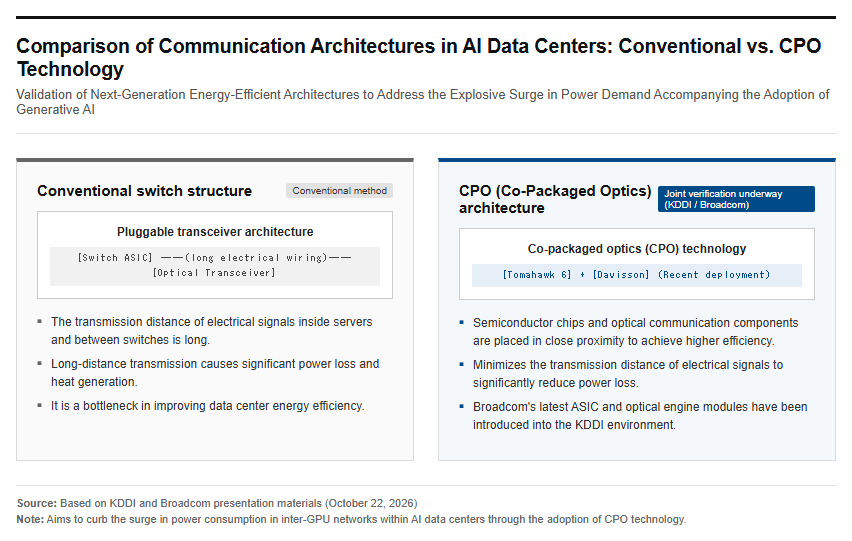
Starting on October 22, 2026, the same day as the partnership announcement, joint verification of “Co-Packaged Optics (CPO)” technology—which aims to achieve high efficiency by placing semiconductor chips handling electrical signals in close proximity to optical communication components—was initiated. In conventional data center architectures, long electrical signal transmission distances within servers and between switches have caused significant power loss and heat generation. For this verification, a dedicated testing environment has been established within KDDI’s AI data center, introducing CPO switches that incorporate Broadcom’s latest-generation Ethernet switch ASIC, “Tomahawk 6,” and the “Davisson” optical engine module.
The diagram below shows a comparison between the conventional switch architecture in AI data centers and the new architecture incorporating CPO technology.
The results of this verification are scheduled to serve as the core of the next-generation network infrastructure promoted by KDDI, and will be technically showcased at the “KDDI SUMMIT 2026” event to be held at the TAKANAWA GATEWAY Convention Center on October 27 and 28, 2026.
The Surge in Data Center Power Consumption and Its Underlying Factors
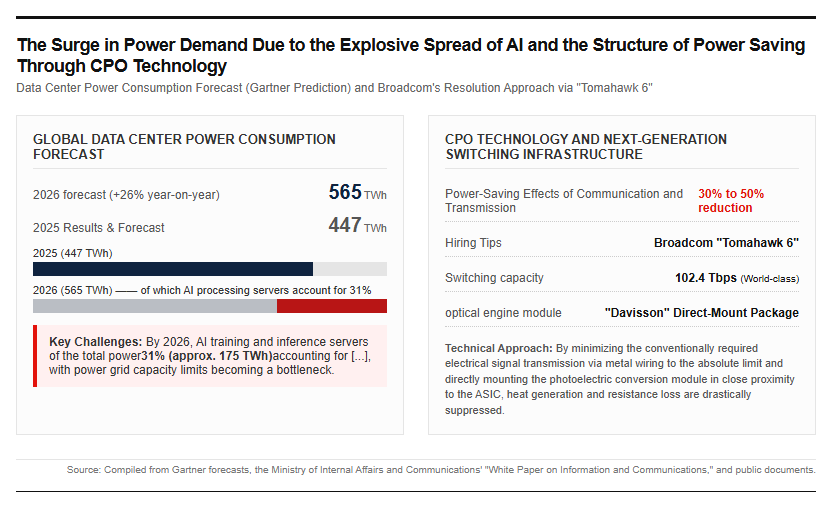
Behind this partnership are the accelerating global adoption of generative AI and the accompanying sharp increase in data center power consumption. According to a June 2026 forecast by research firm Gartner, global data center power consumption is projected to reach 565 TWh (terawatt-hours) in 2026, a 26% increase year-over-year from 447 TWh in 2025. Furthermore, power consumption by servers optimized for AI training and inference processing continues to grow, and will account for 31% of total data center power consumption by 2026.
Looking at the domestic situation, as pointed out in the Ministry of Internal Affairs and Communications’ 2025 White Paper on Information and Communications and other reports, the concentration of data center locations in the Tokyo and Kansai areas and the shortage of power grid capacity have become serious concerns. For the training of large language models (LLMs) and real-time AI inference, AI computing infrastructure with tens of thousands of GPUs connected in sophisticated parallel configurations is indispensable. However, the limits of physical power supply capacity are increasingly becoming a bottleneck that directly restricts the pace of AI innovation.
To reduce environmental impact and operational costs while sustaining AI advancement, thorough power saving across all layers—ranging from inside the chip to network communications—is indispensable, and the partnership between KDDI and Broadcom is precisely a direct response to this structural challenge.
The Power-Saving Revolution Brought by Optical-Electrical Convergence and CPO Technology
CPO Technology and the Mechanism of the Latest “Tomahawk 6” Chip
Photo-electronic fusion (optical-electrical integration) is a technology that highly combines electrical signals, which handle data processing, and optical signals, which excel in long-distance, large-capacity transmission. In conventional data center switches, data was sent through metal wiring (electrical signals) running on the board to optical transceivers at the edge of the wiring board, where it was converted into optical signals for transmission. The resistance loss and heat generation in this electrical wiring area accounted for a large proportion of total power consumption.
In contrast, CPO (Co-Packaged Optics) technology packages the photoelectric conversion module (optical engine) by mounting it directly in close proximity to the switch board (ASIC) that processes data. This minimizes the physical distance of electrical signal transmission to the utmost limit, making it possible to reduce communication-related power consumption by 30% to nearly 50% compared to conventional methods.
The Broadcom “Tomahawk 6” adopted in this verification is a state-of-the-art Ethernet switch ASIC that achieves a switching capacity of 102.4 Tbps (terabits per second), class-leading globally for a single semiconductor chip. By integrating Broadcom’s “Davisson” optical engine module with this, a next-generation switching infrastructure that achieves both ultra-high bandwidth and power-saving performance has been established.
Details of the Joint Verification at KDDI’s AI Data Center
In the joint verification conducted by KDDI and Broadcom, the evaluation goes beyond mere numerical measurement of power consumption to provide a comprehensive assessment of communication performance simulating actual AI distributed training and inference processing. In distributed AI training, parameter synchronization and data exchange occur frequently among multiple GPUs, so even minor communication latency or packet loss can cause the entire computation to halt or experience delays.
The evaluation items for this verification include the following:
– Quantitative Evaluation of Power Reduction Rate by Introducing CPO Switches
– Measurement of Packet Loss Rate During Distributed Training and Inference Execution
– Operational Verification of Congestion Control Mechanisms During Network Congestion
– Verification of Effective Throughput Stability in Actual Data Transmission
The diagram below illustrates data communication within the inter-rack network inside an AI data center.
By applying Broadcom’s advanced flow control technologies and congestion detection algorithms to the verification environment, tests are being conducted to determine whether lossless communication with zero packet loss can be achieved in an ultra-large-scale AI cluster closely resembling a production environment. The results of this verification will be directly incorporated into the basic design of KDDI’s future commercial AI data centers.
Infrastructure Upgrades Spanning from Data Centers to Homes
Expansion into Home Broadband and the Digital Belt Initiative
This partnership between KDDI and Broadcom goes beyond merely revamping internal data center networks. The two companies are also teaming up in the in-home broadband space closest to customers, with a policy to leverage Broadcom’s expertise in optoelectronic conversion technology to explore the transition to next-generation FTTH (fiber-optic communication).
KDDI is promoting the “Digital Belt Initiative,” which connects all of Japan with a low-latency network by fusing infrastructure assets such as submarine cables and data centers with advanced technologies like the All-Photonics Network (APN) and next-generation mobile communications (6G). To deliver advanced AI processing results generated in data centers to ordinary households and corporate terminals without latency, it is essential to expand bandwidth and reduce power consumption not only on the cloud side but also in the access network known as the “last mile.”
By connecting data centers to homes with an end-to-end optical and power-optimized network, we aim to build a communication infrastructure where even ordinary households can comfortably use bidirectional, highly real-time generative AI services and advanced robotics integration.
Future Outlook and Key Points of Next-Generation Communication Infrastructure
The biggest points of focus moving forward are the establishment of an optoelectronic fusion network architecture that incorporates the verification results, and the schedule for its phased rollout in KDDI’s commercial AI data centers. As power shortages in data centers become a direct hindrance to AI development, building communication infrastructure that puts CPO technology into practical use will provide a significant competitive advantage in the global data center race.
The main points to watch going forward are as follows:
– Timing of Full-Scale Deployment of CPO-Equipped Switches in Commercial AI Data Centers
– Standardization of Optoelectronic Convergence Architecture and the Expansion of the Ecosystem
– Implementation and Deployment of Photoelectric Conversion Technology in Home Access Networks (Next-Generation FTTH)
– Application to the construction of regionally distributed AI data centers in Japan
As “Watt-Bit collaboration”—which optimizes power supply and communication traffic in an integrated manner—is discussed as a national agenda, the initiatives by KDDI and Broadcom serve as a concrete leading example toward realizing a sustainable AI society. The combination of advanced semiconductor technology and telecommunications carrier operational know-how is expected to significantly accelerate improvements in the energy efficiency of AI infrastructure.
Reference page
- [Partnering with Broadcom on Network Infrastructure Technology for the Societal Implementation of AI | KDDI Newsroom] https://newsroom.kddi.com/news/detail/kddi_nr-1205_4772.html
- Broadcom Ships Tomahawk 6: World’s First 102.4 Tbps Switch | Broadcom
- 【2025 Information and Communications White Paper | Overview of Key Issues | Ministry of Internal Affairs and Communications】https://www.soumu.go.jp/johotsusintokei/whitepaper/ja/r07/html/nd121100.html
【#KDDI #Broadcom #AIDataCenter #PowerSaving #PhotonicsElectronicsConvergence #CPO #TelecomInfrastructure】

コメント