
Minister of Economy, Trade and Industry Ryosei Akazawa announced the end of application acceptance for electric vehicle and other purchase subsidies, and expressed his intention to consider shortening the subsidy suspension period (gap period) in the next budget. The background involves budget depletion due to the rapid expansion of domestic EV sales, and discussions are underway regarding future institutional stabilization and the reduction of subsidy unit prices.
- EV demand exceeding expectations and digestion of the 110 billion yen budget
- The full picture of the application deadline suddenly set for arrivals on November 20
- METI Minister Akazawa’s announcement on shortening the gap period and the FY2027 budget request
- Reduction of subsidy unit prices and evaluation criteria emphasizing economic security
- Sharpening disparities in subsidy allocations across vehicle models and manufacturers
- Trends in Delivery Postponements and Future Outlook Including Municipal Support
EV demand exceeding expectations and digestion of the 110 billion yen budget
The Subsidy for Promoting the Introduction of Clean Energy Vehicles (CEV Subsidy), for which approximately 110 billion yen was allocated in the FY2025 supplementary budget, was digested at a faster-than-expected pace in response to the soaring demand for electric vehicles (EVs) and plug-in hybrid vehicles (PHEVs) in Japan. Domestic EV sales in September 2026 reached 16,074 units, an 88.6% increase compared to the same month of the previous year, marking an all-time high for a single month. The EV share of total passenger car sales also rose to 4.5%, with Toyota selling 3,231 units of the bZ4X and Nissan selling 2,013 units of the Leaf, accelerating adoption centering on standard-class EVs. This rapid market expansion was largely driven by the effect of government subsidies, and became the main reason why the application acceptance period, originally expected to run from early to late December 2026, was significantly shortened. The figure below provides an overview of the budget trend, which declined sharply amid the surging demand.
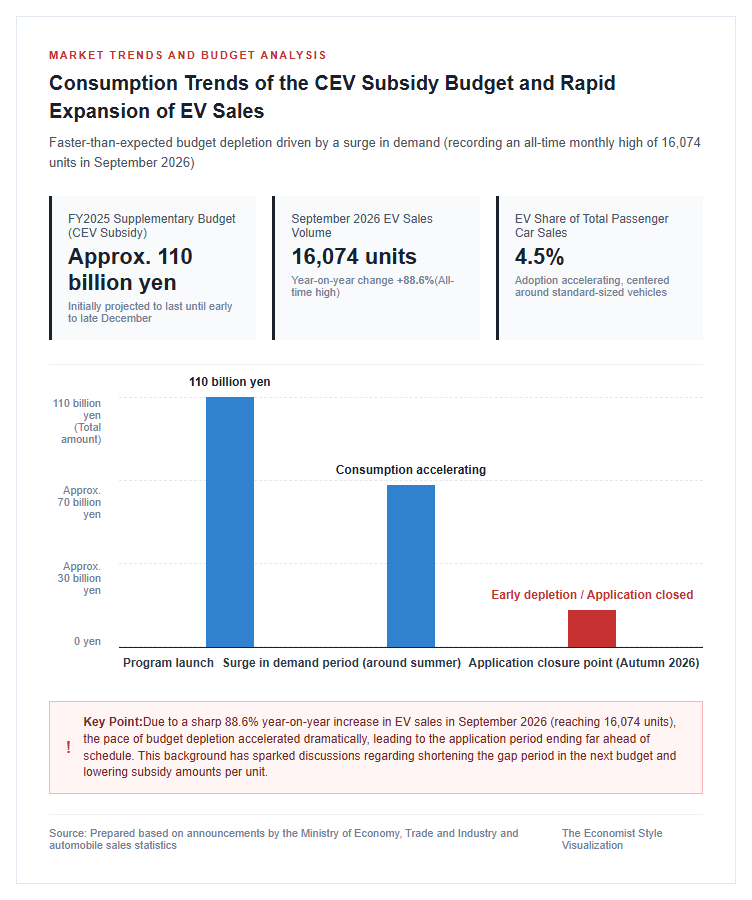
The remaining budget, which stood at approximately 12.1 billion yen as of November 16, plummeted over just a few days, forcing an early review of the institutional operations.
The full picture of the application deadline suddenly set for arrivals on November 20
The executive agency, the Next Generation Vehicle Promotion Center, and the Ministry of Economy, Trade and Industry ended the acceptance of vehicle applications for the FY2025 supplementary CEV subsidy with arrivals on November 20, 2026 (online applications until 17:15 on the same day). Looking at the transition of the remaining budget, the balance of approximately 12.1 billion yen on November 16 decreased to about 10.7 billion yen on the 17th, about 9.0 billion yen on the 18th, and about 6.6 billion yen on the 19th, dropping at a pace of 1.4 billion to 2.4 billion yen per day. Applications worth approximately 5.7 billion yen flooded in for arrivals on November 20 alone, and the balance after tallying fell to about 930 million yen. Since it became certain that applications exceeding the remaining balance would arrive by November 24, after the long weekend, the termination of applications on that day was officially decided. Application documents arriving at the secretariat on or after November 21 have been subjected to strict operational rules where they are all rejected and will not be disbursed, regardless of the vehicle’s new registration date or mailing dispatch date. No relief measures were applied to buyers who could not complete their applications by November 20 due to delayed trade-in vehicle deliveries and other reasons, sending major ripples through the market.
Government policy and institutional review toward shortening the gap period
METI Minister Akazawa’s announcement on shortening the gap period and the FY2027 budget request
At a post-cabinet press conference on November 24, 2026, Minister of Economy, Trade and Industry Ryosei Akazawa officially announced the end of CEV subsidy applications and expressed his intention to minimize the gap period that occurs before the implementation of the next budget as much as possible. The Ministry of Economy, Trade and Industry has already included 110 billion yen—the same scale as this year’s supplementary budget—in its rough budget request for the initial FY2027 budget. Minister Akazawa indicated a policy to consider appropriate measures during the budget compilation process to prevent market cooling and purchase postponement. As a past precedent, when applications were terminated early due to budget depletion in FY2018, a relief measure was implemented to retroactively make vehicles newly registered on or after January 1, 2019 eligible for subsidies following the cabinet decision on the following fiscal year’s budget. However, it remains undecided whether a similar registration date criterion will be adopted this time, and consumers who purchase and register cars within the year are required to plan their finances keeping in mind the possibility that government subsidies may not be obtained.
Reduction of subsidy unit prices and evaluation criteria emphasizing economic security
In the upcoming CEV subsidy system, the government is proceeding with reducing the subsidy unit price per vehicle and revising the calculation method to ensure the system’s sustainability and stable operation. Prior to this, the Ministry of Economy, Trade and Industry had announced a policy to lower the upper subsidy limit for vehicles newly registered from January 2027 onward to roughly 60% of the current level (from a maximum of 1.3 million yen to 780,000 yen for standard EVs, and from 580,000 yen to 458,000 yen for mini-EVs), but the termination of applications on November 20 effectively eliminated the opportunity to apply under these revised amounts. In addition, the new criteria place strong emphasis on economic security evaluations, allocating a score out of 100 points for the adoption of domestically produced batteries and the procurement systems for critical minerals such as rare earths. Meanwhile, the weighting for items with smaller performance differences among manufacturers, such as environmental performance and recycling measures, has been lowered, clearly demonstrating the policy intent to favor companies contributing to supply chain resilience and domestic investment.
Impact on the automotive industry and future buyer trends
Sharpening disparities in subsidy allocations across vehicle models and manufacturers
The introduction of new evaluation criteria has brought the disparities in subsidy amounts granted to different automakers and vehicle models into sharp focus. Toyota’s bZ4X, equipped with domestically produced batteries, maintained the maximum subsidy cap of 1.3 million yen, while the jointly developed Subaru Solterra secured 1.29 million yen and Honda’s Honda e maintained a high level of 1.3 million yen. While Tesla’s Model 3 also maintained 1.27 million yen, assessments for foreign manufacturers became stricter. Models such as China-based BYD’s Seal saw a significant reduction from the previous 450,000 yen down to 150,000 yen due to low evaluation scores, and Germany’s Volkswagen ID.4 was also scaled back from 860,000 yen to 460,000 yen. Furthermore, even among domestic manufacturers, Nissan’s Leaf and Ariya, as well as Suzuki’s e Vitara, are scheduled for substantial reductions of 290,000 yen each—dropping from 1.29 million yen to 1 million yen, and from 1.27 million yen to 980,000 yen, respectively, for registrations from January 2027 onward. Such preferential allocation under the system has a direct impact on consumers’ vehicle selection and the sales strategies of various companies.
Trends in Delivery Postponements and Future Outlook Including Municipal Support
Following the closure of national subsidy applications, a variety of responses are emerging in the automotive market and at dealership frontlines. It has been reported that some automakers and dealerships, such as Nissan Motor, are intentionally postponing and adjusting customer vehicle delivery schedules in order to gauge the eligibility conditions of the next budget and the timing of the system’s resumption. For buyers awaiting delivery, it is recommended to verify the difference between the vehicle registration/notification date and the actual delivery date, and to recalculate the final total payment in the event that national support cannot be obtained. On the other hand, municipalities with their own independent purchase subsidies, such as Tokyo, continue to accept applications for ZEV vehicle purchase subsidies of up to 1.3 million yen even after the end of the national subsidies, leaving options open to reduce out-of-pocket costs by utilizing local government support. The figure below organizes the overall workflow and decision-making axes for considering EV purchases moving forward.
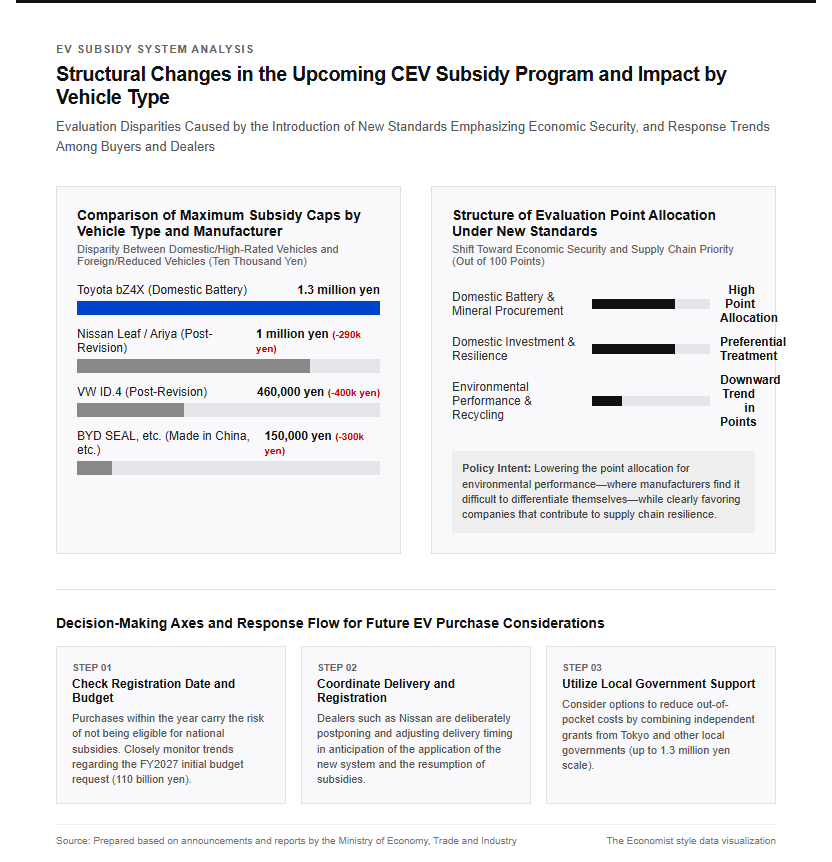
Moving forward, toward the Cabinet decision on the government’s year-end budget proposal, it is essential to closely monitor the scope of relief during the gap period and the details of the fiscal 2027 system.
Reference Page
- [Next Generation Vehicle Promotion Center: “CEV Subsidy (Vehicles)”] https://www.cev-pc.or.jp/hojo/cev.html
- [Ministry of Economy, Trade and Industry: “Clean Energy Vehicle Introduction Promotion Subsidy”] https://www.meti.go.jp/policy/mono_info_service/mono/automobile/cev/r7h_cev.html
[#EVSubsidies #CEVSubsidies #METI #EconomyMinisterAkazawa #ElectricVehicles #AutomotiveIndustry]

コメント