
On November 25, 2026, Suzuki unveiled its new electric vehicle (EV) “Ignis” for the European market for the first time in the world. This move is driven by growing demand for small EVs in the European market and a low-cost expansion strategy that leverages Japanese kei car technology.
- World premiere of a global strategic vehicle based on the “e SKY” mini EV
- Driving and Maneuverability Performance Realized by “HEARTECT-e” and eAxle
- Background of the Slump in Heavyweight EVs and the Creation of the New EU Category “M1E”
- Germany’s Defiance and the European Situation Surrounding the Review of Decarbonization Regulations
- Utilization of existing lines and thorough cost reduction through “Small, Few, Light, Short, and Beautiful”
- Price Competition with Chinese Manufacturers and Future Points of Interest in the European Market
World premiere of a global strategic vehicle based on the “e SKY” mini EV
On November 25, 2026, Suzuki held an online world premiere for its new compact EV “Ignis” intended for global markets. The launch is scheduled to roll out sequentially in various countries, starting with Europe, around summer 2027. This model was developed using the body and powertrain of the “e SKY” mini EV passenger vehicle, which was released in Japan on November 16, 2026, as its foundation.
The development concept is “Easy to Switch – the best city car for your neighbourhood,” pursuing ease of use that feels natural even when transitioning from gasoline-powered or larger vehicles. President Toshihiro Suzuki stated that this is Suzuki’s first global strategic compact EV, embodying the company’s management philosophy of “Small, Less, Light, Short, and Beautiful.”
The exterior features front and rear LED lamps inspired by digital numerals, and the inclusion of wide fenders and front/rear bumpers gives it a powerful design. Please refer to the figure below.
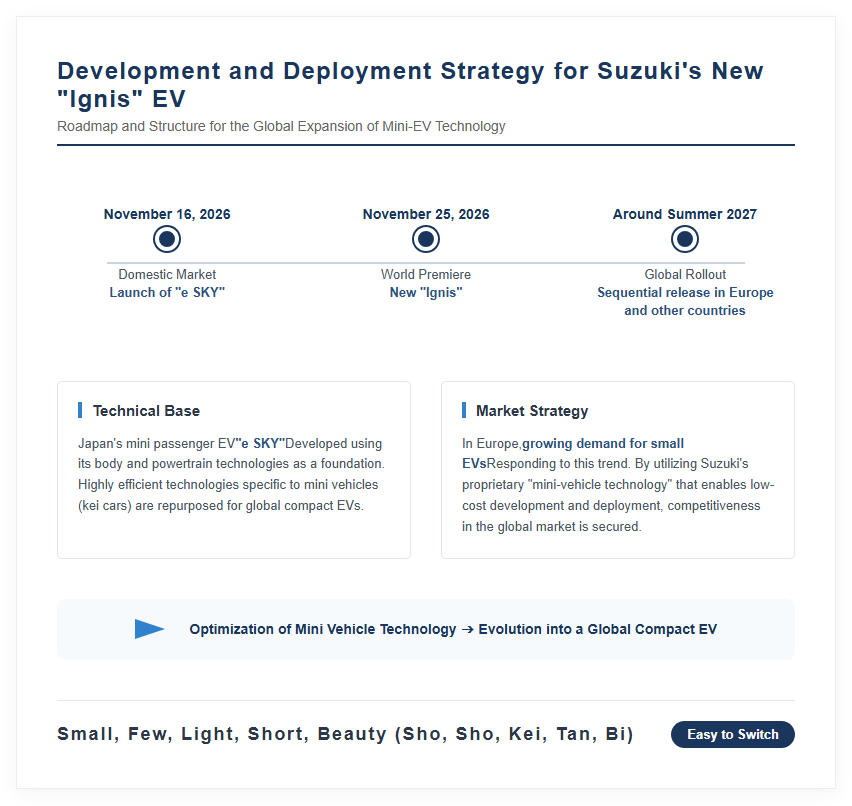
The main basic specifications and rollout schedule are as follows.
- World Premiere Date: November 25, 2026
- European Launch Schedule: Sequential rollout starting around summer 2027
- Production Site: Kosai Plant in Kosai City, Shizuoka Prefecture (Production expected to begin during fiscal year 2026)
- Design Keywords: “Smart,” “Iconic,” “Cozy”
Driving and Maneuverability Performance Realized by “HEARTECT-e” and eAxle
The new Ignis adopts the “HEARTECT-e” EV-dedicated platform. By efficiently arranging the drive battery under the floor, a lightweight yet high-rigidity body structure was achieved. Furthermore, it is equipped with a powertrain that combines the “eAxle”—a lightweight, compact unit integrating a newly developed motor, inverter, and reduction gear—with a lithium iron phosphate (LFP) battery that offers excellent safety and long life.
The vehicle features an EV-specific suspension and ensures excellent maneuverability with a minimum turning radius of 4.5m. Although this is slightly larger than the 4.4m minimum turning radius of the Japanese “e SKY” mini EV it is based on, it maintains high convenience for city driving. Additionally, it is equipped with regenerative coordinated braking, an electric brake booster, and “Easy Drive” pedals to enable a natural pedal feel.
Extensive driving tests were conducted on urban streets and winding roads in various countries, including Europe, to optimize the control systems and suspension for local environments. The main technical elements are as follows:
- Platform: EV-dedicated “HEARTECT-e”
- Battery Type: Lithium iron phosphate (LFP) battery
- Maneuverability: 4.5m minimum turning radius
- Braking System: Regenerative coordinated brake, electric brake booster
Tailwinds from Structural Changes and Regulatory Trends in the European EV Market
Background of the Slump in Heavyweight EVs and the Creation of the New EU Category “M1E”
For a long time, the European EV market has been dominated by high-priced, heavyweight models, primarily large SUVs equipped with high-capacity batteries. However, heavyweight EVs—which rely heavily on infrastructure and have high vehicle prices—have hit a wall in terms of widespread adoption among general consumers, leading the market to reach a plateau. Against this backdrop, major European manufacturers such as Volkswagen and Renault have been forced to shift their focus toward small, affordable EVs.
In response to these market changes, the EU (European Union) solidified its policy in December 2025 to create a new small EV category, “M1E,” within its vehicle classifications. The M1E category targets small EVs with a total length of 4.2m or less and is a system designed to support cost reduction and widespread adoption by relaxing technical requirements. The European Commission has revealed that it referred to the rationality of Japanese kei car standards when designing this system.
Its compatibility with urban environments, as shown in the image below, is attracting attention.
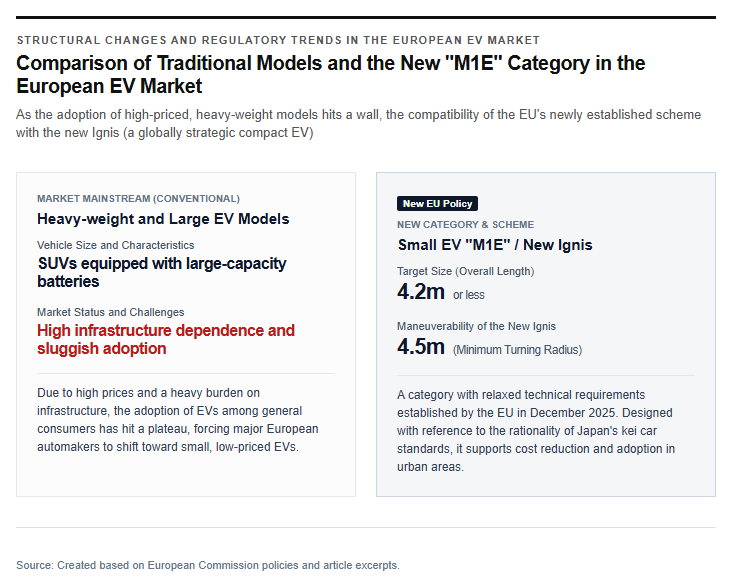
The main background factors in the European market are as follows:
- Challenges of Conventional EVs: Stagnating demand due to increasing size and price
- EU Policy Shift: Decision to create the “M1E” small EV category in December 2025
- Reference Standard: Set with reference to Japanese kei car standards (total length $\le$ 3.4m, total width $\le$ 1.48m)
Germany’s Defiance and the European Situation Surrounding the Review of Decarbonization Regulations
While the European Commission has maintained a policy to completely ban the sale of new internal combustion engine (ICE) vehicles by 2035, voices from the European automotive industry—currently facing severe restructuring and deteriorating business performance—are growing stronger in calling for a review of these regulations.
In September 2025, German Chancellor Merz expressed his intention to strongly urge EU member states and the European Commission to withdraw the policy banning the sale of new internal combustion engine (ICE) vehicles. This move comes against the backdrop of German giants such as Volkswagen, Mercedes-Benz, and BMW being forced into factory shutdowns and personnel reductions due to sluggish EV sales. The EU was also forced to shift its policy by announcing an action plan in March 2025, which included relaxing CO2 emission regulations for new vehicles and permitting the sale of vehicles using synthetic fuels (e-fuels) after 2035.
These political and economic shifts in Europe are reflected in the following elements:
- German Government Trends: Chancellor Merz demands withdrawal of the 2035 internal combustion engine ban
- Crisis in the European Auto Industry: Factory production adjustments and personnel reductions due to sluggish sales
- EU Deregulation: Shift toward a policy of continued permission for synthetic fuel-powered engines
Suzuki’s “Low-Investment Strategy” and Future Global Outlook
Utilization of existing lines and thorough cost reduction through “Small, Few, Light, Short, and Beautiful”
While major automakers and Chinese manufacturers are investing massive amounts of capital to build dedicated factories, Suzuki is pursuing a unique low-investment strategy to expand globally with minimal investment. For the new Ignis, there are plans to utilize existing lines at the Kosai Plant in Shizuoka Prefecture, Japan, for integrated production alongside domestic models, rather than constructing new overseas factories.
Furthermore, based on the “Small, Few, Light, Short, and Beautiful” philosophy cultivated over years of kei car development, Suzuki is adopting an approach to improve energy efficiency by lightening the vehicle body instead of installing excessive battery capacity. Additionally, through collaboration with Toyota Motor Corporation and Daihatsu Motor Co., Ltd., they are proceeding with the joint development of EV units and platforms to distribute development costs and reduce manufacturing expenses.
The strengths of Suzuki’s low-investment strategy are as follows:
- Production System: Integrated domestic production utilizing existing equipment at the Kosai Plant in Shizuoka Prefecture
- Design Philosophy: Thorough lightweighting and cost reduction through “Small, Few, Light, Short, and Beautiful”
- Industry Collaboration: Joint technological development in the electrification field with Toyota and Daihatsu
Price Competition with Chinese Manufacturers and Future Points of Interest in the European Market
The biggest competitors in the European market are Chinese companies like BYD, which are launching aggressive low-price offensives using in-house battery production and economies of scale as weapons. While the EU has implemented additional tariffs of up to 38.1% on Chinese-made EVs, Chinese manufacturers are moving to circumvent these tariffs by building local factories.
There are observations that the new Ignis will be launched in the UK at a price point below £20,000 (approximately 4 million yen), but official vehicle pricing, range, power output, and other specifications have not yet been announced. As the launch approaches in the summer of 2027 in Europe, the key focus will be on compliance with safety standards (Euro NCAP), maintaining competitiveness at local retail prices, and the extent to which EU M1E preferential measures will apply to vehicles produced in Japan. All eyes are on Suzuki’s challenge to redefine kei car technology for the global market.
The main points to watch moving forward are as follows:
- Price Competition: Battles over retail prices against low-cost EVs from Renault and Chinese manufacturers
- Regulatory Application: The treatment of Japanese-made vehicles under the EU’s M1E standard preferential measures
- Performance Announcements: Disclosure of battery capacity and driving range ahead of the summer 2027 launch
Reference Pages
- [Suzuki Motor Corporation News Release] https://www.suzuki.co.jp/release/
- [Suzuki Mobility Concept Vision e-Sky] https://www.suzuki.co.jp/car/entertainment/mobilityshow/2025/vision_e-sky/
- [Toyota Motor Corporation Global Newsroom] https://global.toyota/jp/newsroom/corporate/41769006.html
[#Suzuki #EV #Ignis #EuropeanMarket #AutoNews]


コメント