BP, a major UK oil company, has begun adjustments to withdraw from its offshore wind power project off the coast of Yusa Town, Yamagata Prefecture. This move is driven by a major shift in management strategy, focusing on profitability due to global inflation and rising interest rates, as well as a shift in the company’s focus on profitability and returning investment to the fossil fuel sector.
- Consideration of withdrawal from the Yusa Town offshore project in Yamagata Prefecture
- Decisions on management efficiency improvements due to business integration with JERA
- A return to oil and gas and consideration for investors by the new CEO
- Thorough selection and concentration in low-carbon businesses
- The shock of a series of withdrawal dominoes and soaring costs
- The Need for Institutional Reform and the Disparity with Advanced Overseas Examples
- Residents’ Opposition Movement and Concerns for Environmental Protection
- The Future of Rebuilding the Business Environment Through Public-Private Collaboration
Consideration of withdrawal from the Yusa Town offshore project in Yamagata Prefecture
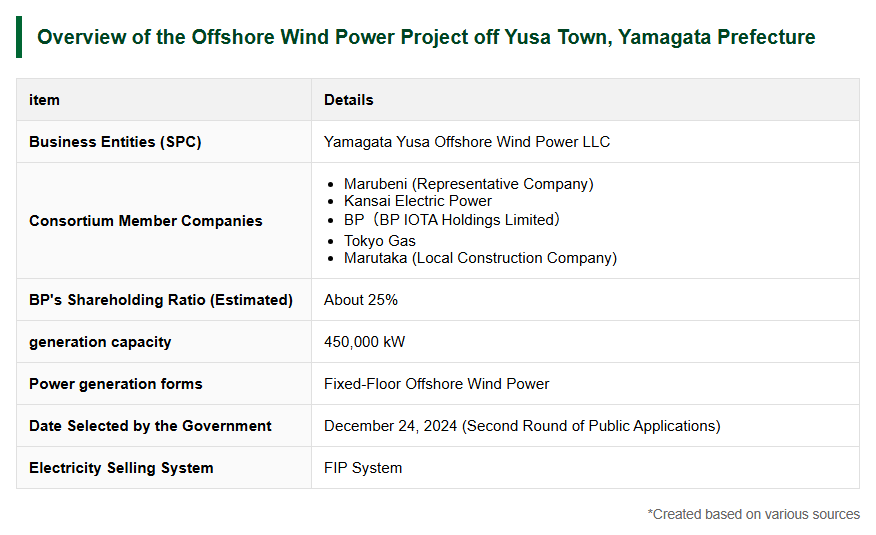
On July 5, 2026, it was revealed that BP, a major British oil company, had begun discussions with a participating business consortium to withdraw from offshore wind power projects off the coast of Yusa Town, Yamagata Prefecture. This project is led by the general trading company Marubeni, with Kansai Electric Power, Tokyo Gas, and local construction company Marutaka as the operating body, including ‘Yamagata Yusa Offshore Wind Power LLC.’ BP is one of the major shareholders holding about 25% of this special purpose company (SPC), and has played a key sponsoring role alongside its largest shareholder, Marubeni, and Kansai Electric Power.
The project off Yusa Town, Yamagata Prefecture, was selected in December 2024 through the government’s second round of public recruitment, and plans are made to build and operate a fixed-floor offshore wind power plant with a generation capacity of 450,000 kW. BP itself has commented that “nothing has been decided at this time,” but adjustments are progressing toward Marubeni and other participating companies taking over the shares held by BP. Therefore, the project itself is expected to continue as planned under the hands of the remaining Japanese business consortium, without being canceled. However, the fact that BP, one of the world’s leading energy companies, is considering divesting from its main projects in Japan highlights investors’ concerns about the profitability and attractiveness of the domestic offshore wind market.
Please refer to the diagram below.
Decisions on management efficiency improvements due to business integration with JERA
The consideration of BP’s withdrawal this time is deeply related to the company’s ongoing business restructuring in Japan. In 2025, BP will integrate Japan’s major energy company JERA with the global offshore wind business to establish a new company, “JERA Nex bp.” As a result, other offshore wind projects progressing off the coasts of Aomori and Akita Prefectures have been gradually transferred to this integrated company.
However, regarding the project off Yusa Town, Yamagata Prefecture, BP itself had been involved in winning the bid before this business integration took the lead, making smooth transfer to the integrated company difficult. From the BP’s perspective, while the basic strategy is efficient business promotion through JERA Nex bp, the BP may have judged that having the BP handle only the Yamagata project alone would offer little management or strategic benefit. BP has indicated its intention to continue its involvement in Japan’s offshore wind market through JERA Nex bp, and this decision does not mean a complete withdrawal from the Japanese market. That said, the stricter investment decisions on a project-based basis suggest the difficulty of attracting foreign capital in Japan’s future energy policy.
Redefining the energy transition faced by major oil companies
A return to oil and gas and consideration for investors by the new CEO
The background to BP’s withdrawal from the Yamagata project is the company’s fundamental strategic shift in response to changes in the global energy situation. Murray Auchincross, who took office in January 2024, announced a major overhaul of the “rapid decarbonization” path previously pursued by his predecessor Bernard Rooney. While fossil fuel prices have soared and profits surged following recovery from the COVID-19 pandemic and Russia’s invasion of Ukraine, profitability in the renewable energy sector has declined due to inflation and rising costs. In response to this situation, BP’s stock price has been sluggish compared to its competitors, and investors have increasingly called for a focus on oil and gas businesses with potential short-term returns.
The CEO of Auchincross has promised a shift from the previous “idealistic” shift to a “pragmatic” approach, pausing investments in new offshore wind projects and introducing job freezes. In 2023, the company invested $2.5 billion of its total $16 billion in capital expenditures, including renewable energy, hydrogen, and electric vehicle (EV) charging, but going forward, it plans to prioritize investments in oil and gas assets with existing strengths, such as the Gulf of Mexico and the U.S. shale gas basin. The consideration of withdrawing from Yamagata can be seen as part of structural reforms aimed at streamlining these “large-scale low-carbon projects that take time to generate cash” and meeting shareholder expectations.
Thorough selection and concentration in low-carbon businesses
BP is not abandoning all low-carbon businesses; instead, it is focusing on areas where short-term returns are expected. For example, in June 2024, it agreed to invest $1.4 billion to acquire all shares of BP Bunge Bioenergia, a Brazilian sugar and ethanol joint venture. While continuing to invest in relatively fast-yielding businesses such as biofuels, investment decisions are being made with extreme caution regarding offshore wind power, which requires substantial capital and several years of construction time.
BP has also set a goal to achieve $2 billion in cost reductions by the end of 2026 compared to 2023, while also working on downsizing its executive team and streamlining its organization. In the renewable energy sector as well, there is a movement to reallocate personnel who were previously searching for new projects to projects already in operation, such as offshore wind in the UK and Germany. Such global investment withdrawal and resource concentration have dampened the formation of projects in new markets like Japan, posing a major challenge for renewable energy policies in countries that had relied on the financial and technological capabilities of energy majors.
Structural Challenges of Offshore Wind Power in the Japanese Market
The shock of a series of withdrawal dominoes and soaring costs
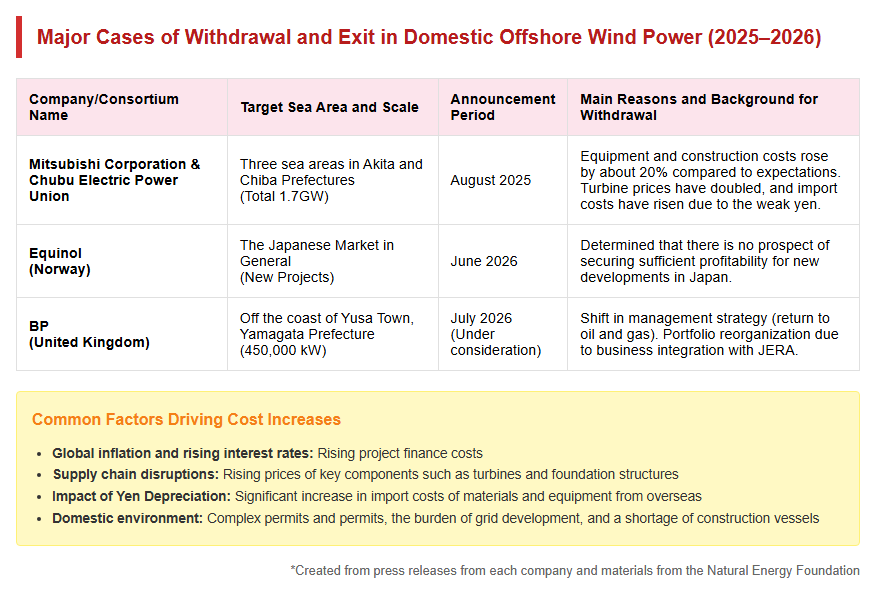
In Japan’s offshore wind industry, major players have been leaving one after another before BP, raising growing concerns about a “domino of withdrawal.” In August 2025, Mitsubishi Corporation and Chubu Electric Power Alliance, which had won the largest offshore wind project in Japan, announced its withdrawal from three offshore areas (totaling 1.7GW) in Akita and Chiba Prefectures, shocking the industry. Following its withdrawal, Mitsubishi Corporation recorded a total impairment loss of approximately 52.4 billion yen by the fiscal year ending March 2025. Furthermore, in June 2026, Norwegian oil giant Equinor also announced its withdrawal from the Japanese market.
The biggest common factor behind these withdrawals is the global surge in material and equipment prices, inflation, and a high interest rate environment. In the case of Mitsubishi Corporation, it has been pointed out that the overall construction cost rose by about 20% from the time of bidding, and turbine prices even doubled. In Japan, where domestic supply chains are not well established, major components must be imported, and the ongoing weakening yen has led to a vicious cycle of further driving up import costs. The fact that cost increases far exceeded initial expectations and the electricity selling prices offered at the time of bidding became unprofitable has led to a wave of global companies leaving.
Please refer to the diagram below.
The Need for Institutional Reform and the Disparity with Advanced Overseas Examples
In response to these circumstances, calls for a fundamental review of Japan’s offshore wind bidding system are rapidly increasing. Overseas, especially among leading offshore wind countries in Europe, rising costs are a common challenge, but each country is responding with agile system changes. For example, in the UK, after no bidders appeared in the 2023 tender, the following year’s tender took the bold step of raising the price ceiling by as much as 66%. As a result, the price has been revised from about 11 yen per kWh to about 19 yen per kWh in Japanese yen. In Denmark as well, when bidding fails, detailed interviews with businesses are conducted, signaling a bold policy to revise the next bidding system.
In contrast, Japan faces many unique barriers, including the complexity and lengthening of its licensing system, the burden of transmission grid construction costs, and even cabotage regulations (restrictions on domestic coastal transport) that cause shortages of construction vessels. Currently, the government is advancing the introduction of the “Central Approach” and expanding development into the Exclusive Economic Zone (EEZ) through the revised “Renewable Energy Sea Area Utilization Act,” but in reality, it has not kept pace with the rapid changes in the business environment. Specialized organizations such as the Renewable Energy Foundation recommend that the withdrawal of Mitsubishi Corporation and BP should not be seen as failures of offshore wind power itself, but rather as an opportunity to enhance the flexibility and effectiveness of the system.
Harmony with Local Communities and Future Energy Policies
Residents’ Opposition Movement and Concerns for Environmental Protection
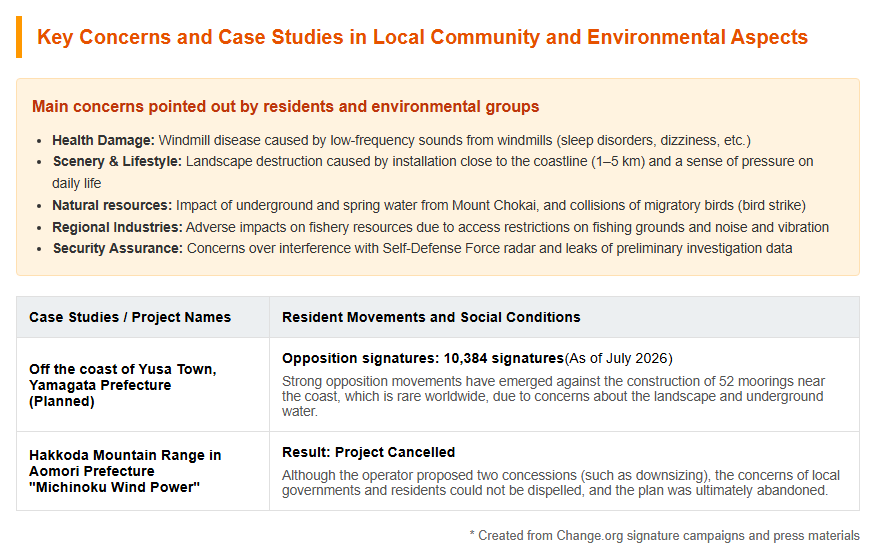
Alongside issues of business profitability, a major challenge in the spread of offshore wind power is building consensus with local residents. In Yusa Town, Yamagata Prefecture, there has been intense opposition to plans to build as many as 52 large wind turbines at a close distance of just 1 to 5 kilometers from the coastline, raising concerns about the impact on the landscape and health. On the online petition site ‘Change.org,’ 10,384 signatures (as of July 2026) have been collected calling for the cancellation of the Yusa Town offshore wind power project, with residents strongly protesting about health damage caused by low-frequency sound called ‘windmill disease,’ underground water from Mt. Chokai, and negative impacts on local fishery resources.
In the past, there have been cases where the “Michinoku Wind Power Project” in Aomori Prefecture was forced to cancel due to strong opposition from local governments and residents. Even at this time, although the business side proposed two concessions, they ultimately could not dispel local anxiety. While renewable energy is often seen as “environmentally friendly,” large-scale civil engineering projects and the installation of massive structures are recognized as potentially damaging local ecosystems and traditional landscapes. Going forward, to establish offshore wind power as Japan’s main power source, it is essential not only to distribute economic benefits but also to sincerely address residents’ concerns, provide thorough explanations based on scientific evidence, and thoroughly implement environmental protection measures.
Please refer to the diagram below.
The Future of Rebuilding the Business Environment Through Public-Private Collaboration
The shocking news of BP’s consideration of withdrawal once again highlighted that Japan’s energy policy is at a critical crossroads. The government positions offshore wind power as a “pillar” for expanding renewable energy and has set an ambitious goal to increase the share of wind power to 4–8% by fiscal year 2040. However, if major players continue to leave, achieving this goal will become extremely difficult. In response, Minister Muto expressed his intention to reorganize the business environment by the end of the year, including reviewing the public recruitment system, and to promptly conduct re-public recruitment in areas where withdrawals occurred.
The future focus will be on whether the government can introduce price adjustment mechanisms that absorb inflation risks and present a roadmap to enhance operators’ foresight. In addition, industrial policies that accelerate the development of domestic supply chains and reduce cost fluctuation risks caused by import dependence are also required. On the other hand, the remaining corporate alliances, such as Marubeni, face the challenge of how to complete projects while enduring increased financial burdens and risks caused by BP’s departure. Offshore wind power is a key technology responsible for improving Japan’s energy self-sufficiency, decarbonization, and creating new industrial infrastructure. We are currently in a phase where the ability of both the public and private sectors to implement this field is being tested in Japan.
[#洋上風力発電 #BP #エネルギー政策 #再生可能エネルギー #日本経済 #ビジネスニュース #丸紅 #山形県遊佐町]


コメント