As a method to dramatically reduce API costs for generative AI, a local proxy tool called “pxpipe” has emerged, which converts text into images for loading. This tool, which exploits the gaps in traditional text-based billing systems, has made a significant impact on the developer community.
- The High Barrier of Operating AI Agents
- The reverse idea of treating text as an “image”
- Demonstrating concrete cost savings of up to 70%
- Operation and implementation details as a local proxy
- The trade-off between compression with loss and maintaining accuracy
- Security Measures and Impact on the AI Ecosystem
The High Barrier of Operating AI Agents
For individual developers using Claude Code, an AI coding tool, or Fable 5, the latest frontier model, pay-as-you-go API charging has become an extremely pressing issue. Especially when AI agents operate autonomously, a large number of system prompts, detailed tool documentation, and an accumulated chat history are sent with each request, causing the input token volume to grow exponentially.
Under these circumstances, on May 20, 2026, the open-source project “pxpipe,” written in TypeScript, was released on GitHub. Led by developer Steven Chong, this project is offered under the MIT license and has attracted significant attention in a short period since its launch. pxpipe functions as a proxy operating locally, parsing massive text data sent from sources like Claude Code. It adopts a highly original approach: extracting the unaltered static ballast parts, converting them into PNG images, and then transferring them to the model.
Please refer to the diagram below.
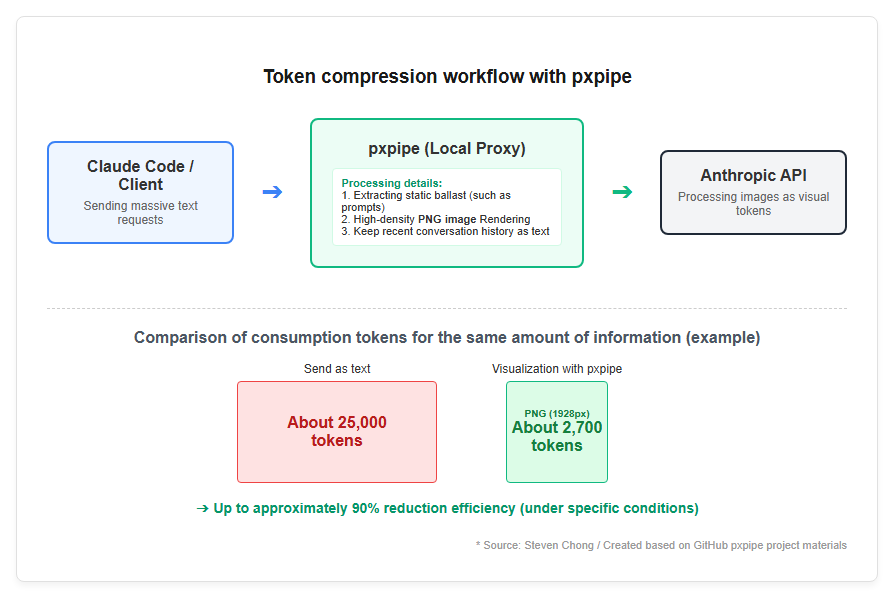
This diagram shows the flow of how pxpipe converts text into dense PNG images and presents them to the model as visual information.
The reverse idea of treating text as an “image”
The reason pxpipe claims to reduce costs lies in the pricing structures set by each AI platform company for image data. On fee plans like Anthropic, text data is charged based on the number of characters (tokens), whereas image data is calculated based on a fixed number of visual tokens based on pixel dimensions. pxpipe leverages this asymmetry by cramming as much text as possible into a single image, maximizing the amount of information per token.
Specifically, text can be typeset into columns 1928 pixels wide, and up to about 92,000 characters can be packed into a single PNG image. If this high-density image is rendered at 1928×1928 pixels, approximately 4,761 visual tokens are consumed. Computationally, it can transmit information about 3.1 to over 19 times more efficiently per token than sending text, which is a major source of cost reduction.
Amazing savings and technical mechanisms
Demonstrating concrete cost savings of up to 70%
The effectiveness of PXPIPE is clearly demonstrated not only in theoretical numbers but also in the difference in billing amounts during actual development sessions. According to publicly released demo data, there was a case where a session performing exactly the same task reduced the cost of $42.21 for standard Claude Code to just $6.06 by going through pxpipe. In this case, the actual cost is calculated to be reduced by more than 85%.
Broader measurements indicate that in actual production load environments, the final bill is declared to decrease by an average of 59% to 70%. The reliability of these figures lies in the method of measurement. PXPIPE not only reduces some input data but also calculates the “total billing amount” as the denominator, including cache read/write and output tokens.
-
A 59% reduction was recorded in 13,709 request snapshots.
-
8,904 compressed request traces measured approximately a 70% reduction.
In this way, pxpipe delivers tangible benefits in high-density content such as code, JSON, and tool output that agents handle daily.
Operation and implementation details as a local proxy
pxpipe resides as a proxy server at the user’s local environment address 127.0.0.1:47821. It intercepts calls to client message sending (/v1/messages) endpoints such as Claude Code and processes them just before forwarding them to Anthropic’s servers. The main elements targeted by processing are the following three elements.
-
Static blocks of system prompts and tool documentation.
-
Tool results such as file loading and log output.
-
Accumulated old chat history.
On the other hand, recent conversational turns and response text from the model are made transparent as text to maintain accuracy and improve responsiveness. The proxy includes a request-based estimator, and for low-density text (such as sparse prose) where imageization would actually increase token consumption, it is smart enough to automatically avoid imageization. Installation itself is simple, requiring no build or complex configuration, and can be launched instantly using the npx command.
Operational Limitations and Future Outlook
The trade-off between compression with loss and maintaining accuracy
An unavoidable aspect of using pxpipe is the fact that the imaging process involves “lossy compression (Rossi).” Since AI models read the provided images using their own visual functions (vision encoders), there is a higher risk of misreading compared to reading text directly. It is particularly weak in handling strings with strict strings such as hash values, IDs, and secret codes, where even a single mistake is not allowed.
According to benchmark results, in tests that returned an accurate 16Hex string, Fable 5 answered correctly 13 out of 15 times, whereas Opus 4.8 scored 0 out of 15 times. Due to this difference in accuracy, pxpipe is designed by default to run on Fable 5 or GPT-5.6, while settings like Opus 4.8, which have weaker visual capabilities, require manual opt-in.
-
If a misreading occurs, the model risks starting a plausible “composition” without producing an error.
-
As a countermeasure, recent turns are always kept as text, and important identifiers are left in the text area.
Thus, balancing convenience and accuracy is key to operational practice.
Security Measures and Impact on the AI Ecosystem
Because of the nature of proxy tools that intervene between API calls, ensuring security and privacy is a top priority. Version 0.8.0, released on July 3, 2026, enhanced security management. By default, the dashboard is bound only to the loopback interface (127.0.0.1), designed to prevent unauthorized access from external networks. Since data passing through pxpipe is plaintext before encryption, developers handling sensitive information must be especially cautious in their environment settings.
Looking ahead, the key focus is on how AI platforms respond. If cost-cutting methods like PXPIPE through imagery become widely adopted, platforms may reconsider how visual tokens are counted and priced. Currently, this saving method is born from the “market distortion” of the price difference between text and images, but whether it remains sustainable depends on each company’s trends. Developers will need to build flexible workflows to prepare for API specification changes while enjoying current price advantages.


コメント