
Seven volunteer countries on OPEC Plus have agreed to continue increasing production by 188,000 barrels per day through August 2026. This is driven by expectations for supply normalization following the resumption of navigation through the Strait of Hormuz, and a situation where market interest is shifting from supply shortages to oversupply.
- Specific Decisions and Participating Countries for August Production Increase
- Steps toward completing the phased downsizing plan
- Recovery of navigation and normalization of logistics in the Strait of Hormuz
- Sharp Drop in Crude Oil Prices and Shifting Market Sentiment
- UAE Withdrawal and Iraq’s Demand to Expand Production Quotas
- Fiscal Equilibrium The Difficulties of Oil-Producing Countries Over Oil Prices
- Supply-Demand Balance and Adjustment Valve for the Second Half of 2026
- Unstable Ceasefire and Risk of Renewed Middle East Tensions
Specific Decisions and Participating Countries for August Production Increase
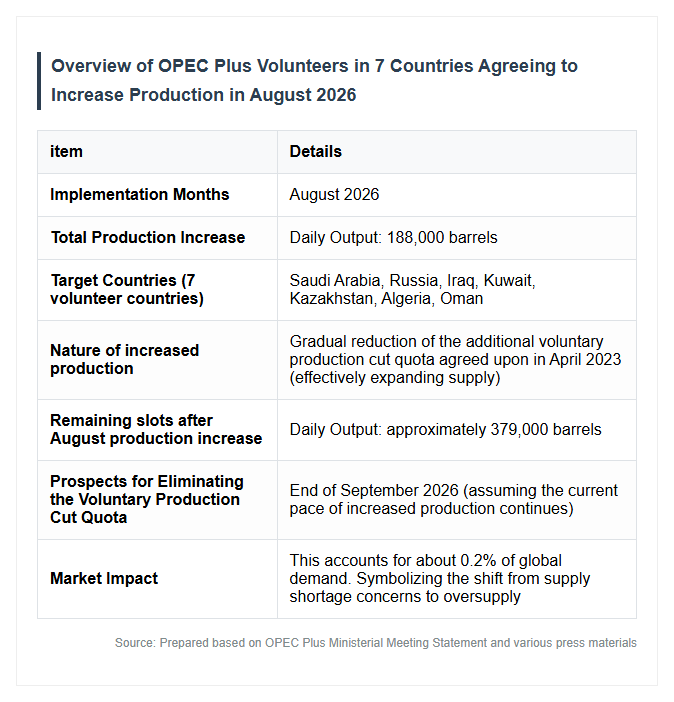
On July 5, 2026, seven volunteer countries of OPEC Plus—composed of OPEC and non-member oil-producing countries such as Russia—held a ministerial meeting online. At this meeting, it was officially decided to increase the production quota for August 2026 by a total of 188,000 barrels per day. The participation in this increase is limited to seven countries: Saudi Arabia, Russia, Iraq, Kuwait, Kazakhstan, Algeria, and Oman, while the current production quotas are expected to remain unchanged for other member countries. This production increase will be at the same level as those implemented in June and July 2026, and approximately 0.2% of global oil demand will be newly added to the market. In the statement, the volunteer countries reaffirmed their commitment to “prioritizing market stability,” emphasizing their policy of gradually expanding supply while carefully assessing geopolitical risks and demand trends. Market participants analyze that this decision aims to meet demand by increasing inventory during the summer demand period while avoiding sudden price fluctuations. Please refer to the diagram below.
Steps toward completing the phased downsizing plan
This August production increase signifies the continuation of the phased voluntary production reduction (effectively increased production) policy that began in April 2026. The seven volunteer countries have been gradually returning supply to the market by monthly expansion of the quota for an additional voluntary production cut of 1.65 million barrels per day, agreed upon in April 2023 (about 1.5 million barrels after the UAE’s exit in May 2026). As of July 2026, the remaining production cut quota stands at approximately 567,000 barrels, and if the agreed August and September increases continue at a pace of 188,000 barrels per month, the voluntary production cut quota for 2023 will be completely eliminated by the end of September 2026. This roadmap was originally designed as a normalization process following significant production cuts in 2023, but internal frictions such as the withdrawal of the United Arab Emirates (UAE), a core member, and Iraq’s demands to increase production have complicated its implementation. Nevertheless, the fact that this agreement has shown OPEC Plus maintains its cooperative framework and prioritizes supply normalization sends a strong message to the market.
Dramatic changes in market environment and impact on prices
Recovery of navigation and normalization of logistics in the Strait of Hormuz
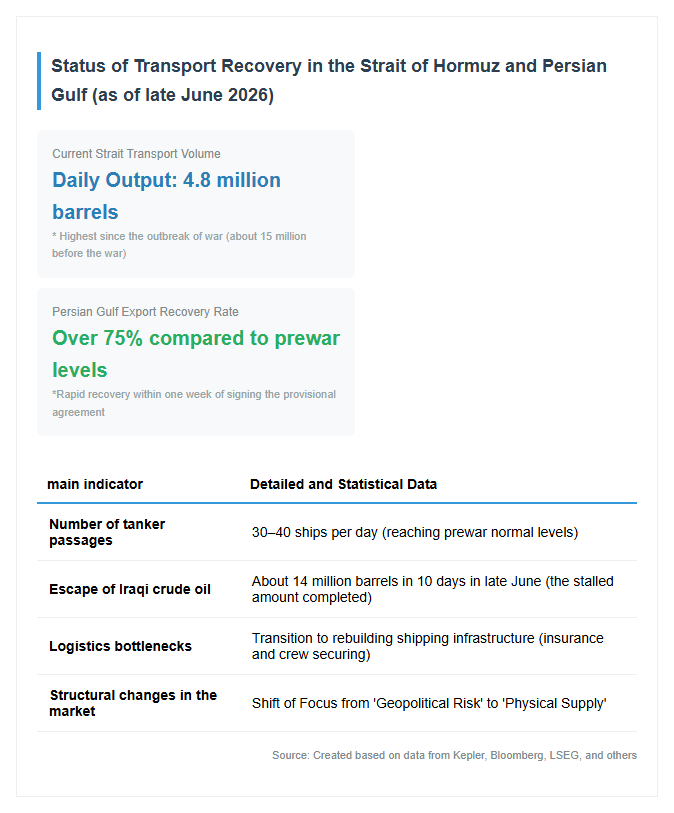
The biggest factor that dramatically shifted the supply-demand balance in the crude oil market is the recovery of transport volumes in the Strait of Hormuz at a pace faster than expected. Although the strait was temporarily blockaded at the end of February 2026 due to worsening conditions in Iran, reports from June 24 to 25, 2026, show that daily transport volume increased to about 4.8 million barrels, the highest level since the start of hostilities. Looking at overall crude oil exports from the Persian Gulf, recovery has progressed to at least 75% of prewar levels, and the daily number of tanker ships passing has reached 30–40 vessels, close to the usual prewar levels. In particular, the news that about 14 million barrels of Iraqi crude oil, which had been stranded in the gulf due to turmoil in the Strait of Hormuz, departed within ten days in late June 2026 was a decisive blow that dispelled concerns about supply shortages. While strait blockades, once considered a low-frequency tail risk, are now being priced into the market as a “risk that is becoming normalized,” the acceleration of physical oil outflows has rapidly shifted market attention from “unreachable crude oil” to “overflowing crude oil.” Please refer to the diagram below.
Sharp Drop in Crude Oil Prices and Shifting Market Sentiment
Against the backdrop of supply normalization, crude oil futures prices are on a noticeable downward trend. On June 26, 2026, WTI crude oil futures in the New York market closed at $69.23 per barrel, marking the first time since February 27, 2026, the day before the outbreak of the Iran War, that it fell below $70. This means that the premium associated with geopolitical risks has almost completely disappeared from the market. In the market, a structure called “contango,” where near-term prices fall below future, indicating a loosening in supply and demand, is intensifying short-term oversupply. In response, financial giant Morgan Stanley significantly revised its forecast for Brent crude oil prices in the third quarter of 2026 from the previous $90 per barrel to $75. Additionally, the company has newly indicated a global supply and demand surplus of 4.8 million barrels per day in 2027. In the U.S., gasoline retail prices, which briefly surpassed $4 per gallon, have fallen back to the low $3 range as supply concerns ease, signaling expectations for a global easing of inflationary pressures.
Structural Pressure and Internal Situations Among Oil-Producing Countries
UAE Withdrawal and Iraq’s Demand to Expand Production Quotas
The unity of OPEC Plus faces serious challenges due to differences in intentions among member countries. The biggest shock was the United Arab Emirates (UAE) leaving OPEC effective May 1, 2026. The UAE has chosen to break free from group production restrictions in order to conduct exports that reflect its own high production capacity. Furthermore, Iraq is strongly calling for a review of its current production quotas, given its severe financial situation and recovery needs. On June 25, 2026, the Iraqi Ministry of Oil officially denied reports of an exit from OPEC, but continued to advocate for a reassessment of production caps in a way that reflects the sustainable production capacity of member countries. Iraq’s crude oil exports account for about 90% of its revenue, and due to production and export constraints caused by the war, Iraq experienced a revenue decrease of approximately $5.5 billion in March 2026 alone compared to the same month last year. Such dissatisfaction poses a risk to undermining organizational cohesion and making it increasingly difficult to maintain Saudi-led production discipline.
Fiscal Equilibrium The Difficulties of Oil-Producing Countries Over Oil Prices
What oil-producing countries face is the structural pressure to “protect revenue by volume,” forcing them to increase volume to maintain revenue during falling prices. According to estimates by the International Monetary Fund (IMF), Iraq’s fiscal equilibrium oil price (the price of crude oil needed to cover the budget) in 2024 is $84 per barrel, which represents a significant deficit at the current level of around $70. Saudi Arabia and Kuwait also require high prices ranging from $80 to $100, and current price levels pose a significant threat to their national finances. Ironically, every time OPEC Plus announces increased production, oversupply speculation spreads in the market, putting further downward pressure on prices. When prices fall, countries with tight finances are more motivated to release more crude oil to the market to secure revenue targets. This synthetic fallacy that “individual rational actions harm overall interests” is currently OPEC Plus’s biggest dilemma, making discussions about production policies after August difficult.
Future Outlook and Key Points to Watch
Supply-Demand Balance and Adjustment Valve for the Second Half of 2026
In shaping the crude oil market in the second half of 2026, several other important factors are unfolding simultaneously besides the OPEC positive trend. One is the coordinated release of the Strategic Petroleum Reserve (SPR), led by the International Energy Agency (IEA). The global SPR releases, which were around 2.5 million barrels per day in April–June, are expected to be significantly reduced to 700,000 barrels per day in July–August, following supply recovery. Going forward, conversely, additional demand to restock, which has released reserves, may be recognized as a price support factor. Additionally, U.S. monetary and energy policies are key. President Trump’s intentions ahead of the November 2026 U.S. midterm elections, along with additional production demands aimed at controlling prices, are expected to shake the market. On the supply side, major U.S. energy companies, which are non-member countries, continue to refuse short-term production increases in favor of shareholder returns, which remains a source of medium- to long-term supply shortages.
Unstable Ceasefire and Risk of Renewed Middle East Tensions
Finally, the most uncertain factor remains the outlook for the Middle East situation. The memorandum signed by the United States and Iran on June 18, 2026, is merely a prerequisite for starting negotiations toward a final agreement (permanent end of hostilities) and does not guarantee a complete end to the fighting. Negotiation hurdles are extremely high, including nuclear development issues, lifting frozen assets, and the possibility that the Iranian Revolutionary Guard might impose tolls on the Strait of Hormuz in the future. In fact, even after the signing, exchanges of attacks have been observed around the Strait of Hormuz, and if military tensions rise again, the current optimistic scenario of ‘oversupply’ could collapse in an instant. Although the market is experiencing a shedding of geopolitical risk premiums, experts point out that a complete return to a ‘safe Strait of Hormuz’ is not expected for the time being, and rising transportation costs and persistent surges in insurance premiums will continue to support crude oil prices in the long term. Traders and investors need to closely monitor the reality of supply recovery while continuing to prepare for sudden price rebounds caused by geopolitical clashes.
[#原油市場 #OPECプラス #中東情勢 #経済ニュース #ホルムズ海峡 #エネルギー政策]
コメント