
Sony Bank announced the establishment of a trust subsidiary in the United States to issue and manage US dollar-pegged stablecoins. Behind this is a strategy to support Sony Group’s vast entertainment economy with digital financial infrastructure and dramatically improve payment efficiency in the global market.
- Establishment of a U.S. subsidiary and obtaining conditional approval
- The significance of entering the massive dollar-denominated stablecoin market
- Building Payment Infrastructure in the Sony Economic Zone
- Technological Infrastructure and Scalability to Web3 Finance
- Regulatory Authority (OCC) Review and Opposition from Industry Groups
- Future Schedule and Dual Domestic and International Strategies
Establishment of a U.S. subsidiary and obtaining conditional approval
On July 6, 2026, Sony Financial Group announced that its subsidiary, Sony Bank, will establish a new wholly owned subsidiary, Connectia Trust, National Association, in New York State, USA. In October 2025, the company applied to the U.S. Office of the Comptroller of the Currency (OCC) for a national trust bank license, and as of July 2026, it has obtained “conditional approval” in the OCC’s review process. The headquarters is planned to be located at 25 Madison Avenue in New York. This new company operates as a “special purpose bank” that does not require deposit acceptance or FDIC (Federal Deposit Insurance Corporation) insurance, and its main tasks include issuing US dollar-pegged stablecoins, managing reserve assets, and providing custody services for digital assets. Sony Bank has been exploring the use of blockchain technology, such as starting in April 2024 by considering proof-of-concept experiments using Polygon PoS, but with the establishment of this subsidiary, it marks a major shift from the demonstration stage to full-scale commercialization.
The significance of entering the massive dollar-denominated stablecoin market
Sony Bank’s decision to base itself in the U.S. rather than Japan is due to the overwhelming dominance of the US dollar in the stablecoin market. As of February 2026, the global stablecoin market capitalization exceeds $310 billion (about 48 trillion yen), with Tether (USDT) accounting for about $183.6 billion and USDC about $75.3 billion, making up 83% of the market for the top two coins alone. All of these are pegged to the US dollar and serve as the base currency for digital asset trading and cross-border settlements. Sony Bank’s proprietary stablecoin is also intended to provide direct access to this massive dollar-denominated economic sphere. The chart below illustrates the share of major currencies in the global stablecoin market and the market size Sony Bank is targeting.
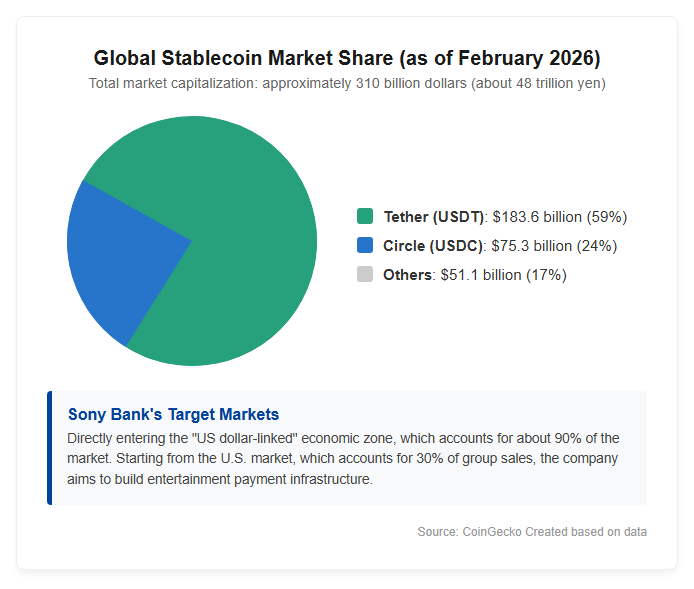
Additionally, in the United States, the GENIUS Act, which sets the regulatory framework for stablecoins in July 2025, will be enforced, and the ability to operate in a legally established environment is another factor that supported the U.S. entry at this timing.
Strategic Background: Vertical Integration of Entertainment × Finance
Building Payment Infrastructure in the Sony Economic Zone
The first use case for stablecoins issued by the new company is their use as payment methods in Sony Group’s entertainment business, including games, anime, and movies. Currently, subscription payments for digital content like PlayStation are mainly made by credit card, but by introducing stablecoin payments, it becomes possible to significantly reduce the payment fees paid to card companies. The U.S. market is a key hub, accounting for over 30% of the Sony Group’s total sales, and reducing settlement costs here directly leads to improved profit margins for the entire group. Additionally, stablecoins can settle instantly 24/7, 365 days a year, offering the advantages of “programmable money,” such as cross-border fund transfers and quick payment of rewards to creators. Sony Bank aims to provide “sensibility value,” a unique financial experience that cannot be replicated by other banks, by combining the reliability cultivated through traditional banking operations such as mortgages and foreign currency transactions with the diverse IP (intellectual property) of the Sony Group.
Technological Infrastructure and Scalability to Web3 Finance
Sony Bank’s stablecoin strategy goes beyond simply providing payment methods, aiming to build next-generation financial infrastructure in the Web3 era. On the technical side, we are considering adopting “Polygon PoS,” which enables low-cost, high-speed processing, and introducing highly anonymous identity verification technologies using zero-knowledge proofs (ZKP). Additionally, through a business partnership with Bastion Platforms, a US-based stablecoin infrastructure provider, we have established a robust system foundation compliant with regulations. Sony Group has already launched “Soneium,” an Ethereum layer 2 network, and by having its proprietary stablecoin function as a payment currency on this network, NFT buying and selling and transactions on decentralized applications (dApps) can be conducted seamlessly. Furthermore, through the smartphone app “Sony Bank CONNECT,” it offers convenience to users, especially younger generations, without making them conscious of Web3 technology, aiming to expand its future customer base. The diagram below is a conceptual diagram showing how each of Sony Group’s services and financial infrastructure will be connected.
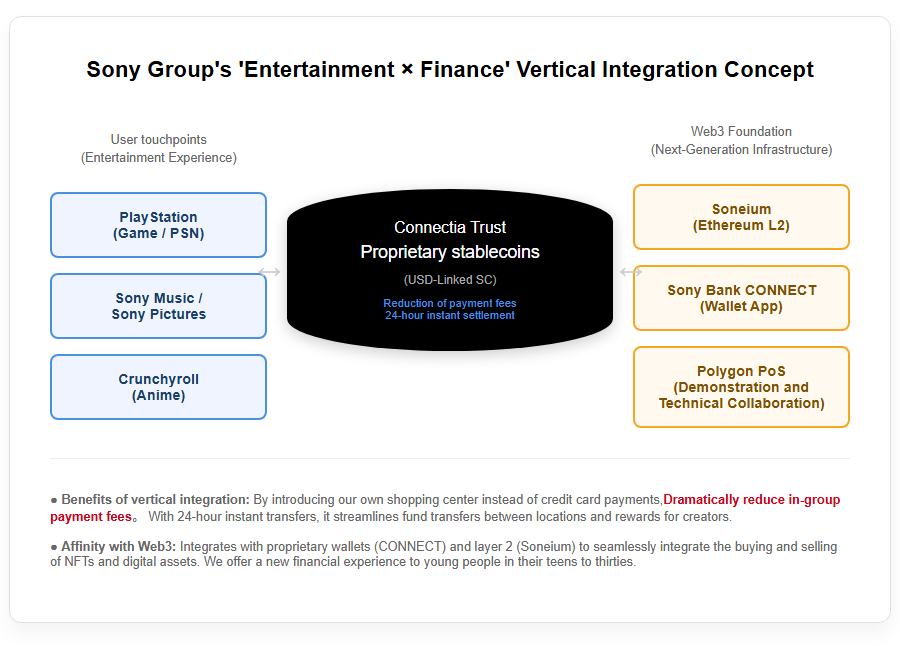
Future developments and how to engage with regulators
Regulatory Authority (OCC) Review and Opposition from Industry Groups
To start a business in the United States, you must pass the strict screening by the OCC. The “conditional approval” obtained by Sony Bank means that final system audits and compliance confirmation remain pending. On the other hand, industry groups within the U.S. are also expressing concern about this development. The National Association of Independent Banks (ICBA) submitted a statement of opposition to Sony Bank’s application in November 2025. ICBA points out that the Sony Group, as a commercial enterprise, may undermine the “principle of separation of commerce and banking” if it has a banking subsidiary, and that offering deposit-like services without FDIC insurance could cause consumer confusion. There has also been criticism for insufficient disclosure of information such as stablecoin issuance volume, details of reserve assets, and redemption methods. How Sony Bank ensures transparency in addressing these concerns and advances dialogue with regulators will be the top focus for launching operations within fiscal year 2026.
Future Schedule and Dual Domestic and International Strategies
Sony Bank plans to begin issuing US dollar-denominated stablecoins within fiscal year 2026, following the establishment of a U.S. subsidiary. While the impact of this business on performance for the fiscal year ending March 2027 is considered minimal, it is expected to serve as the foundation for the group’s overall digital asset business in the medium to long term. What’s interesting is that they are paralleling different strategies both within Japan and overseas. Domestically, we have partnered with fintech company JPYC Corporation to promote the use of Japanese yen-denominated stablecoins in compliance with the revised Payment Services Act. In other words, domestically, we are pursuing a dual global strategy: strengthening the ‘Japanese yen economic zone’ in collaboration with existing leading players, and directly entering the ‘US dollar economic zone’ overseas through our own brand of trust banking. Once this vertically integrated payment platform is completed, Sony will strengthen its role as a payment infrastructure company with functions close to its own currency issuance rights, while still being a content company.
[#ソニー銀行 #ステーブルコイン #Web3 #コネクティアトラスト #デジタル金融 #米国進出 #フィンテック #ソニーFG]


コメント