
On July 7, 2026, Shizuoka Prefecture Governor Yasutomo Suzuki expressed his intention to approve the commencement of construction on the Shizuoka section of the Linear Chuo Shinkansen. With the long-standing biggest barrier in the plan, the new section taking action marks a historic turning point for the national project of the Linear Chuo Shinkansen, which aims for a new opening.
- Governor Suzuki’s Political Judgment and Succession from the Previous Governor
- Completion of 28 dialogues and full details of environmental conservation measures
- A 10-year construction period equation and scenarios for opening in 2036
- Total construction costs ballooned to 11 trillion yen and impact on management
- Transforming the industrial structure to integrate the three major metropolitan areas
- Repeated construction delays and residents’ understanding outside Shizuoka
Governor Suzuki’s Political Judgment and Succession from the Previous Governor
On July 7, 2026, Governor Yasutomo Suzuki formally expressed his intention to approve the commencement of construction of the Shizuoka section of the Linear Chuo Shinkansen at a plenary meeting of the Shizuoka Prefectural Assembly. Since taking office in 2024, this issue has been considered the most important and weighty issue for the governor. After a briefing session conducted by JR Central for basin residents, it was determined that understanding among local residents has steadily progressed. Governor Suzuki reflected that serious discussions were necessary to balance the issues raised by former Governor Heita Kawakatsu, such as securing water resources and conserving the ecosystem of the Southern Alps, with construction work, and evaluated the previous governor’s raising of these issues as highly significant. With this approval of the commencement of construction, the prefecture will begin final coordination with JR Central toward concluding a “Nature Conservation Agreement” that includes specific environmental conservation measures.
Completion of 28 dialogues and full details of environmental conservation measures
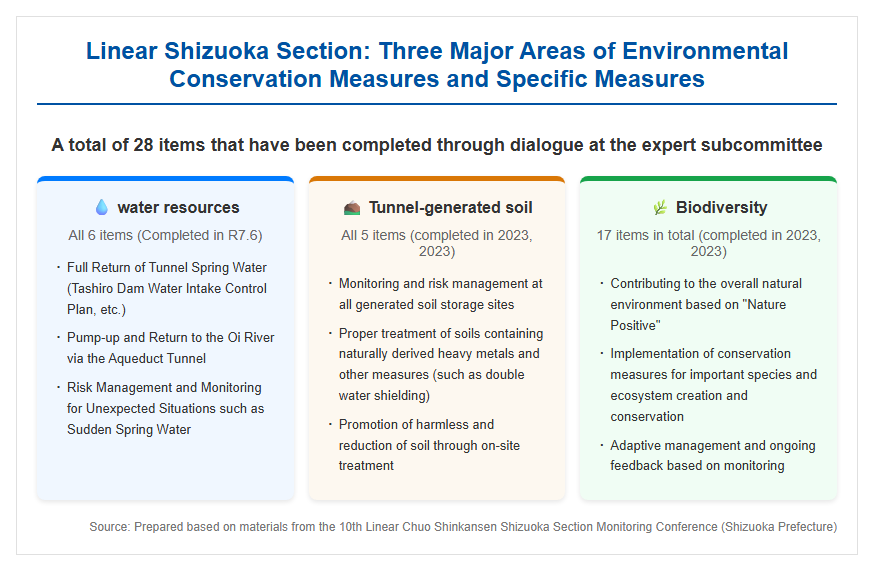
The main basis for approving construction was that the dialogue covering 28 items in three areas—’Water Resources,’ ‘Biodiversity,’ and ‘Tunnel-Generated Soil’—presented by Shizuoka Prefecture—was fully completed at the expert subcommittee meeting on May 15, 2026. Regarding the biggest issue of water resources in the Oi River, agreements have been reached on measures such as the Tashiro Dam water intake restriction plan as a response to the “full volume reversion” of the entire tunnel spring water flow back into the Oi River. Furthermore, JR Central has introduced the concept of “Nature Positive,” which enriches the natural environment of the Southern Alps beyond mere conservation, making it even richer than before construction. As shown in the image below, concrete measures are included to protect the rich water environment and ecosystem of the Southern Alps, such as conservation and monitoring of important species, and proper treatment of soil containing heavy metals.
A realistic roadmap for opening in the mid-2030s
A 10-year construction period equation and scenarios for opening in 2036
With the approval of the Shizuoka section to start construction, the opening date is finally becoming more concrete, but there are physical constraints unique to railway construction. The Minami-Alps Tunnel Shizuoka section stretches about 8.9 km, but it is analyzed that it takes about 1 to 2 years for preparation and yard maintenance, about 6 to 7 years for excavating difficult terrain, and about 2 to 3 years for equipment work and commissioning. Adding these together, it takes about 10 years and 1 month from groundbreaking to opening, and if full-scale preparations begin within 2026, the earliest opening is calculated to be around 2036. JR Central has tentatively set 2035 as the opening date in its management plan estimates, but drilling in the complex Southern Alps is so difficult that it is called a ‘geological museum,’ and the risk of further delays due to unforeseen circumstances remains.
Total construction costs ballooned to 11 trillion yen and impact on management
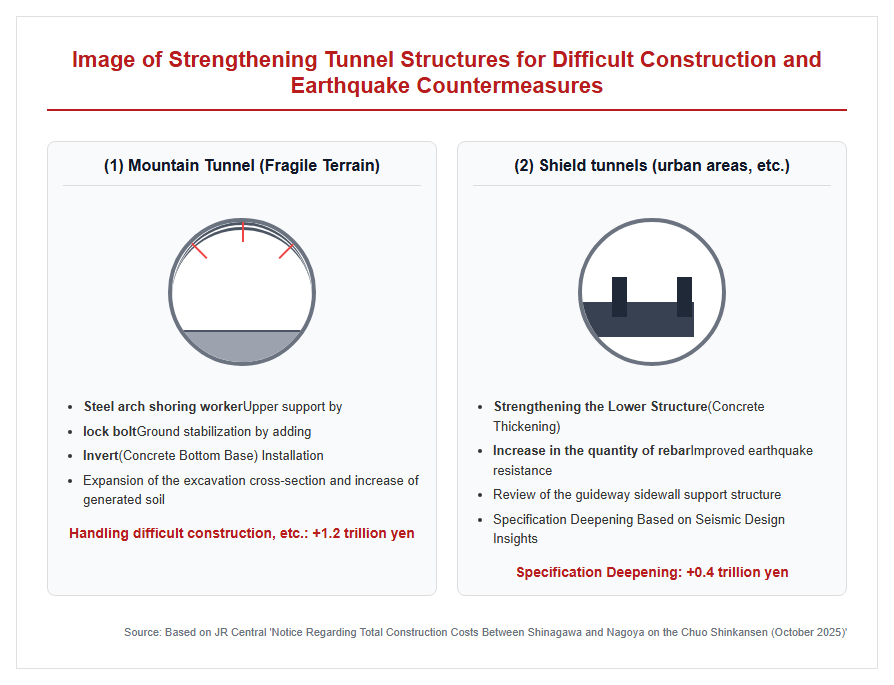
As projects drag on, the cost burden is also becoming more serious. The total construction cost between Shinagawa and Nagoya has increased further from 7.04 trillion yen in 2021, and in a detailed review in October 2025, it was announced that it is projected to swell to 11.0 trillion yen. The approximately 4 trillion yen increase is driven by the recent sharp rise in material and labor costs due to rising inflation (about 2.3 trillion yen), measures for difficult construction such as adapting to fragile mountain tunnels (about 1.2 trillion yen), and deepening specifications to strengthen earthquake preparedness (about 0.4 trillion yen). JR Central plans to secure funds mainly through operating cash flow while maintaining sound management and stable dividends. However, the significant increase in construction costs is a factor that encourages consideration of future freight and rate structures and the creation of flexible price pass-through mechanisms that respond to inflation.
The diagram below illustrates the reinforced tunnel structure to cope with difficult construction projects.
The Birth of the Super Megaregion and the Remaining Challenges
Transforming the industrial structure to integrate the three major metropolitan areas
The completion of the linear will bring about social transformation that goes beyond mere travel time savings. By connecting Tokyo, Nagoya, and Osaka in about one hour, a massive economic zone called the “Super Mega-Region” will be created, with a population of about 65 million and a GDP of about 300 trillion yen. With the connection between Shinagawa and Nagoya taking as little as about 40 minutes, the manufacturing industry in the Chukyo area and the IT and design functions of the city center are closely integrated, and a fast-paced business model of “development in Tokyo, production in Nagoya” is expected to accelerate. Additionally, it is estimated that the entire line will boost the economy by approximately 27 trillion yen over the next 50 years, and it has the potential to dramatically reshape the Japanese lifestyle by popularizing dual-base living around intermediate stations and sharing advanced medical and educational functions over a wide area.
Repeated construction delays and residents’ understanding outside Shizuoka
While the start of construction in the Shizuoka section is in sight, many hurdles remain before the full completion of the Shinagawa-Nagoya section. According to an interview with JR Central, out of the 84 construction zones originally targeted for 2027, 31 will be delayed until after 2027. These issues are also caused by difficulties in land acquisition outside Shizuoka, unexpected troubles during deep underground excavation in urban areas, and concerns from residents over noise and waste disposal. Now that the stagnation in the Shizuoka section has been resolved, managing progress in other sections where construction is delayed and deepening residents’ understanding through careful explanations throughout the line have become the most important issues to ensure the mid-2030s opening.
[#リニア中央新幹線 #静岡県 #鈴木康友 #JR東海 #スーパーメガリージョン #地域経済 #環境保全 #土木工事]


コメント