Shimizu Corporation is promoting large-scale digitalization at the construction site of Japan’s tallest skyscraper, Torch Tower, which employs up to 7,000 workers. Behind this lies the structural challenges of severe labor shortages and stagnant productivity faced by the construction industry.
- 1-1: The full picture of the massive project challenging a height of 390 meters
- 1-2: Why is digitalization of large-scale sites urgent now?
- 2-1: Streamlining Administrative Tasks with ‘Worksites’ and ‘SCC’
- 2-2: Eliminating Communication Blind Spots with ‘Starlink’ and ‘SmartStation’
- 3-1: Patent Opening to Break Free from Individual Site Management and Share “Knowledge”
- 3-2: Next-Generation Construction Production Featuring Autonomous Robots and Takumi Collaboration
1-1: The full picture of the massive project challenging a height of 390 meters
Currently, in the Tokiwabashi district in front of the Nihonbashi exit of JR Tokyo Station, a large-scale mixed-use redevelopment project called “TOKYO TORCH” covering a site area of 3.1 hectares is underway. Shimizu Corporation is responsible for the construction of the core main tower, the Torch Tower. This building boasts a grand scale with 62 floors above ground and 4 basement levels, with a total floor area of approximately 551,000 square meters, and is expected to reach a height of about 390 meters upon completion. This far surpasses the current tallest building in Japan, the Azabudai Hills Mori JP Tower (about 325 meters) and Osaka’s Abeno Harukas (about 300 meters), making it expected to become the tallest in Japan. Construction began in 2023, and the project aims for completion in 2028. The interior is planned to include offices, restaurants, a hotel, and even rental housing. For construction, Shimizu Corporation alone employs 300 people per day, and including partner companies, up to 5,000 to 7,000 people will be involved on site. To safely and smoothly manage sites of such an unprecedented scale, a highly advanced management system that surpasses traditional methods is required.
1-2: Why is digitalization of large-scale sites urgent now?
Behind the construction industry’s rapid digitalization lies a serious structural problem. First, due to the “2024 problem” associated with work style reforms, it has become inevitable to limit working hours and address the shortage of workers. In particular, labor productivity in Japan’s construction industry has been steadily declining since fiscal year 1992, and as of fiscal year 2021, it accounts for only 83% of the manufacturing sector, presenting a harsh reality. One reason for this is the industry-specific custom where management is independent at each site, and past failures or insights are not shared. Additionally, in super-large sites with around 7,000 workers, managing paper-based daily work reports, safety and environmental logs, and work instructions is a significant workload for staff. With a construction period of 60 months, efficient site management through digitalization is extremely important to reduce each individual’s workload and improve productivity. Furthermore, changes in the external environment—such as global inflation, soaring material prices, and price increases due to a weak yen—are also risks that worsen construction profitability, making thorough efficiency improvements using digital technology indispensable as a survival strategy.
A cutting-edge system for controlling construction sites through ‘information’
2-1: Streamlining Administrative Tasks with ‘Worksites’ and ‘SCC’
To centrally manage the vast amount of information generated on site, Shimizu Corporation has introduced the construction management service “WorkSite” provided by MCD3. This promotes the digitization of work daily reports and safety and environmental logs, which were previously done on paper, improving operational efficiency and productivity. Additionally, as a command center to monitor the overall situation on site in real time, a “Smart Control Center (SCC)” has been installed within the site office. Please refer to the diagram below.
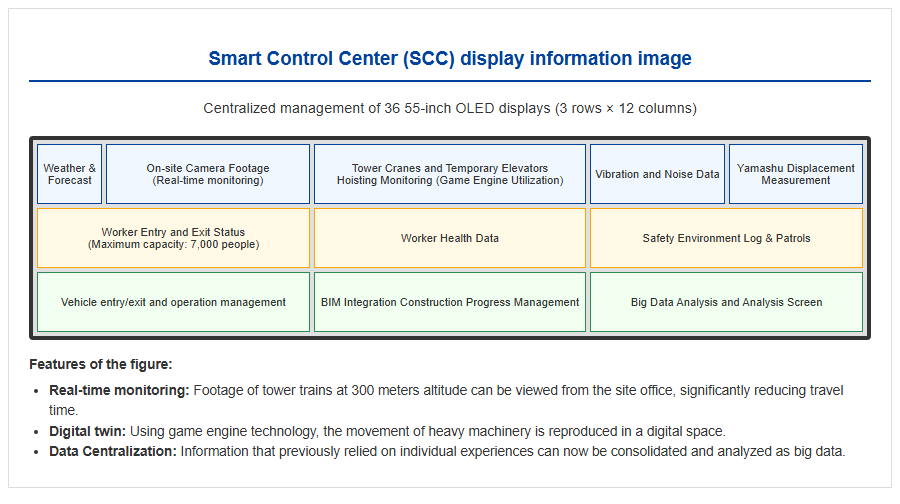
。 This SCC features 36 55-inch OLED displays (3 rows × 12 columns) lined up, consolidating all kinds of information such as workers’ entry and exit status, health status, vehicle operation, on-site camera footage, as well as weather, vibration, and noise data. Particularly noteworthy is the lifting monitoring system that utilizes game engine technology. This allows the movement of tower cranes and temporary elevators to be reproduced in digital space, allowing accurate understanding of material and personnel movement even while in SCC. By analyzing and utilizing this big data, scientific progress management without relying on experience or intuition becomes possible, greatly contributing to reducing travel time and raising safety awareness.
2-2: Eliminating Communication Blind Spots with ‘Starlink’ and ‘SmartStation’
One of the biggest challenges at skyscraper construction sites is securing communication environments on high floors and underground areas where radio waves are difficult to reach. Especially on construction floors over 100 meters high, it is common for mobile networks from the ground to become unstable. To solve this problem, Shimizu Corporation introduced the satellite communication service “Starlink Business.” By installing a dedicated antenna above the tower crane, a high-speed and stable communication environment of up to 220Mbps is achieved, even on ultra-high-rise construction floors. Furthermore, as the foundation of this communication infrastructure, the company has deployed its proprietary next-generation distribution board, the “Smart Station,” on each floor. Please refer to the diagram below.
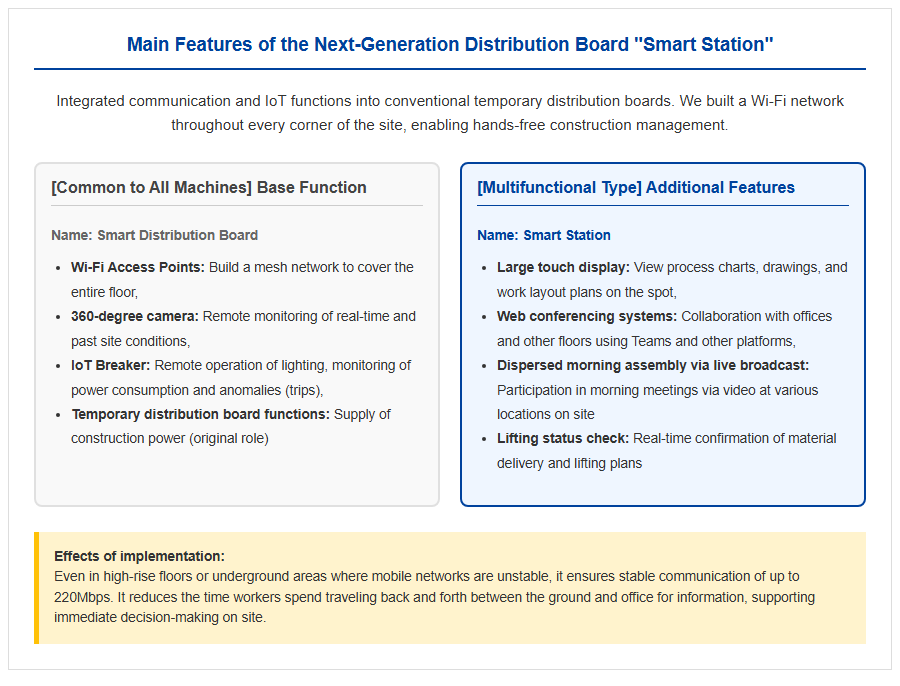
。 In addition to functioning as a distribution board, this device is equipped with Wi-Fi access points and 360-degree cameras, creating a mesh network that covers the entire building. The multifunctional type equipped with a touch panel enables web conferencing, blueprint viewing, and even distributed morning meetings via live broadcast, providing an environment where workers can access necessary information on site even if they come to the site empty-handed.
Open strategies shaping the future of the industry and outlook for 2030
3-1: Patent Opening to Break Free from Individual Site Management and Share “Knowledge”
Shimizu Corporation has launched an innovative ‘open strategy’ aimed not only at its own profits but also at raising the technological foundation of the entire construction industry. In August 2025, it announced that it would open over 200 construction-related patents held by the company to external parties, enabling other companies to use it at a low annual license fee of only 500,000 yen. This is a grand effort to eliminate the inefficiency of “duplicate investment” in similar technologies, which had previously occurred when each company locked in its own unique technologies. Traditionally, developing new seismic and energy-saving technologies required investments ranging from hundreds of millions to several billion yen, but with this patent release, even small and medium-sized construction companies with limited R&D resources will be able to utilize cutting-edge technologies. Shimizu Corporation plans to eventually open 1,000 patents, about half of its patents, aiming to lead a paradigm shift from technological competition to “technical collaboration.” By transforming the experience and know-how that were previously completed at each site into a “shared asset” for the entire industry, the plan is to contribute to improving productivity in Japan’s construction industry and building safer, more resilient social infrastructure.
3-2: Next-Generation Construction Production Featuring Autonomous Robots and Takumi Collaboration
As the ultimate form of digitalization, Shimizu Corporation is advancing the construction of a next-generation building production system that collaborates with autonomous robots and humans under the concept of “Shimz Smart Site.” Please refer to the diagram below.
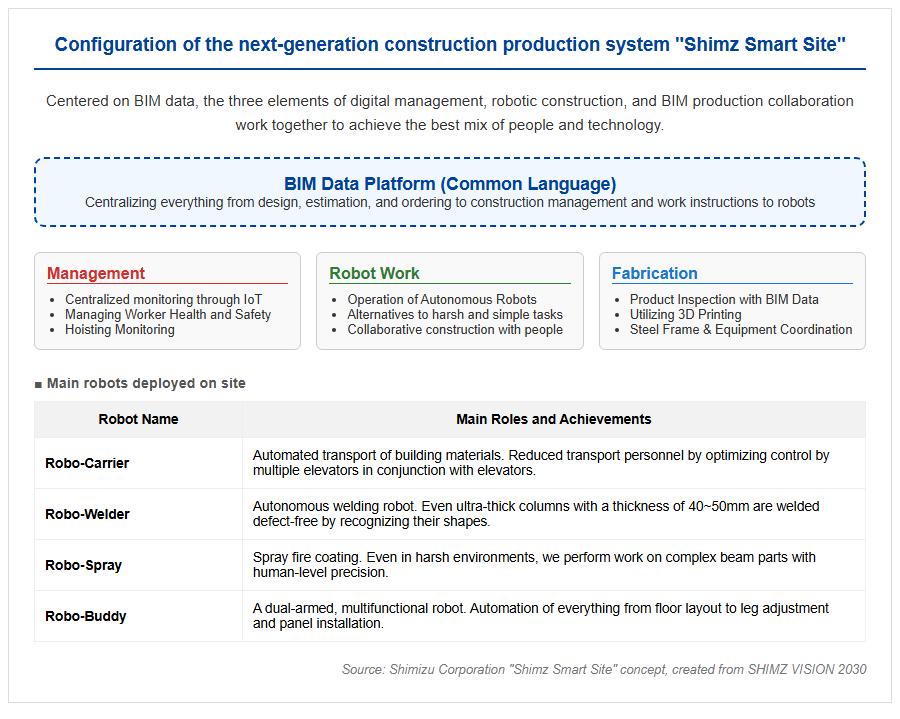
。 On site, tools such as the “Robo-Carrier,” which automatically transports building materials, the “Robo-Welder,” which handles welding tasks requiring skilled skills, and the “Robo-Spray,” which sprays fire-resistant coatings, have been deployed in actual combat. These robots work autonomously based on complex design data, working in conjunction with data platforms centered on BIM (Building Information Modeling). Shimzu Corporation’s long-term vision, “SHIMZ VISION 2030,” aims to evolve into a “smart innovation company” that creates new value beyond the boundaries of the construction business. By complementing craftsmanship with digital technology and having robots take over dangerous and simple tasks, humans will be able to focus more on advanced creativity and quality control. Shimizu Corporation continues its challenge to realize a future society where robots and humans can cooperate as a natural occurrence at construction sites 50 years from now, where everyone can experience wealth and happiness.
[#建設DX #清水建設 #TorchTower #超高層ビル #ロボット施工 #Starlink #2024年問題 #BIM]

コメント