In the May 2026 Economic Sentiment Index, the consensus index, which reflects the current economic situation, rose for three consecutive months, indicating that the underlying sentiment is improving. Behind this are positive factors such as semiconductor and AI-related sectors driving stock prices that hit record highs, as well as improved capital investment willingness.
- Factors behind the coincident index rising for three consecutive months
- Continuous Rise in Leading Indexes and Economic Outlook
- June Business Sentiment Survey by Teikoku Databank
- Manufacturing and Services Driven by AI and Semiconductors
- Benefits of rising interest rates and difficulties related to personal consumption
- Economic improvement in all 10 regions for the first time in three years
- Concerns over high interest rates and rising costs for the first time in 31 years
- Current state of capital investment willingness and labor shortages
- Summer demand and real purchasing power support
- Easing of future uncertainties and lingering negative factors
Factors behind the coincident index rising for three consecutive months
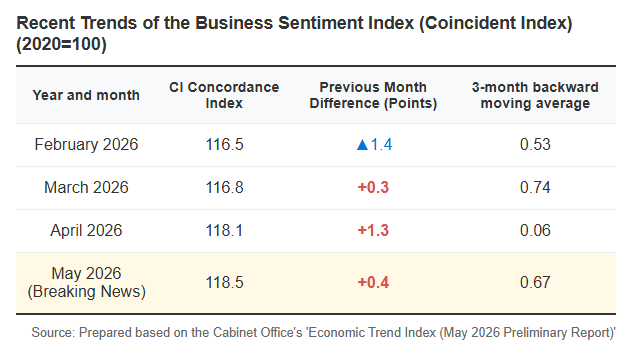
According to the preliminary economic trend index for May 2026, released by the Cabinet Office on July 7, 2026, the coincident index, which indicates the current economic situation, rose by 0.4 points from the previous month to 118.5, marking three consecutive months of improvement. The fundamental judgment, which mechanically applied the index movement, maintained the previous month’s judgment and was described as “showing improvement.” The individual chains that contributed significantly to this rise are as follows.
-
Durable Consumer Goods Shipments Index (Contribution 0.43)
-
Retail by Commercial Sales (0.34 per year)
-
Industrial Goods Shipments Index (0.19)
As shown in the graph below, the concordance index has shown stable movements.
On the other hand, although the investment goods shipment index and effective job openings-to-applicants ratio contributed negatively, combining multiple indicators related to production and employment confirmed an overall economic recovery.
Continuous Rise in Leading Indexes and Economic Outlook
The leading index, which reflects the economy several months ahead, rose 0.7 points month-on-month to 116.8 in May 2026, marking a long period of growth for 12 consecutive months. The 3-month backward moving average increased by 0.83 points, and the 7-month backward moving average increased by 1.09 points, both maintaining long-term positive states. Leading indices include the Tokyo Stock Price Index and real machinery orders, and the continued strength of these indicators suggests that the domestic economy is likely to continue recovering for the foreseeable future. According to the Cabinet Office’s criteria, when the coordinated index is on an upward phase while the leading index continues to improve ahead of others, it is an important signal of the sustainability of economic expansion.
June Business Sentiment Survey by Teikoku Databank
In the June 2026 Economic Trend Survey by Teikoku Databank, published following Cabinet Office statistics, the Economic DI rose by 1.0 points from the previous month to 42.6, marking two consecutive months of improvement. This survey targeted 22,572 companies nationwide and examined the actual state of the domestic economy from a perspective closer to corporate management. In June, demand for IT infrastructure for generative AI and data centers remained resilient, and the Nikkei Stock Average surpassed 70,000 yen, reaching a new high, providing positive news for the financial market. Additionally, expectations of a resolution in the Middle East following the US-Iran ceasefire agreement have also helped mitigate corporate uncertainty about the future. However, the persistently high purchasing prices and labor shortages still have a significant impact, and the business sentiment felt by companies has not fully recovered.
[Industry Structure & Disparities] Disparities in Business Sentiment by Industry and Scale
Manufacturing and Services Driven by AI and Semiconductors
The current economic recovery is being driven by AI and semiconductor-related sectors, driven by demand for digitalization and labor-saving efforts. Looking at the industry-specific DI for June 2026, 9 out of 10 industries showed improvement. In particular, “manufacturing” rose sharply by 1.8 points from the previous month, while “machinery manufacturing,” which includes semiconductor manufacturing equipment, improved by 3.2 points for the second consecutive month. In the service industry as well, demand related to IT infrastructure led to improvements in “information services” for the first time in six months, and “maintenance, security, inspection,” which benefited from increased events and fee revisions, is also showing signs of recovery. Semiconductor sectors such as memory are thriving due to AI demand, especially among large corporations, and this has spread through the supply chain to machinery manufacturing by small and medium-sized enterprises and wholesale industries in steel and machinery, boosting business sentiment regardless of scale.
Benefits of rising interest rates and difficulties related to personal consumption
With the Bank of Japan progressing with phased rate hikes and the policy rate reaching 1% by June 2026, the outlook for each industry is divided. The financial sector improved for the first time in five months, up 2.5 percentage points from the previous month, boosting economic sentiment at banks and other sectors driven by higher lending yields and increased interest income. On the other hand, high prices and rising interest rates have cooled consumer sentiment, with “retail” being the only sector among the 10 industries to worsen. The specific breakdown is as follows.
-
Automobile and Parts Retail (Four Consecutive Months of Decline)
-
Textiles, textile products, and apparel retail (continued reserves)
-
Food and Feed Manufacturing (Delayed Price Pass-Through)
In addition to a frugal trend driven by rising prices, unstable weather has also affected ‘ryokan and hotels,’ causing a renewed decline and a lack of strength in sectors related to personal consumption.
Economic improvement in all 10 regions for the first time in three years
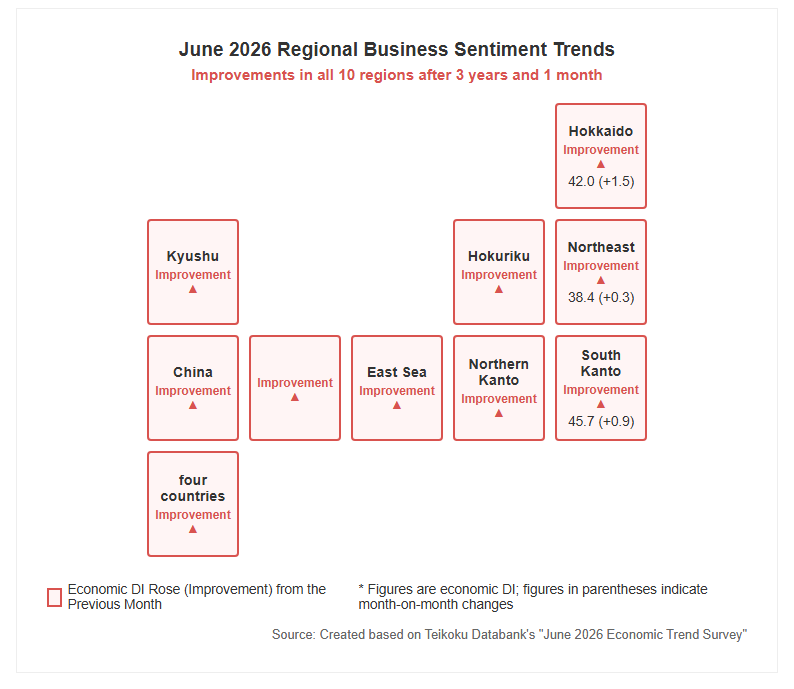
By region, for the first time in three years and one month since May 2023, all ten regions saw economic improvement. Infrastructure demand such as redevelopment is boosting the regional economy, and electronic components-related sectors continue to play a supporting role. In southern Kanto, semiconductor manufacturing equipment for data centers is active, and the financial sector has also recovered to 50 units. In Hokkaido, the construction industry has been rising for two consecutive months, driven by infrastructure demand such as the Shinkansen extension, leading the overall market. The following map shows the business conditions of each region.
Wholesale has also improved in Tohoku, but sluggish catch volumes and rising prices have led to difficulties in fisheries and food and beverage sales, resulting in regional variation by industry.
[Management & Strategy Background] The Arrival of the 1% Interest Rate Era and Corporate Concerns
Concerns over high interest rates and rising costs for the first time in 31 years
The policy rate reaching 1% marks a major milestone, marking the first level in 31 years for the Japanese economy. As a topic in economic trend surveys, many companies expect further increases in long-term interest rates and are concerned about increased borrowing burdens and rising costs. Especially for small and medium-sized enterprises, there is a risk of being forced to shift from the previous low-interest rate management model. Financial institutions’ lending attitude (DI) is 53.8, showing signs of improvement, but concerns remain about rising interest rates suppressing housing demand and more cautious decisions on capital investment. How companies can pass on the rise in interest rates to selling prices and secure profits has become the top priority in their management strategy.
Current state of capital investment willingness and labor shortages
While business sentiment is improving, severe labor shortages are restricting business activities. In June 2026, the DI for over-underemployment stands at 59.7 for regular employees and 54.7 for non-regular employees, indicating a still high sense of deficit. In response, the DI for corporate capital investment increased by 1.2 points from the previous month to 46.7. Digitalization and labor-saving investments to address labor shortages are becoming more active, and especially with the recovery of operations in manufacturing and construction, demand for dispatch and recruitment for securing personnel is also increasing. Companies are increasingly allocating funds not just for scale, but toward efficiency investments aimed at boosting productivity with limited staff.
[Future Outlook & Key Points] Sustainability of Gradual Recovery and Risk Factors
Summer demand and real purchasing power support
Looking ahead, the domestic economy is expected to see high wage increases, summer bonuses, seasonal demand related to extreme heat, and summer demand for travel and leisure. Government growth investments and price measures are supporting the real purchasing power of households, so the trend is expected to remain upward for the time being. The fact that retail sales of home appliances and information equipment such as air conditioners have risen for four consecutive months due to seasonal demand indicates signs of recovery in part of domestic demand. The key to future economic improvement lies in how much positive impact the currently sluggish social services sectors such as retail and hospitality will be directed toward consumption, as high wage increases are directed toward consumption.
Easing of future uncertainties and lingering negative factors
From a medium- to long-term perspective, rising purchase prices due to a weaker yen and higher crude oil prices continue to squeeze corporate profitability. Since interest rate hikes by the Bank of Japan are putting downward pressure on capital investment and housing demand, the pace of economic improvement is expected to be limited to a modest and weak pace. Forecasts using the ARIMA model by Teikoku Databank indicate that while a recovery is expected for the time being, high costs and rising interest rates will be a burden. Although the ceasefire agreement between the U.S. and Iran has eased uncertainty about the future, it remains necessary to continue monitoring the impact of global price trends and exchange rate fluctuations on the Japanese economy. The next indicator release is scheduled for August 5, and a major focus will be on how the impact on the real economy will manifest after interest rates reach 1%.
[#景気動向指数 #日本経済 #金利上昇 #半導体 #AI需要 #設備投資 #帝国データバンク #内閣府]


コメント