
Marubeni sold its oil and gas stake in the U.S. Gulf of Mexico, known as ‘Big Foot.’ This decision is based on the strategic backdrop of asset replacement outlined in the medium-term management strategy “GC2027” and the construction of a natural gas value chain with an eye toward a decarbonized society.
- Full details of oil equity sales in the U.S. Gulf of Mexico
- Cash generation and profit contribution through asset replacements
- Medium-Term Management Strategy GC2027 and Shift to Non-Resource Sectors
- Energy transition and focus on natural gas
- A path to enhancing corporate value aiming for a market capitalization exceeding 10 trillion yen
- Balance between growth investing and shareholder returns, and future outlook
Full details of oil equity sales in the U.S. Gulf of Mexico
On July 8, 2026, Marubeni announced that it had completed the sale of its “Big Foot” oil and gas interest in the U.S. Gulf of Mexico, which it held through its subsidiary. This interest is located about 360 km south of New Orleans, USA, at a depth of approximately 1,600 meters, and is operated by Chevron, a global oil giant. Since starting production in 2018, Big Foot has maintained a crude oil processing capacity of approximately 75,000 barrels per day and has maintained stable operations so far. Marubeni has been involved in this project from the development stage, promoting business development including the construction of offshore platforms together with partner companies, playing a key role from launch to stable operation. This sale was determined to be the right timing to appropriately recover the value of the upstream business the company had cultivated.
Cash generation and profit contribution through asset replacements
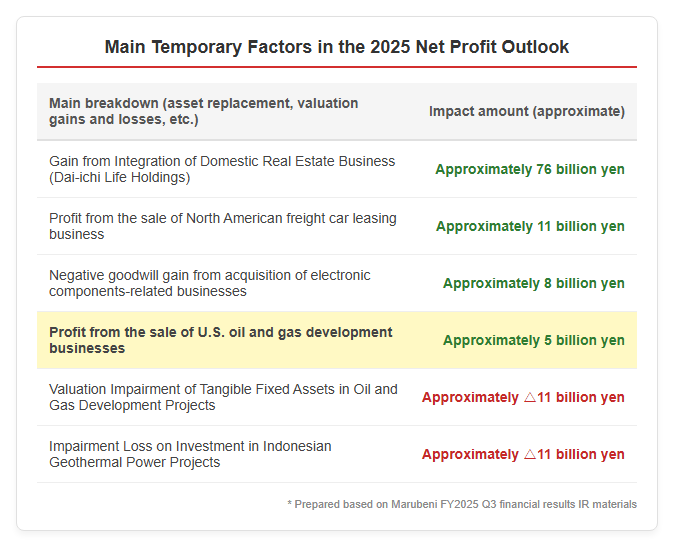
This sale of oil and gas interests embodies one of Marubeni’s key measures in its medium-term management strategy “GC2027,” which is “promoting investment recovery.” The company plans a pipeline of business sales and recoveries totaling 670 billion yen over three years from fiscal 2025 to 2027, accelerating asset replacements in low-growth or inefficient businesses. In the past, it has continuously reviewed its portfolio based on the long-term climate vision by transferring oil and gas fields in the British North Sea in 2021. According to the financial results for the third quarter of fiscal 2025, approximately 5 billion yen is expected to be recorded as a one-off profit due to the sale of U.S. oil and gas development-related businesses, strengthening the financial base through asset liquidation. The cash generated will be prioritized for reallocation to strategic platform-type businesses that will serve as future revenue bases, as well as investments in areas with higher growth potential. Please refer to the diagram below.
Background of Management and Strategy
Medium-Term Management Strategy GC2027 and Shift to Non-Resource Sectors
The core of Marubeni’s management strategy is to build a “stable and diversified” business portfolio that is less affected by fluctuations in resource prices. As of the fiscal year ending March 2024, about 81% of the company’s total assets belong to non-resource sectors, and about 67% of its actual net profit is generated by non-resource sectors, making its non-resource ratio exceptionally high compared to other general trading companies. GC2027 further accelerates this trend, positioning high-growth “strategic platform-type businesses” such as agricultural materials, North American mobility, and power as drivers of profit growth. This oil equity sale is not just a withdrawal, but a strategic choice to redirect management resources to strengthen non-resource sectors, while properly managing dependence on the resource sector. By fiscal year 2025, the company aims to establish a revenue base of over 450 billion yen in actual net profit annually, and this sale will help enhance that resilience.
Energy transition and focus on natural gas
Marubeni has set a goal to achieve net zero greenhouse gas emissions across the entire group by 2050, accelerating the “energy transition” from oil to natural gas and even renewable energy in the process. On June 17, 2026, just before the sale of its oil interests, it announced that it would become a wholly owned subsidiary of EagleRidge, a U.S. natural gas development and production company. This is because the strategic pillar focuses on building a natural gas value chain centered on North America, aiming to strengthen the environmentally friendly energy supply network by integrally covering upstream and downstream coverage. The company positions natural gas as a “critical resource for base metals and energy transitions,” aiming to maintain long-term corporate value by compressing fossil fuel assets like oil and expanding existing natural gas-centered assets while enhancing cost competitiveness.
Future Developments and Highlights
A path to enhancing corporate value aiming for a market capitalization exceeding 10 trillion yen
In its Medium-Term Management Strategy GC2027, Marubeni significantly moved up the achievement of its long-term goal of “over 10 trillion yen market capitalization” by fiscal 2030 to the end of fiscal 2027. Around 2019, the market capitalization was around 1 trillion yen, but thanks to the implementation of structural reforms and increased attention from the ‘Buffett effect,’ it is expected to reach about 5 trillion yen in 2024, steadily approaching the target. From an academic perspective, the key is whether general trading companies can overcome challenges such as “conglomerate discounts” and “route dependence” through portfolio optimization through asset replacement. Agile decisions like the recent oil equity sale strongly leave a strong impression on investors that the company is evolving toward “management focused on capital efficiency.” The company is also aiming to improve its rating, with the S&P upgrade intended to lead to a higher PER and lower capital costs.
Balance between growth investing and shareholder returns, and future outlook
What Marubeni needs going forward is how to balance how to allocate the cash raised from asset sales to high value-added growth areas while simultaneously strengthening returns to shareholders. During the three years of GC2027, the plan is to execute a total of 1.7 trillion yen in new and capital investments, with the majority concentrated in growth sectors such as agriculture and mobility. On the other hand, regarding shareholder returns, the company continues its ‘progressive dividend’ with an annual dividend of 100 yen per share, raising the total payout ratio to around 40%. In fiscal 2025, the company will increase its annual dividend to 107.5 yen and significantly expand the treasury stock purchase quota, maintaining an aggressive stance. The funds raised from this sale will also serve as the source for such “offensive investments” and “defensive returns,” supporting medium- to long-term profit growth and a dramatic expansion of corporate value.
[#丸紅 #総合商社 #石油ガス売却 #GC2027 #エネルギートランジション #企業価値向上 #投資戦略]


コメント