Thomas Domke, former CEO of GitHub, has established a new company, Entire, to build a next-generation development platform where AI agents and humans collaborate. This move aims to fundamentally redesign the traditional development cycle, which assumed humans manually writing and reviewing code, to fit the AI-driven era.
- The largest seed fundraising in history and the establishment of Entire
- The “Limitations of the AI Era” Faced by Traditional Git and GitHub
- A new answer as a decentralized Git-compatible network
- A “Git-compatible database” that records context
- Semantic inference layer to prevent conflicts between agents
- AI native UI: humans command swarms of AI
- Implementation of “Checkpoints,” which embeds AI interactions into Git
- Legacy of GitHub and migration to the ‘3rd Generation’ platform
- Redefining Development Culture: From Code to Intent
The largest seed fundraising in history and the establishment of Entire
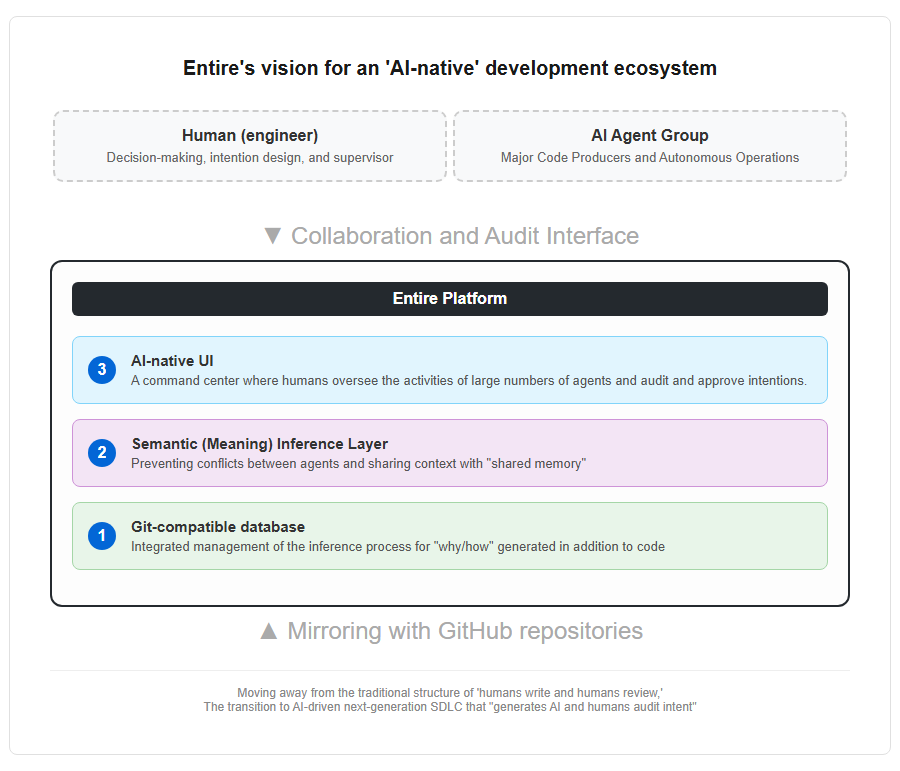
Thomas Domke, who led GitHub’s growth, has announced his intention to step down as CEO in August 2025. Subsequently, on February 10, 2026, we announced the establishment of a new company, Entire, raising $60 million (about 9 billion yen) in one of the largest seed rounds ever in the development tools sector. This round also included Microsoft’s VC arm M12, with Entire’s valuation already reaching $300 million (about 45 billion yen). Returning to his roots as a startup founder, Domke chose to build a new development foundation from scratch that goes beyond the existing GitHub framework. The diagram below is a conceptual diagram of the new development ecosystem Entire aims for.
The “Limitations of the AI Era” Faced by Traditional Git and GitHub
The current Software Development Lifecycle (SDLC) is based on a human-centered design, where humans write code in files or folders, and others visually review it via pull requests (PR). However, when AI agents become the main code producers and generate thousands of lines of code in a single session, the model becomes dysfunctional. It is physically impossible for humans to visually review the vast amounts of AI-generated “AI slops” (poor code), and the existing review flow is becoming a serious bottleneck in development. Domke asserts, “The concept of understanding and reviewing code is a dying paradigm,” emphasizing that existing architectures are not keeping up with the pace of the AI era.
A new answer as a decentralized Git-compatible network
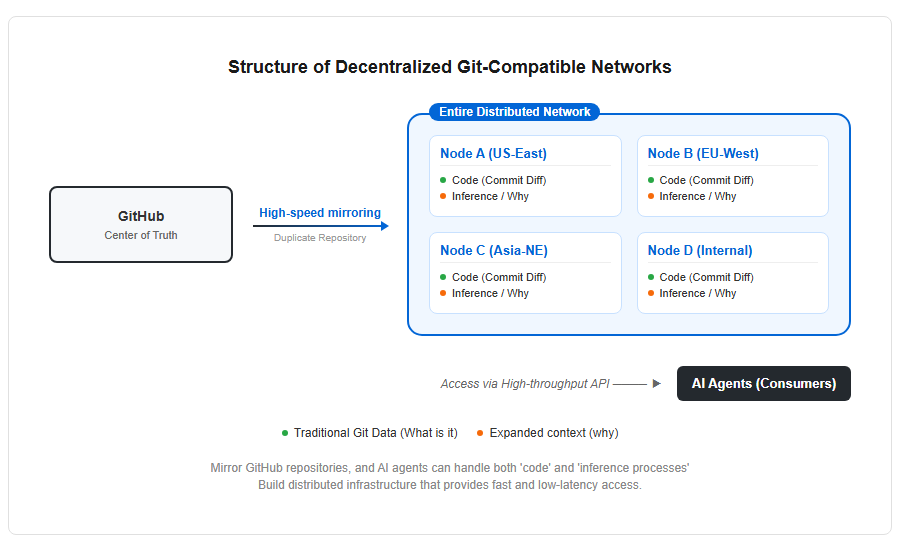
Entire aims to be more than just a code hosting service. They are mirroring GitHub repositories to build a “decentralized, Git-compatible, high-speed network” that AI agents can efficiently access. Until now, Git only stored the difference of what the file had changed, but Entire’s foundation encompasses the inference process of “why” those changes were made. This will transform the repository from a mere repository of source code into a dynamic data center where AI learns and references, and multiple agents work in coordination. The basic structure of this network is shown in the diagram below.
Three technological foundations enabling AI-native development
A “Git-compatible database” that records context
Entire’s platform is broadly composed of three layers. The first layer is a “Git-compatible database” that centrally manages AI-generated code. Unlike traditional Git repositories, this database is designed to query not only the code itself but also the underlying “inference steps” and “design intent” via API. This enables AI agents to instantly understand what prompts and dialogues generated past code. By maintaining compatibility with existing Git ecosystems, companies are provided with mechanisms to expand into AI-native environments without discarding existing assets.
Semantic inference layer to prevent conflicts between agents
The second layer is the universal “semantic reasoning layer.” In environments where multiple AI agents work in parallel, inconsistencies between deliverables and unintended code conflicts frequently occur. Through this layer, Entire acts as a “shared memory” that enables agents to share context and collaborate. Agents can build code while understanding each other’s work intentions, preventing loss of understanding and large-scale degradation. This will serve as a critical infrastructure for a future where AI reviews and optimizes code written by AI.
AI native UI: humans command swarms of AI
The third layer is the “AI-native UI,” designed from scratch based on the assumption of collaboration between humans and AI agents. While current IDEs and GitHub screens are optimized for humans writing code line by line, the UI envisioned by Entire serves as a command center for humans to supervise multiple agents (fleets) and efficiently approve and deploy large volumes of changes. Here, the focus is on ‘intent auditing’ rather than ‘visual verification of differences.’ Humans can focus on advanced decision-making by reviewing AI’s reasons for decisions and test results, without getting caught up in detailed implementation details.
The first product, “Checkpoints,” and future prospects
Implementation of “Checkpoints,” which embeds AI interactions into Git
As its first product, Entire released the open-source CLI tool “Checkpoints.” This is a tool that automatically records development sessions with AI agents like Claude Code and Google Gemini CLI to Git, linking code commits to Git. The recorded data includes human-AI interaction logs (transcripts), prompts used, inference processes, reference files, and the amount of tokens consumed. This information is stored in a separate branch (entire/checkpoints/v1) separate from the main code, allowing you to implement it without breaking existing workflows. The following list includes examples of key metadata recorded by Checkpoints.
-
Dialogue between humans and AI
-
Specific instructions (prompts) given to AI agents
-
The reasoning steps AI takes to make decisions
-
History of external tools called during sessions
-
Number of Tokens Consumed and Cost Information
Legacy of GitHub and migration to the ‘3rd Generation’ platform
GitHub and GitLab are called “second-generation” centralized social coding hubs, but they are not designed for massive traffic and commits by AI agents. In fact, GitHub has seen an increase in obstacles associated with migrating Azure, and some point out that its massive Ruby monolith (an overgrown codebase) is hindering its evolution. In contrast, emerging players like Entire and Pierre are aiming for “third-generation” infrastructure that prioritizes AI agent throughput. In some parts of the industry, GitHub’s network effects have already begun to fragment, and the shift to trustworthy community-driven platforms like Forgejo and AI-native emerging platforms is predicted to be irreversible.
Redefining Development Culture: From Code to Intent
Domke’s challenge is not merely replacing tools, but updating the very definition of software development. The proportion of AI-generated code is rapidly increasing, with many organizations reporting that by the end of 2025, AI-assisted code will account for 20–40%. In such a world, the role of developers shifts from “the code writer” to “the person who designs intent and oversees AI.” The foundation provided by Entire transparently transparently explains why AI wrote code that way, serving as a layer of trust for humans to responsibly manage software. If these next-generation platforms are demonstrated in enterprise environments from the latter half of 2026 onward, the long-standing era dominated by GitHub will mark a major turning point.
[#GitHub #Entire #AI駆動開発 #Git #分散型プラットフォーム #トーマスドムケ #ソフトウェア開発 #次世代インフラ]
コメント