Terra Drone has announced its policy to establish a system to mass-produce tens of thousands of defense drones annually in Japan. Behind this lies a strategic goal of responding to a tense security environment and building a robust domestic supply network independent of imports.
- Production plans and aims for up to tens of thousands of units per year
- Strengthening the supply network through domestic development and production of parts
- Battlefield-proven “Combat Proven” technology
- Deployment of Interceptor Drones “Terra A1” and “Terra A2”
- Stock Market Frenzy and Future Expectations
- Strategic Differences and Differentiation from Competing ACSL
- Relaxation of the Three Principles on Transfer of Defense Equipment and Establishment of a U.S. Corporation
- Becoming a Leader in Next-Generation Defense Platforms
Production plans and aims for up to tens of thousands of units per year
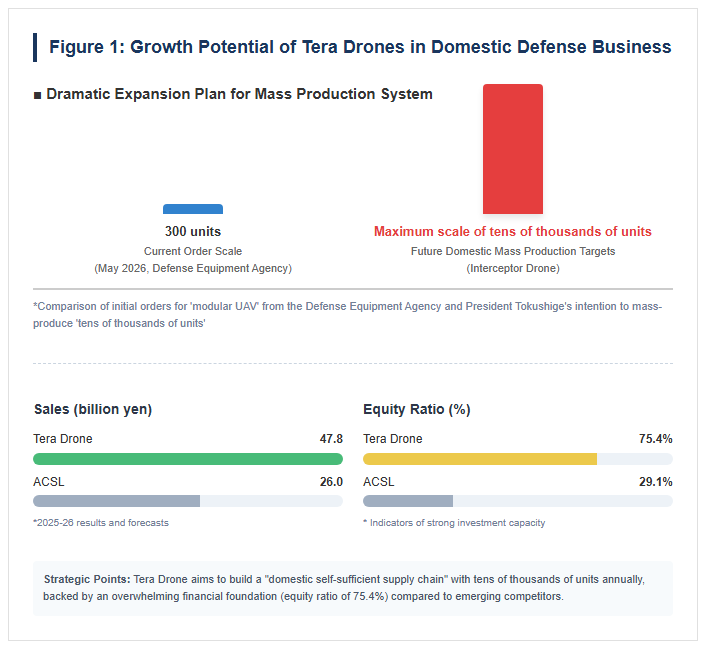
In July 2026, Tera Drone President Toru Tokushige expressed his intention to establish a system capable of mass-producing tens of thousands of defense drones annually within Japan. Since announcing its full-scale entry into the defense equipment market in March 2026, the company has rapidly expanded its business, and this announcement is at the core of that effort. The main target for mass production is drones for interception, aiming to provide a low-cost, sustainable defense against threats such as inexpensive suicide drones. Mr. Tokushige strongly emphasizes the importance of in-house production, given the tense security environment around Japan, including the situation in Taiwan. While civilian drone services were once the main focus, the defense sector is expected to become a major pillar of growth going forward. This scale of tens of thousands far exceeds the production volume of Japan’s traditional defense industry, hinting at the formation of a new defense ecosystem led by startups. Please refer to the diagram below.
Strengthening the supply network through domestic development and production of parts
A key point of this plan is not just assembling the drone itself, but also advancing domestic development and production at the component level. Currently, many drone parts rely on overseas manufacturing, and Mr. Tokushige has expressed a strong sense of crisis about supply continuity in times of crisis. Therefore, we are planning to accelerate the establishment of a supply chain that can procure key components such as motors and communication equipment domestically. Additionally, regarding the nature of the factory, we are considering facilities that provide physical protection and confidentiality with wartime awareness. This aims to maintain a system that can maintain supply to the Self-Defense Forces even if imports are cut off. From the perspective of economic security promoted by the Japanese government, this move toward “domestic production” holds extremely important significance. Terra Drone has already received an order from the Defense Equipment Agency for 300 modular UAVs for 115 million yen, marking the first step in domestic supply based on proven results.
Ukraine’s Combat Data and Multilayered Defense Strategy
Battlefield-proven “Combat Proven” technology
Teradrone’s strength lies in its ability to directly reflect the daily updated combat data from the Ukrainian battlefield into product development. In 2026, the company consolidated its two Ukrainian interceptor drone companies, Amazing Drones and Winny Labs, into consolidated subsidiaries. In modern conflicts, drone technology evolves over weeks, so evaluation in real combat environments is essential, not just theoretical theory. Terra Drone’s drones are resistant to operating in electronic warfare environments such as GPS jamming, based on their rigorous operational experience in Ukraine. The status of a combat-proven “Combat Proof Proof” stands as a strong testament to the trust of domestic and international defense authorities. Leveraging the agile development unique to startups, we have established a system that instantly connects on-site needs to aircraft updates.
Deployment of Interceptor Drones “Terra A1” and “Terra A2”
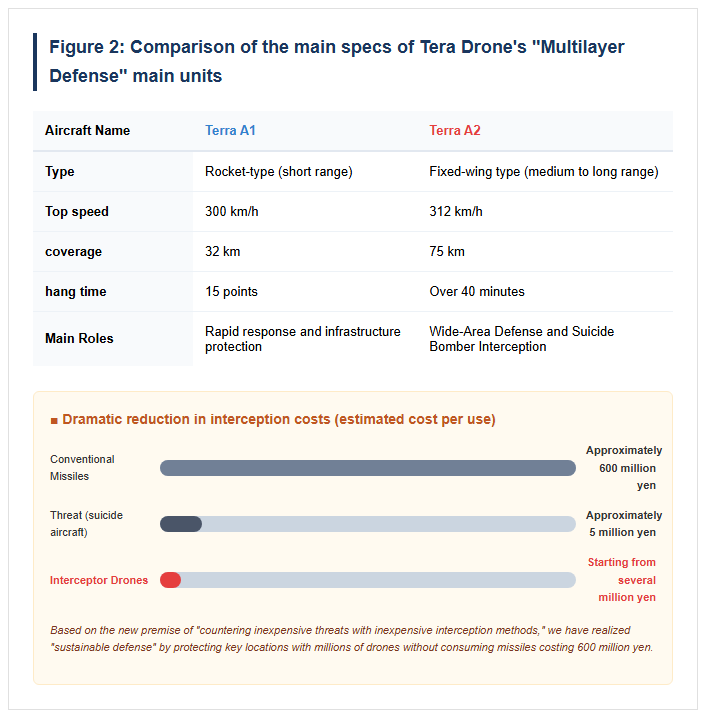
Terra drones offer “multi-layered defense” solutions tailored to different distances and applications. Representative examples include the rocket-type short-range interceptor drone “Terra A1” and the fixed-wing long-range interceptor drone “Terra A2.” The Terra A1 reaches a top speed of 300 km/h and is characterized by its excellent responsiveness. Meanwhile, the newly announced Terra A2 boasts high specs with a speed of 312 km/h, a coverage range of 75 km, and an endurance of over 40 minutes, excelling at neutralizing suicide drones such as the Shahed type in wide-area combat. These aircraft can eliminate threats at a cost of just a few million yen, replacing expensive interceptor missiles worth hundreds of millions of yen, enabling a dramatic reduction in defense costs. We have also added reconnaissance and autonomous mobility products to our lineup, and are advancing the construction of an unmanned defense platform that handles everything from airspace surveillance to neutralization. Please refer to the diagram below.
Market expectations and changes in competition and industry structure
Stock Market Frenzy and Future Expectations
Teradrone’s full-scale entry into the defense business and the announcement of an acquisition of a Ukrainian company sent shockwaves through the stock market. Although the losses widened in the first quarter of the fiscal year ending January 2027 due to upfront investments, the stock price hit the upper limit of the price limit on the next trading day. Investors value the massive growth story of “defense drones” against the backdrop of rising geopolitical risks over short-term financial figures. As of May 2026, stock prices may reach more than five times their public price, indicating extremely high market expectations. On the other hand, while some point out supply-demand risks, such as the overheated PBR temporarily reaching 19.5 times, the sound financial foundation of a 75.4% equity ratio supports large-scale aggressive investments. Riding the backdrop of national policy to expand defense budgets, the company is establishing itself as a leading player in defense tech.
Strategic Differences and Differentiation from Competing ACSL
One of the leading domestic competitors is the ACSL originating from Chiba University. ACSL leads on a track record, having secured a total of 1.42 billion yen in large orders from the Ministry of Defense, but adopts a strategy that contrasts with Tera Drone. While ACSL follows the traditional and orthodox path of “domestic in-house development and government procurement,” Tera Drone’s approach is a speed-focused, unconventional approach centered on “overseas M&A, practical demonstrations, and global expansion.” Tera Drone’s President Tokushige leverages his decisiveness as a serial entrepreneur, personally visiting Ukraine to conduct direct negotiations, widening the gap with a management style not found in traditional Japanese companies. In the short to medium term, ACSL, which focuses on domestic government demand, is showing stability, but in the long term, there is growing potential for Teradrone to reach the global defense market. Rather than being completely competitive, the two companies are expected to become more distinct based on differences in technological background and target markets.
Global Expansion and Future Outlook
Relaxation of the Three Principles on Transfer of Defense Equipment and Establishment of a U.S. Corporation
For the future development of Terra drones, the partial revision of the “Three Principles on Transfer of Defense Equipment” in April 2026 will provide a strong tailwind. This revision significantly eased restrictions on the transfer of finished products and promoted the overseas transfer of defense equipment through public-private cooperation. The company is seizing this opportunity and plans to establish a U.S. subsidiary, Terra Defense, within fiscal year 2026. Through our U.S. subsidiary, we plan to build a global supply network to NATO member countries and Asian nations, and also utilize the Japanese government’s framework for Support for Comrade Countries (OSA). Furthermore, in Estonia, we have established the European defense business headquarters “Terra Defense Europe,” and are strengthening our maintenance and logistics system centered on Europe. We are preparing to deploy products that combine Japanese technology with Ukraine’s combat data to meet global defense needs.
Becoming a Leader in Next-Generation Defense Platforms
From a medium- to long-term perspective, Tera Drone is not just an airframe manufacturer; it aims to dominate the “sky infrastructure” by integrating UTM technology with defense systems. As defense budgets rapidly increase worldwide, the importance of software that controls inexpensive, large numbers of drones and efficiently protects airspace is becoming increasingly important. Tera Drone actively incorporates expertise that has supported Japan’s defense industry, such as inviting Keiichiro Iwasaki, former Mitsubishi Heavy Industries executive, as an advisor. By simultaneously strengthening the supply base for domestically produced drones and gaining leadership in the global market, we have the potential to become a new global standard in defense technology. Going forward, it is expected that comprehensive security solutions that transcend civilian and military boundaries, such as protecting critical infrastructure and urban defense, will be provided.
[#テラドローン #防衛産業 #国産ドローン #経済ニュース #ウクライナ #安全保障 #新興株 #スタートアップ]


コメント