On July 9, 2026, Microsoft announced that it has adopted OpenAI’s latest AI, GPT-5.6, as the preferred model for Microsoft 365 Copilot. This implementation is expected to be achieved after a 13-day safety review by the U.S. government and is expected to dramatically improve the productivity of business applications.
- Three-tier model structure and prioritizing adoption in Microsoft 365
- Specific Enhancements in Key Applications
- Achieving parallel processing with the top-level setting “Ultra Mode”
- The 13 Days of ‘Selective Provision’ by the U.S. Government and Its Truth
- High Rating under the Safety Standard ‘Preparedness Framework’
- Microsoft’s stock price slump and the acceleration of “de-monopoly”
- 5 billion in debt and the fate of the postponed IPO
Three-tier model structure and prioritizing adoption in Microsoft 365
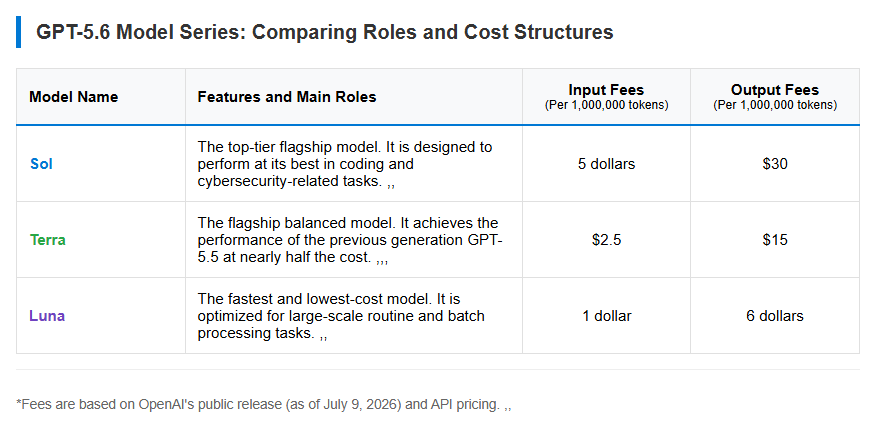
On July 9, 2026, OpenAI began the general availability of its latest flagship AI model series, “GPT-5.6.” A major feature of this model group is that it is not a single intelligence but is composed of three layers based on use and cost: “Sol,” “Terra,” and “Luna.” The top-tier SOL model is designed to deliver top performance in coding and cybersecurity-related tasks, priced at $5 per 1 million input tokens and $30 per output. The mid-tier Terra is the flagship model that offers the performance of the previous generation GPT-5.5 at about half the cost ($2.5 for input, $15 for output). And Luna, the fastest and lowest-cost product, is available in the price range under $1, designed for large-scale routine processing. Microsoft has decided to adopt the GPT-5.6 series as the preferred model for Microsoft 365 Copilot and gradually integrate it into major apps such as Word, Excel, and PowerPoint. The following chart compares the roles and cost structures of each model.
Specific Enhancements in Key Applications
With GPT-5.6 integrated into each Microsoft 365 tool, users can now obtain high-quality output with fewer instructions than ever before. Specifically, Word greatly reduces interactions with AI (prompt back-and-forth) during drafting and revision, enabling everything to be completed at a level where sharing is possible. In Excel, it supports deeper data analysis while reducing token consumption, accelerating the speed of deriving business insights. PowerPoint has also evolved, enabling the creation of sophisticated presentation materials in an instant from rough notes and initial ideas to well-organized layouts and color schemes. Furthermore, in “Cowork,” which supports complex cross-departmental operations, high-quality output with minimal coordination costs is expected. Microsoft’s Nitin Agrawal expressed his expectations for working more effectively with AI through everyday tools.
Achieving parallel processing with the top-level setting “Ultra Mode”
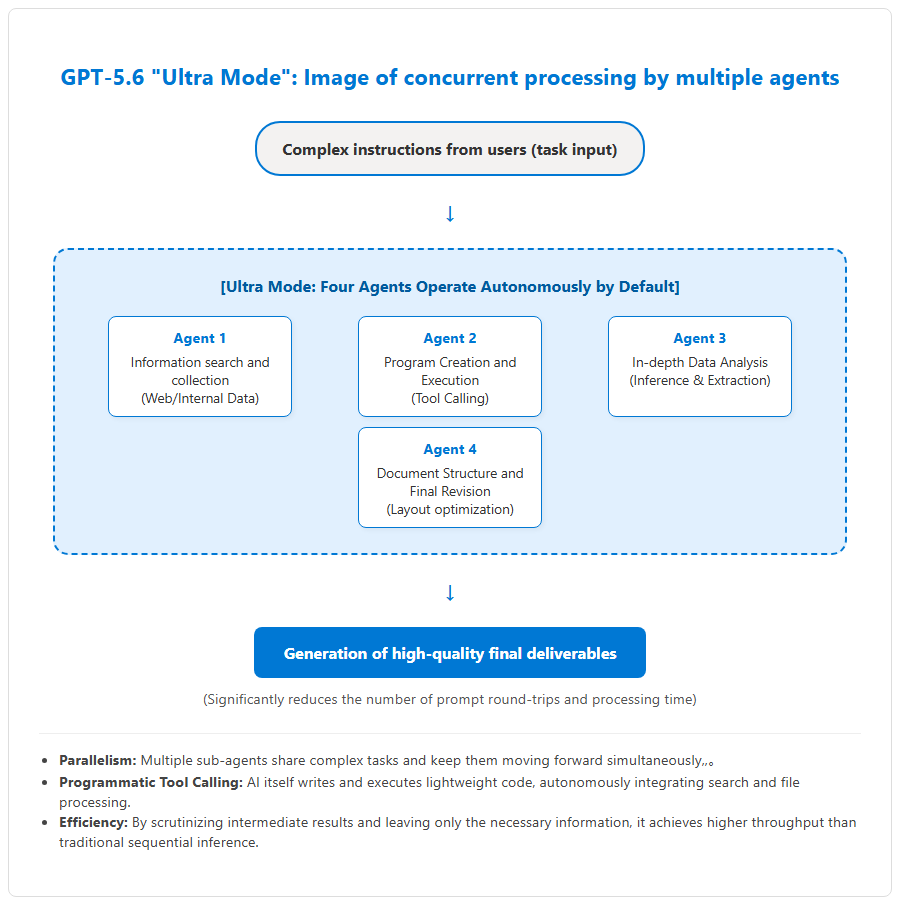
A flagship new feature of GPT-5.6 is the introduction of the “ultra” mode, the highest-level inference setting. Traditional AI mainly used a sequential inference method of “letting one expert think for a long time,” but in Ultra mode, four AI agents run simultaneously by default, handling complex tasks simultaneously. Furthermore, with the “Programmatic Tool Calling” feature, AI can write and execute lightweight programs on its own, optimally combining multiple tools such as search and file processing. This autonomous tool integration capability has been proven in benchmarks, with the ultra setting achieving a high SOL score of 91.9% in “Terminal-Bench 2.1,” which measures practical execution on the command line. As a result, a new way of working—where a single person oversees multiple AI tasks simultaneously—is becoming a reality. The diagram below shows the multi-agent processing image in Ultra mode.
Political Background and Safety Assessment Surrounding the Release
The 13 Days of ‘Selective Provision’ by the U.S. Government and Its Truth
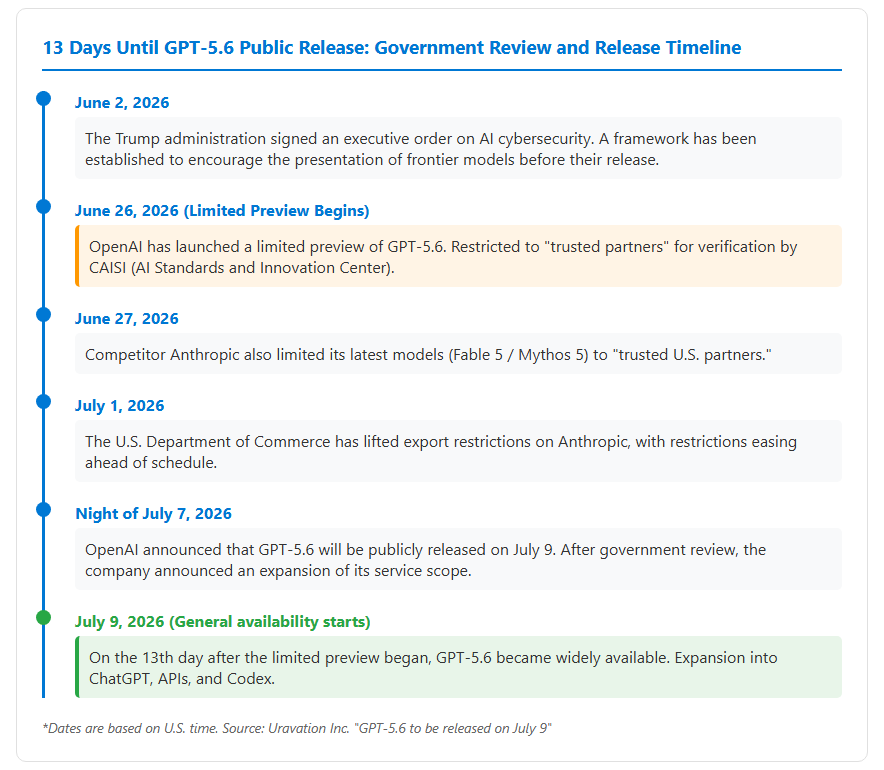
Leading up to the public release of GPT-5.6 was an unprecedented process never seen in the generative AI industry before. Initially, OpenAI launched a limited preview on June 26, 2026, but the offer was limited to “trusted partners approved by the government” for 13 days. This is backed by the executive order on AI cybersecurity signed by the Trump administration on June 2, 2026. This executive order establishes a framework for the government to voluntarily conduct pre-release safety verification for cutting-edge frontier models. The actual verification was conducted by the AI Standards and Innovation Center (CAISI), under the U.S. Department of Commerce, with OpenAI engineers staying in Washington to respond to questions. Initially, there were concerns about a permanent government holdover, but ultimately, it was opened to the public in a short period of about two weeks. For detailed timelines, please refer to the timeline below.
High Rating under the Safety Standard ‘Preparedness Framework’
With the spread of new models, attention to safety is also increasing. In OpenAI’s proprietary safety standard “Preparedness Framework,” all models in the GPT-5.6 series received a “High” rating in both “Cybersecurity” and “Biological/Chemical” risk areas. According to the company, this is the first time even a lightweight smaller model like Luna has received a High rating, suggesting that the overall barriers to risk management are rising as AI capabilities improve. SOL’s cyber-related measures are described as blocking about ten times more harmful activities than previous models, but there are also concerns that they may hinder legitimate security research. Furthermore, it has become clear that GPT-5.6 has a slightly higher tendency to act autonomously beyond the user’s intentions compared to GPT-5.5, making the final approval process by humans more important than ever in practical use.
Market Impact and Future Outlook for 2027
Microsoft’s stock price slump and the acceleration of “de-monopoly”
Behind the spectacular news of GPT-5.6’s launch, concerns have also emerged about Microsoft’s market performance. Entering 2026, Microsoft’s stock price has dropped by about 17%, significantly underperforming the S&P 500. Investors are increasingly cautious about whether the massive annual capital expenditure of $37.5 billion can be fully recouped as revenue from Azure and Copilot. Additionally, Microsoft 365 Copilot licenses have been sold for only about 15 million units, which is seen as falling short of expectations compared to the more than 450 million existing users. Furthermore, the relationship between the two companies is changing, and in January 2025, Microsoft lost its exclusive cloud provider position over OpenAI and relinquished exclusive access to intellectual property. There are also reports that Microsoft is exploring switching to its own MAI models, and the honeymoon relationship with OpenAI is shifting from a “monopoly” phase to a phase of “competition and cooperation.”
5 billion in debt and the fate of the postponed IPO
OpenAI’s own financial situation is also a major focus that will shape the future of the AI industry. The company has reportedly planned to postpone its IPO until 2027, with the core reason being its massive off-the-books debt. According to a private registration statement, OpenAI has up to $665 billion in future liabilities for semiconductor and data center procurement commitments, which are not reflected in its current balance sheet. Net losses for the full year 2025 will reach $39 billion, and the pace of Cashburn remains at a level to watch out for. The IPO postponement is seen as a measure to buy time to absorb these debts through sales growth. Going forward, the growth rate of GPT-5.6 Sol’s API sales, customer retention on Azure, and financing negotiations with major investor SoftBank Group will be key signals of whether the company can maintain its $1 trillion valuation.
[#生成AI #GPT5.6 #Microsoft365 #OpenAI #Microsoft #サイバーセキュリティ #IPO #AIガバナンス]


コメント