
The Ministry of Justice has launched a survey on the actual situation of “buildings with unknown owners,” estimated to be over 10 million nationwide. The underlying goal is to resolve delays in recovery work and stagnation in real estate transactions during large-scale disasters, and to promote proper management and utilization at the national level.
- Background and scale of the large-scale investigation initiated by the Ministry of Justice
- “Invisible Buildings” Hindering Disaster Recovery and the Economy
- Mandatory Inheritance and Address Change Registration and Introduction of Penalties
- Administrative intervention in aging condominiums and amendments to the Sectional Ownership Act
- The risks of vacant houses caused by unregistered housing and the issue of “hidden uninheritance”
- Survey results announced in March 2026 and expectations for Landbank
Background and scale of the large-scale investigation initiated by the Ministry of Justice
The Ministry of Justice announced that in 2026, it is conducting its first large-scale on-site investigation into “buildings with unknown owners” that have not been registered in Japan. According to government estimates, there are more than 10 million such buildings nationwide, accounting for about one-sixth of all buildings. Specifically, according to the Ministry of Internal Affairs and Communications’ “Housing and Land Statistics Survey,” the total number of buildings nationwide is about 62.4 million, but the actual number confirmed in real estate registry is only about 51.6 million, resulting in a difference of about 10.8 million units.
The Real Estate Registration Act requires registration applications within one month of new construction, but in practice, there are many cases where applications are left unaddressed, or only the main house is registered even when there are multiple buildings on the premises. The Ministry of Justice plans to compile the investigation results by March 2026 and begin considering concrete solutions to thoroughly enforce registration. This is also clearly stated in the “Regulatory Reform Implementation Plan” approved by the Cabinet in June 2025, which aims to eliminate unregistered buildings, making it a national priority to prevent owners from becoming unclear.
“Invisible Buildings” Hindering Disaster Recovery and the Economy
Why is it urgent to understand the actual situation of buildings with unknown owners right now? The main reason is the serious negative impact on recovery and reconstruction during large-scale disasters. For example, during the 2011 Great East Japan Earthquake, the enormous time spent identifying the owners of collapsed buildings became a major obstacle to debris removal and redevelopment projects. If the owner is not identified, procedures for taking legal measures such as administrative execution become significantly more complicated, making rapid rescue efforts and infrastructure restoration difficult.
From an economic perspective, the presence of unidentified buildings hinders smooth real estate transactions and lowers the overall asset value of the region. Buildings left uncirculated without being distributed in markets can cause significant damage to the living environment of nearby residents, such as deteriorating landscapes due to aging, public health issues, and breeding grounds for illegal dumping. This survey is positioned as a foundation to fundamentally resolve these “negative movable assets” issues and to prevent future ownership confusion and promote effective land utilization.
[Market Background] Successive Legal Amendments and Prevention of ‘Negative Assets’
Mandatory Inheritance and Address Change Registration and Introduction of Penalties
Alongside the fact-finding survey, the government is gradually strengthening the real estate registration system. At the core of this is the mandatory registration application. First, starting April 1, 2024, applying for inheritance registration became mandatory. As a result, heirs must register the property within three years from the date they learn of the real estate acquisition, and a penalty provision is established that imposes a fine of up to 100,000 yen if they fail to do so without a valid reason.
Furthermore, starting April 1, 2026, the mandatory registration of “address and name change” will be implemented. Previously, there were no penalties and it was considered voluntary to update registration information related to moving or marriage registration, but now it is now a legal obligation, requiring applications to be submitted within two years of the change. Violations of this rule are subject to a fine of up to 50,000 yen. These legal amendments structurally prevent “unregistered inheritance” and “unregistered address changes,” which account for most causes of unregistered land and buildings with unknown owners, and aim to keep registration information always up to date.
Administrative intervention in aging condominiums and amendments to the Sectional Ownership Act
For particularly complex rights relationships among buildings, the revised Condominium Ownership Act will come into effect from April 1, 2026. The aging of condominiums built after the period of rapid economic growth is accelerating, and the number of properties over 40 years old is expected to surge from about 1.48 million units at the end of 2024 to about 4.82 million units in 20 years. In this amendment, the requirements for rebuilding resolutions have been relaxed from the previous “four-fifths or more” to “three-quarters or more” under certain conditions.
Notably, there is enhanced response to cases where unit owners are missing. Until now, unknown persons were treated as “de facto opposing votes” and were a major obstacle to rebuilding or large-scale repairs, but after the amendment, court recognition allows the removal of unknown persons from the denominator of resolutions. Additionally, for areas of private property in poor management, a system was established where, upon application by interested parties, the court appointed a manager to carry out forced removal or repairs of garbage. This aims to mitigate the risk that individual unidentified units could hinder the overall regeneration of buildings and to maintain the value of urban assets.
[Lifestyle and Medium- to Long-Term Outlook] New Systems to Protect Assets and Future Highlights
The risks of vacant houses caused by unregistered housing and the issue of “hidden uninheritance”
Regarding the impact of unregistered or uninherited status on the future of buildings, specific statistical data highlight these risks. According to a case analysis conducted in Kumamoto City, “unregistered buildings” are about 4.5 times more likely to become vacant compared to properly registered buildings. While the vacancy rate for uninherited buildings reaches about 18.4%, properly registered buildings are only about 4.1%.
Please refer to the diagram below.
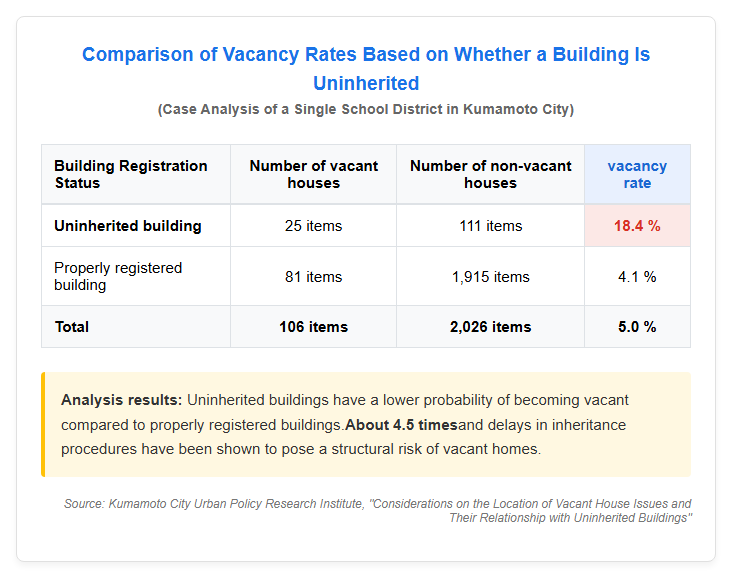
This survey also confirmed the existence of many “hidden uninherited buildings” where spouses continue to live without registration procedures even after the owner’s death. At first glance, these are not vacant houses, so problems are less likely to surface, but if the current residents disappear in the future, the complexity of rights will make selling or utilization difficult, and the risk of being left unused for a long time is extremely high. The Ministry of Justice’s investigation of unregistered buildings is considered an important opportunity to detect these potential potential mismanagement groups early and promote proper succession of rights.
Survey results announced in March 2026 and expectations for Landbank
The Ministry of Justice’s scheduled release of the survey results in March 2026 will bring a major turning point to Japan’s real estate policy and business. Based on the findings, there is a possibility that additional legal frameworks may pursue management responsibilities for unregistered buildings and further simplify registration procedures. Meanwhile, starting April 2026, the “Smart Change Registration” initiative, in which the Legal Affairs Bureau automatically rewrites address changes in cooperation with the Basic Resident Register Network, will also be launched, simultaneously reducing the burden on owners.
In the medium to long term, discussions are expected to accelerate on the full-scale operation of Japanese systems such as the “Landbank” system, which has achieved results in the U.S. (a system where public institutions acquire and reuse negative assets). Another important point of interest is the expansion of systems to smoothly transfer renounced land to the national treasury. By clarifying the actual situation of buildings with unknown owners, the accuracy of risk assessment in real estate due diligence will improve, and new investment opportunities such as pre-owned housing distribution and whole-house renovations are expected to expand.
[#法務省 #不動産登記法 #空き家問題 #負動産 #実態調査 #区分所有法 #経済ニュース]


コメント