
On July 13, 2026, Mitsubishi UFJ Financial Group (MUFG) temporarily surpassed Toyota Motor Corporation in market capitalization, becoming the top Japanese company. This event symbolized the structural shift of the Japanese economy from long-standing deflation to a “world with interest rates,” shifting from manufacturing-centered to a finance-driven economy emphasizing capital efficiency.
- Key Points of the Event: The Meaning of Market Capitalization Exceeding 42 Trillion Yen
- Two Contrasting Giants: Tailwinds in Finance and Headwinds in Manufacturing
- Dramatic improvement in capital efficiency: breaking out of PBR below 1
- Strong Global Portfolio: Bearing the Fruit of Investments
- The Establishment of a ‘World with Interest Rates’: Dramatic Expansion of Bank Earnings
- Future Developments: Maintaining a 12% ROE and Next-Generation Strategy
Key Points of the Event: The Meaning of Market Capitalization Exceeding 42 Trillion Yen
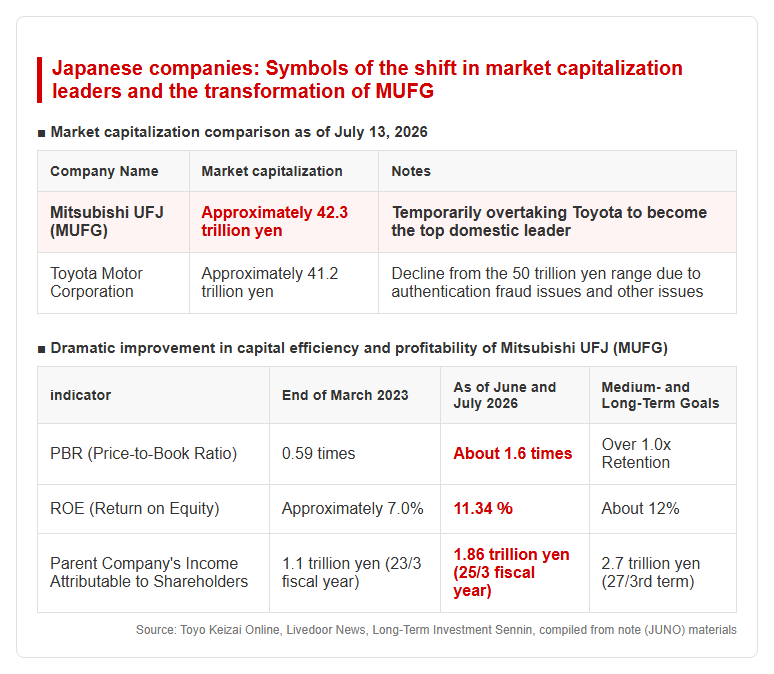
On July 13, 2026, at the Tokyo Stock Market, the market capitalization of Mitsubishi UFJ Financial Group (hereafter, MUFG) temporarily reached approximately 42.3 trillion yen. This figure surpasses Toyota Motor Corporation, which has long dominated the top Japanese company, and marks a historic moment for MUFG to rise to the top domestic position for the first time since its founding. On that day, MUFG’s stock price rose about 3% higher than the previous weekend to 3,564 yen, carrying the market’s expectations on its shoulders.
This turnover carries meaning beyond mere price movements of individual stocks. According to data as of July 2026, Toyota’s market capitalization was about 41.2 trillion yen, while MUFG’s was about 39.47 trillion yen, but even slight stock price fluctuations shifted Japan’s title as the most valuable company from a manufacturing giant to a financial industry. This clearly shows that the era of deflation and low growth known as the “Lost 30 Years” has completely ended, and that the efficient use of capital has shifted to a new economic paradigm where it is properly valued. Please refer to the diagram below.
Two Contrasting Giants: Tailwinds in Finance and Headwinds in Manufacturing
What distinguished MUFG and Toyota was the contrasting external environments they faced. Although Toyota is one of the world’s strongest manufacturers, it faces governance challenges such as authentication fraud issues that have surfaced since 2024. This issue caused Toyota’s market capitalization to drop below 50 trillion yen from a temporary level of 63 trillion yen, which led to selling by investors. Furthermore, export-driven manufacturing faces severe headwinds such as slowing growth in the global EV market, fierce price competition with Chinese manufacturers, and the risk of a reversal of yen appreciation due to Bank of Japan’s rate hikes.
Meanwhile, MUFG is receiving a strong tailwind from the Bank of Japan’s rate hikes. Since the negative interest rate policy was lifted in March 2024, the Bank of Japan has continued phased rate hikes, reaching 1.00% in June 2026—the highest level in about 30 years. When interest rates rise, the interest spread (spread) on loans—the bank’s core business—expands rapidly, creating a structure where profits automatically accumulate. In this way, the main role shifted from heavy, long-term industries benefiting from the weak yen to a dynamic new economic cycle where interest rates and capital efficiency function.
Transforming the ‘Earning Power’ That Changed Market Valuation
Dramatic improvement in capital efficiency: breaking out of PBR below 1
The biggest reason MUFG is enthusiastically supported by investors is its thorough improvement of capital efficiency. In the past, Japanese bank stocks were synonymous with ‘perpetually undervalued stocks,’ where their PBR (price-to-book ratio) fell below 1, even below their bankruptcy value. However, against the backdrop of the Tokyo Stock Exchange’s PBR reform request, MUFG dramatically enhanced its ability to raise capital, reviewing its non-industrial division and actively conducting share buybacks. As a result, the PBR, which was 0.59 times at the end of March 2023, jumped to about 1.6 times by June 2026.
Supporting this revaluation is the improvement in ROE (Return on Equity). MUFG has set a medium- to long-term target of “ROE around 12%,” and improved to 9.9% in fiscal 2024, achieving its medium-term target. The company’s stance on shareholder returns is extremely aggressive, allotting about 40.30% of profits to dividends and clearly committing to a ‘progressive dividend’ policy without dividend reductions. As a result, it gained explosive popularity as the core of long-term asset building for individual investors through new NISA and other platforms. The company’s valuation itself evolved from aiming for “undervalue” to “blue-chip stocks that can maintain high capital efficiency.”
Strong Global Portfolio: Bearing the Fruit of Investments
MUFG’s leap is not only due to a domestic interest rate recovery but also stems from a unique global strategy built over many years. The company’s revenue structure consists of three strong pillars: domestic interest rates, a partnership with Morgan Stanley in the U.S., and retail business in the ASEAN region. In particular, the massive $9 billion investment in Morgan Stanley during the 2008 Lehman Shock was criticized at the time, but today about 20% of the company’s global profits flow into MUFG’s consolidated financial results, making it the strongest revenue engine.
Additionally, it has positioned Asia as a “second mother market,” expanding its overwhelming footprint by bringing Thailand’s Bank Ayutthaya (KS) and Indonesia’s Danamon Bank (BDI) under its umbrella. Operating profit in Asia has expanded fivefold over the past decade, reaching a record high of approximately 500 billion yen in fiscal year 2024. The U.S. wholesale business has also outperformed competitors by achieving the world’s top spot in project finance composition by concentrating management resources after the Union Bank sale. Such regionally diversified portfolios support stable growth even in the highly uncertain world economy.
Structural Changes in the Japanese Economy and Future Highlights
The Establishment of a ‘World with Interest Rates’: Dramatic Expansion of Bank Earnings
The Japanese economy is now steadily moving toward a ‘world with interest rates’ that has existed since the 1990s. There are simulations that policy rates will rise to 1.5% through fiscal 2028 and long-term rates to 3%, meaning the inflation rate of 2% is just around the corner. This macroeconomic shift presents an unprecedented opportunity for Japanese banks, with MUFG’s net profit projected from 1.86 trillion yen in the fiscal year ending March 2025 to 2.7 trillion yen in the fiscal year ending March 2027. The interest rate gap between deposits and loans, which had been compressed to the extreme during the 0% interest rate era, has normalized, and the country has entered a phase where additional profits in the hundreds of billions of yen are automatically generated.
On the other hand, this rapid change also carries risks. While rising interest rates increase lending income, they also cause the value of government bonds and other bonds held by banks to fall, thereby increasing unrealized losses. Drawing on past non-performing loan issues and lessons from the Lehman Shock, MUFG has advanced its ALM (Comprehensive Asset-Liability Management) and thoroughly hedged interest rate fluctuation risks. While households benefit from increased deposit interest income, there are concerns about the negative impact of increased mortgage repayment burdens, raising questions about society’s overall adaptability.
Future Developments: Maintaining a 12% ROE and Next-Generation Strategy
MUFG’s next goal is to consistently maintain a market capitalization of 30 trillion yen and achieve corporate value comparable to the top five global banks. Under the slogan “MUFG Awakening” promoted by Group CEO Hiroki Kamezawa, organizational culture reforms are accelerating. Specifically, efforts are underway to foster a culture of “challenge and speed” where employees proactively think and act, as well as to shift to an “AI Native” organizational management based on generative AI. Centered on the new service brand “M-utto” announced in 2025, the company is also launching a next-generation retail strategy that fuses digital and physical elements.
The key point going forward will be how to sustain the current high capital efficiency (ROE around 12%). Despite concerns such as increased credit costs due to the economic downturn and political uncertainty both domestically and internationally, MUFG aims to place solving social issues as the starting point of its business with the spirit of “righteousness first, profit later.” Whether it can continue to demonstrate true competitiveness in the global market as a driver of Japan’s economic growth, beyond being a financial institution, will be key to securing the top position.
[#三菱UFJ #時価総額 #トヨタ自動車 #金利のある世界 #日本経済 #PBR改革 #ROE #金融株]


コメント