
The first infrastructure subcommittee meeting of the consortium for implementing automated logistics roads was held, initiating concrete considerations of physical infrastructure to resolve the worsening logistics crisis. This initiative forms an important foundation for a national project aiming for practical implementation between Tokyo and Osaka in the mid-2030s.
- Establishment of Consortium and the Role of the Infrastructure Subcommittee
- Background and urgency of the demand for automated logistics roads
- Utilization of Road Space and Diverse Development Forms
- Standardization of transport targets and adoption of T11 pallets
- Timeline and Goals of the Phased Proof-of-Concept Experiment
- Future Issues and Financial and Legal Issues to Be Addressed
Establishment of Consortium and the Role of the Infrastructure Subcommittee
On May 16, 2025, the Ministry of Land, Infrastructure, Transport and Tourism officially launched the “Consortium for the Implementation of Automated Logistics Roads,” led by the Ministry of Land, Infrastructure, Transport and Tourism, with the aim of fundamentally transforming Japan’s logistics structure. This consortium includes 79 companies from construction, logistics, and energy sectors, aiming for practical use by the mid-2030s through public-private collaboration. Within the consortium, three specialized subcommittees have been established according to their roles, and among them, the Infrastructure Subcommittee was launched with Junichi Sugii, General Manager of Corporate Planning at Central Nippon Expressway Company (NEXCO Central Japan), as the representative secretary.
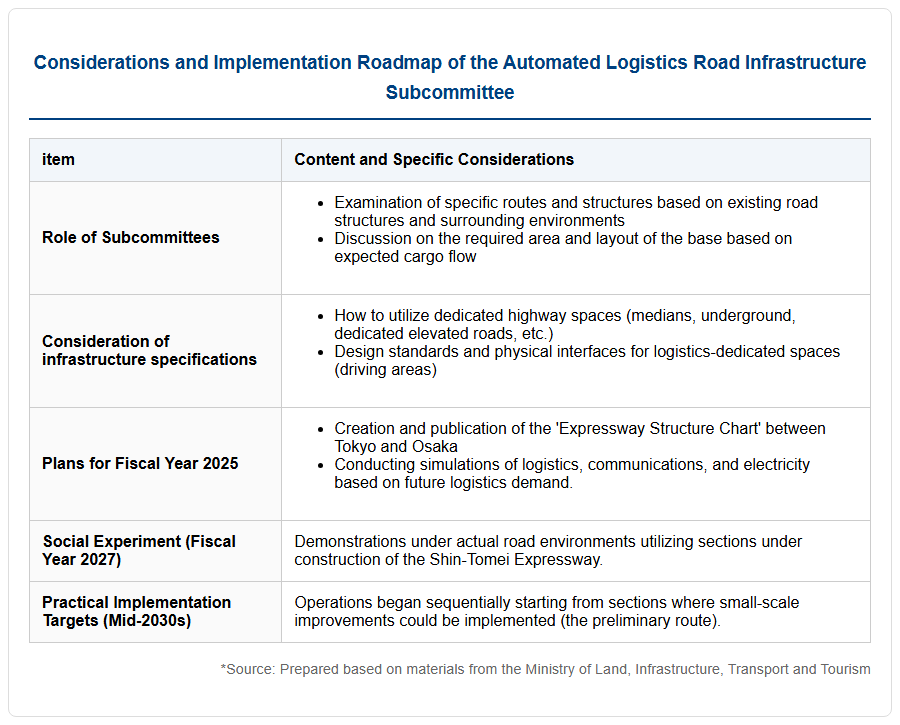
The main focus of discussion in the Infrastructure Subcommittee was on selecting specific routes for automated logistics roads and considering the specifications of driving spaces based on existing road structures and surrounding environments. Additionally, detailed specifications such as the placement of sites needed to handle the expected logistics volume and the area each site should be equipped with are also discussed. In this concept, often called the logistics version of the Shinkansen, the task of this subcommittee is to build the “skeleton” of the physical network. Please refer to the diagram below.
Background and urgency of the demand for automated logistics roads
Behind the urgent construction of automated logistics roads lies the so-called 2024 and 2030 issues, which are the so-called 2024 and 2030 issues, which are worsening driver shortages due to the declining birthrate and aging population. According to estimates by the Ministry of Land, Infrastructure, Transport and Tourism, if fundamental measures are not taken, there could be a shortage of about 25% of the country’s transport capacity, or roughly 720 million tons, by fiscal year 2030. To compensate for this absolute shortage of transport capacity, it became essential to shift from the traditional method of driving trucks to a system where the cargo itself is transported automatically.
Reducing environmental impact is also one of the key objectives. The logistics sector accounts for about 10% of Japan’s total CO2 emissions, and building unmanned transportation systems utilizing clean energy has become a social responsibility toward achieving carbon neutrality by 2050. Automated logistics roads are designed as stable, 24-hour infrastructure that is less affected by traffic jams or weather conditions, aiming to elevate logistics from services dependent on human labor time to stable social infrastructure comparable to electricity and gas.
Efforts toward physical structure design and standardization
Utilization of Road Space and Diverse Development Forms
The biggest feature in the infrastructure design of automated logistics roads is the maximization of existing expressway space. Specifically, the plan is to secure dedicated logistics driving space by establishing central dividers, shoulder sections, underground spaces, or dedicated elevated highways on expressways. This is expected to enable early social implementation while minimizing the acquisition of new land. Regarding the image of maintenance, the configuration shown in the diagram below is being considered.
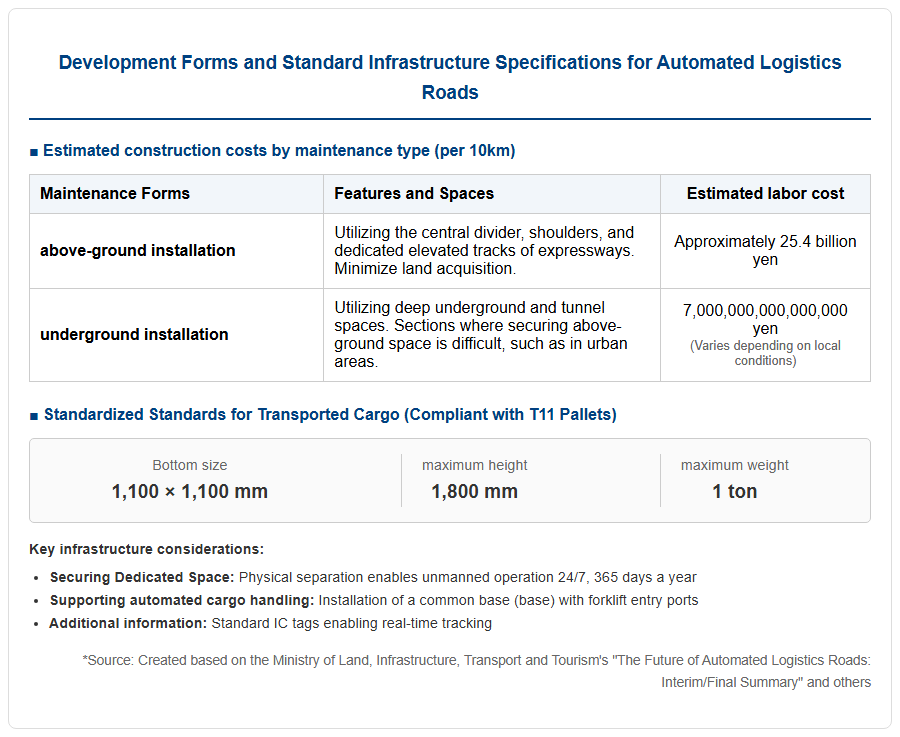
Construction costs vary greatly depending on the development method. For above-ground installation, the estimated construction cost per 10 km is estimated at about 25.4 billion yen, while for underground installations, the range varies from 7 billion to 80 billion yen depending on local conditions. To connect the approximately 500 km distance between Tokyo and Osaka, using ground-based installation would require a massive investment totaling approximately 1.27 trillion yen. The Infrastructure Subcommittee is conducting a detailed review of technical specifications such as tunnel inner diameter, gradient, and curve radius to achieve optimal structures that achieve high transportation efficiency while keeping these enormous construction costs in check.
Standardization of transport targets and adoption of T11 pallets
In automated logistics roads, the key to achieving efficient unmanned transportation is thorough standardization of cargo forms. For this system, it has been decided to adopt the widely used “T11 type pallet” (1100mm×1100mm) as the standard specification for this system. Specific requirements have been set for the cargo to be loaded: height must be 1800mm or less, and weight must be up to 1 ton.
At the bottom of the luggage, a dedicated base with forklift slots is installed, designed to enable smooth automatic loading and unloading using unmanned cargo handling equipment. Furthermore, each package is equipped with an IC tag, and by standardizing information, the policy is to enable real-time tracking and management across the entire system. Such detailed specification setting is an essential process to ensure automation not only on the main road lines but also at transshipment points, preventing congestion throughout the entire supply chain.
Roadmap for Social Implementation and Future Focus
Timeline and Goals of the Phased Proof-of-Concept Experiment
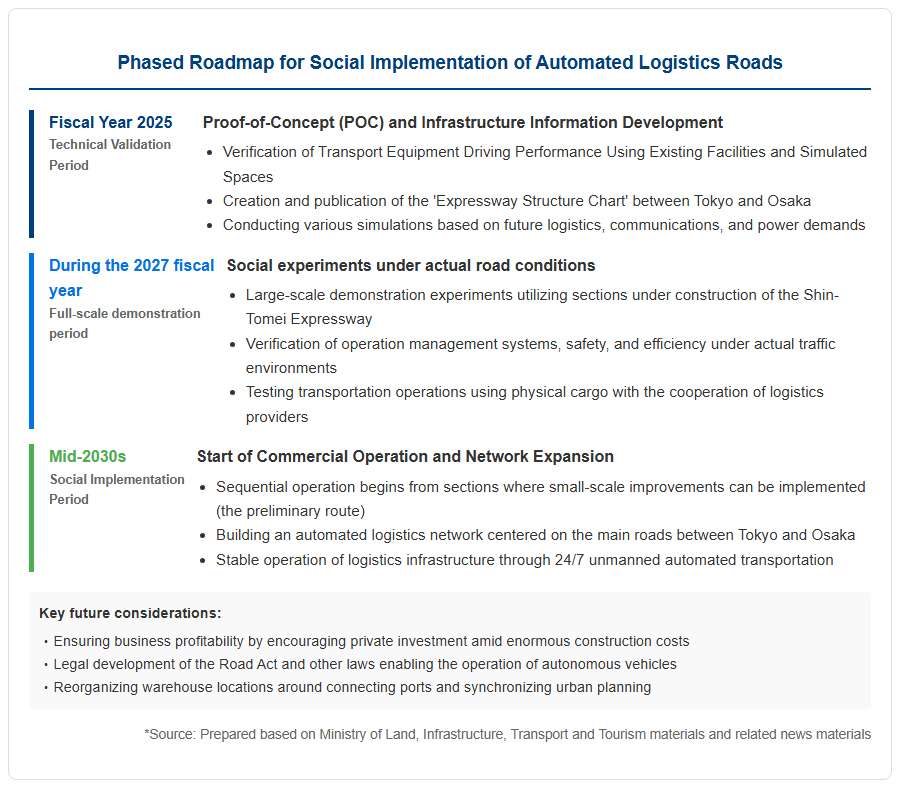
To realize automated logistics roads, the Infrastructure Subcommittee has formulated a phased roadmap aiming for operational commencement by the mid-2030s. First, in fiscal year 2025, a demonstration experiment (POC) utilizing existing facilities and simulated spaces will be conducted. At this stage, technical validation is conducted on six key use cases, including the driving performance of transport equipment, efficiency in loading and unloading operations with unmanned cargo handling devices, and communication stability.
As the second phase, a full-scale social experiment is planned in fiscal 2027, utilizing actual road environments such as the Shin-Hadano to Shin-Gotemba section of the Shin-Tomei Expressway, which is under construction. Here, we plan to conduct actual traffic management systems under actual traffic conditions and test transportation using actual cargo in cooperation with logistics operators. By the mid-2030s, we aim to start operations ahead of schedule in areas with severe congestion near major cities, ultimately aiming to build a network covering Japan’s largest logistics artery from Tokyo to Osaka. For specific schedules, please refer to the table below.
Future Issues and Financial and Legal Issues to Be Addressed
One of the major issues the Infrastructure Subcommittee should address going forward is ensuring business profitability and managing financial risks. Surveys of private businesses have highlighted financial risks such as uncertainty in logistics demand amid enormous construction costs. Since the government taking the lead in development risks competition with other transportation modes and so-called pressure on private enterprises, considerations such as the SPC (Special Purpose Company) system are being advanced to maximize private sector vitality.
Additionally, legal frameworks to support unmanned autonomous driving systems are also an urgent issue. Since current systems such as the Road Act and Road Traffic Act assume manned driving, it is necessary to amend the Road Structure Ordinance to allow unmanned vehicles, clarify responsibility systems in the event of accidents, and establish safety standards. Furthermore, it has been pointed out that this massive infrastructure could accelerate the relocation of surrounding warehouses, raising the question of how to envision grand designs for society as a whole, such as new urban planning centered on connecting ports and optimal role sharing with existing modal shift means such as railways and shipping.
[#自動物流道路 #国土交通省 #物流2024年問題 #インフラ整備 #自動運転 #モーダルシフト #カーボンニュートラル #DX]


コメント