On July 15, 2026, the ruling party’s Development Committee made a final decision to adopt the ‘Katsuragawa Plan,’ which would establish a new station near JR Katsuragawa Station in the suburbs of Kyoto City for the Hokuriku Shinkansen extension route between Tsuruga and Shin-Osaka. Behind this decision lies a political milestone in which the LDP and Nippon Ishin no Kai agreed in the long-standing route debate.
- After years of debate, the ‘Katsuragawa Proposal’ brings an end to the unanimous efforts of the LDP and Japan Innovation Party.
- Establishment of the new station ‘Shin-Kyoto Station’ and the structure of the Obama-Kyoto route
- Construction cost of 3.9 trillion yen, the harsh reality of 26 years of construction
- Validity derived from the new evaluation indicator, ‘Integrated Evaluation’
- The ‘North-South Plan’ Directly Below Kyoto Station Faced Environmental and Cost Barriers
- The intentions of JR West and Shiga Prefecture, and the reason the Maibara route was not chosen
- Opaque negotiations over securing funding and the municipality’s share of the burden
- Environmental Assessment and Parallel Efforts to Solve Conventional Line Issues
After years of debate, the ‘Katsuragawa Proposal’ brings an end to the unanimous efforts of the LDP and Japan Innovation Party.
At the ruling party’s development committee meeting for the Hokuriku Shinkansen held on the morning of July 15, 2026, the extension route west of Tsuruga, which had long been postponed, was unified under the ‘Katsuragawa Plan.’ Although the development policy for this plan was initially decided in 2016 as the ‘Obama-Kyoto Route,’ there has been intense debate over how to pass through Kyoto City due to environmental impacts and construction costs.
A major deciding factor in this decision was the mediation between the ruling Liberal Democratic Party and the largest opposition party, the Japan Innovation Party. As of July 10, 2026, the LDP supported both the ‘North-South Plan’ and the ‘Katsuragawa Plan’ running directly under Kyoto Station, while Ishin had proposed the ‘Maibara Route’ and ‘Katsuragawa Plan,’ which envisioned through the Tokaido Shinkansen. Since the only proposal both parties had jointly presented was the Katsuragawa plan, it emerged as a leading candidate and was ultimately agreed upon. Initially, the Japan Innovation Party sought routes other than via Obama, aiming not to be bound by the Cabinet decision from 50 years ago, but ultimately landed by adjusting the routes at passing points while maintaining the existing Obama-Kyoto route within the framework of the Cabinet decision.
Establishment of the new station ‘Shin-Kyoto Station’ and the structure of the Obama-Kyoto route
The Katsuragawa Plan is a route that heads south from Obama City, Fukui Prefecture, about 5 kilometers west of central Kyoto City, where a Shinkansen station is installed underground near Katsuragawa Station on the JR Kyoto Line (Tokaido Main Line). Regarding this new station, Shoji Nishida, co-chairman of the ruling party’s Development Committee, positions it as “truly a Shin-Kyoto Station,” and expects Shin-Osaka Station to play a role similar to that of Osaka’s hub. Please refer to the diagram below.
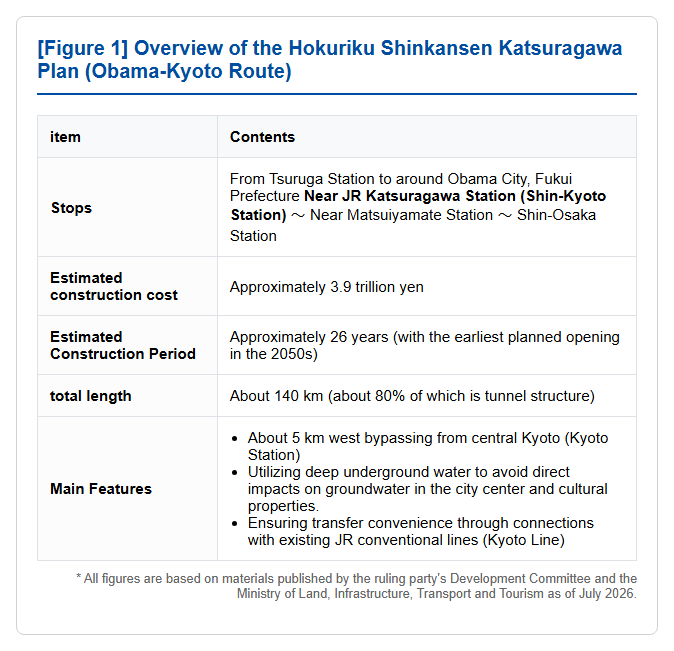
The specific route layout is designed to enter Kyoto Prefecture from near Obama City in Fukui Prefecture, bypassing the city center within Kyoto City. This is expected to help mitigate the previously feared extremely difficult construction in deep underground areas and the direct impact on the concentrated historical cultural properties and groundwater resources around Kyoto Station. Katsuragawa Station can connect with existing JR conventional lines, and from there, the line continues further south via the area near Matsuiyamate Station on the Gakkentoshi Line, ultimately reaching Shin-Osaka Station, making it a total length of about 140 kilometers. With this route finalized, the national project to connect the Hokuriku region and the Kansai area solely by Shinkansen is finally moving toward concrete construction stages.
[Economic Aspects] Verification of the massive investment of 3.9 trillion yen and cost-effectiveness
Construction cost of 3.9 trillion yen, the harsh reality of 26 years of construction
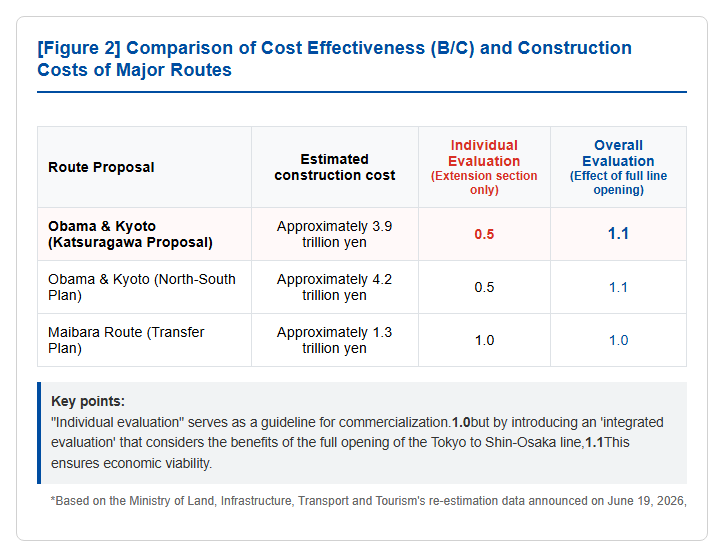
According to the latest estimates presented by the Ministry of Land, Infrastructure, Transport and Tourism, the estimated construction cost of the Katsuragawa plan is about 3.9 trillion yen. This is about 300 billion yen lower than the approximately 4.2 trillion yen of the previously strong “North-South Plan” passing directly under Kyoto Station, which was a strong route comparison presented in June 2026. However, compared to the approximately 1.3 trillion yen ‘Maibara Route’ (Maibara Transfer Plan), which can reduce costs via Shiga Prefecture, this requires nearly three times the investment.
The construction period is also expected to be extremely long, with the shortest required being about 26 years. The main factor is the planned difficult construction of the tracks at a very deep location, 50 meters underground. Even if full-scale construction begins within fiscal 2027, the opening will be delayed until the mid-2050s. The recent surge in labor and material costs has become a serious issue across the entire construction industry, and further increases cannot be ruled out in the future. This massive investment and nearly 30-year construction period are expected to place a heavy burden on national finances and future users, making transparency in planning and steady schedule management strongly demanded.
Validity derived from the new evaluation indicator, ‘Integrated Evaluation’
A key point of contention in selecting the Hokuriku Shinkansen extension route was the method for calculating cost-effectiveness (B/C). In the re-estimation results published by the Ministry of Land, Infrastructure, Transport and Tourism on June 19, 2026, a new indicator called “integrated evaluation” was introduced, in addition to the “individual evaluation” that targeted only the extension section (Tsuruga–Shin-Osaka) that had been used before, as well as the benefits of the full opening of the Tokyo-Shin-Osaka line.
In this integrated evaluation, the Obama-Kyoto route, including the Katsuragawa plan, recorded a score of “1.1,” exceeding the 1.0 standard for project validity. On the other hand, in the individual evaluation of the extension section only, the Katsuragawa plan only scored “0.5,” resulting in a harsh result where only half the benefits are commensurate with the investment amount. The integrated evaluation method is mainly used in road maintenance and similar fields, and this is the first case of such evaluation for the Shinkansen development. Cautious factions such as Ishin argued that this might be a convenient indicator for deciding on the Obama-Kyoto route, but ultimately, the concept of evaluating the Hokuriku Shinkansen as a “network connecting Tokyo and Osaka” became the economic basis supporting the route decision. Please refer to the diagram below.
[Strategy and Background] Why Was the ‘Katsuragawa’ River Chosen from ‘Kyoto Station’?
The ‘North-South Plan’ Directly Below Kyoto Station Faced Environmental and Cost Barriers
Initially, the main axis of the Obama-Kyoto route was considered as the ‘north-south plan,’ which would include a platform directly beneath the current JR Kyoto Station. However, this proposal faced difficult challenges unique to the city of Kyoto. Underground in Kyoto city, abundant groundwater is said to rival the reservoir of Lake Biwa, and large-scale underground construction in city centers like around Kyoto Station carries a very high risk of water pollution and water level drops.
Moreover, Kyoto City is densely packed with cultural assets such as temples, shrines, and ruins, making it extremely difficult to avoid the impact of ground subsidence and vibrations caused by tunnel excavation on these historical sites. The Kyoto Bar Association also issued a cautious opinion statement in March 2022 expressing concern about the negative impact on the landscape and cultural properties, reflecting persistent opposition from local residents and experts. The Katsuragawa plan was a “desperate measure” and at the same time a “practical compromise,” aiming to avoid these delicate central areas and detour about 5 kilometers westward to minimize environmental impact while maintaining its function as Kyoto’s gateway.
The intentions of JR West and Shiga Prefecture, and the reason the Maibara route was not chosen
The ‘Maibara Route’ was always a key comparison during the route selection process. This proposal connects to the Tokaido Shinkansen at Maibara Station, and its biggest advantage was that the construction cost would be less than half that of the Katsuragawa plan. However, as a result, it was never adopted. The main reason for this is the difficulty of coordinating with JR Central, which operates the Tokaido Shinkansen. The Tokaido Shinkansen timetable was already extremely crowded, with no capacity to accommodate Hokuriku Shinkansen trains, and operational challenges arising from system differences were pointed out.
Additionally, the circumstances on the Shiga side had a significant impact. Under the Shinkansen Development Act, the municipality passing through the line must bear part of the construction costs, but Shiga Prefecture strongly opposed the huge burden, arguing that “just passing through the prefecture brings little benefit.” Meanwhile, JR West was concerned about the separation of management on the Hokuriku Main Line, which would run parallel to conventional lines, and the impact on the existing timetable. The failure to coordinate with stakeholders such as JR, the main operator, and Shiga Prefecture, which was required to bear the burden, is the reason the cost-effective Maibara route was rejected.
[Future Developments & Points to Watch] High hurdles to start construction and remaining challenges
Opaque negotiations over securing funding and the municipality’s share of the burden
Although the route has been decided, you must meet the “Five Conditions for Starting Construction” to actually start construction. Among these, securing funding is a particularly significant barrier. The construction costs of the Hokuriku Shinkansen will be borne by the national government and local governments, but the real stage of coordination with Kyoto and Osaka prefectures, which are the local governments along the line, is still to be shared with the massive 3.9 trillion yen cost. In particular, Kyoto City maintains a negative stance toward excessive burdens, stating that it has not attracted the city due to financial difficulties.
Although the government is considering ways to reduce the burden on local governments, the funding sources for specific reduction measures remain unclear. Currently, the main funding source for the Shinkansen development is the loan fees from JR, which are being moved ahead of schedule for the Hokkaido Shinkansen’s extension to Sapporo, leaving limited capacity to invest in the Hokuriku Shinkansen. To aim for approval to start construction within fiscal 2027, it is necessary to establish a path over this funding issue within the next few years, and intense competition between the national and local governments is expected.
Environmental Assessment and Parallel Efforts to Solve Conventional Line Issues
There are also numerous technical and environmental challenges in construction. First, since about 80% of the total length of the 140-kilometer tunnel will be tunnels, it is estimated that the amount of sediment (construction soil) generated will reach approximately 8.8 million cubic meters. This is an enormous amount, enough to fill Koshien Stadium to a height of about 228 meters, making it difficult to secure a disposal site. It is necessary to properly carry out the environmental impact assessment procedures and gain understanding from local residents.
Furthermore, the problem of “parallel conventional lines,” where management is separated from JR after the Shinkansen opens, is also serious. Although the current Katsuragawa proposal does not pass through Shiga Prefecture, discussions have been ongoing for some time regarding the continuation of the Kosei Line running through Shiga Prefecture. While the convenience of the Shinkansen improves, consensus building is essential to avoid situations where conventional lines, which serve as transportation for local residents, become inconvenient or strain local government finances. As detailed route design and environmental surveys progress, what solutions will be presented to address these specific challenges will be the biggest focus for the full line opening in the 2050s.
[#北陸新幹線 #桂川案 #整備新幹線 #日本経済 #インフラ整備 #JR西日本 #新京都駅 #地域活性化]


コメント