Anthropic announced that its top-tier AI model, “Claude Fable 5,” which had been temporarily suspended due to U.S. government export control directives, will be integrated as a standard feature in paid subscription plans starting July 20, 2026. This decision is the result of finding a balance between supply capacity and safety after two rounds of extended free provision periods.
- The journey from export restrictions to permanent integration
- Introducing Boundaries and Leveling Access by Plan
- The Mythos class has reached the pinnacle of reasoning ability.
- The mechanism of the new generation of ‘safety classifiers’ that was key to lifting regulations
- The Importance of Economics and Cost Management After Switching to Pay-As-You-Go
- Geopolitical Risks and the Advent of the “Two-Layer AI” Era
The journey from export restrictions to permanent integration
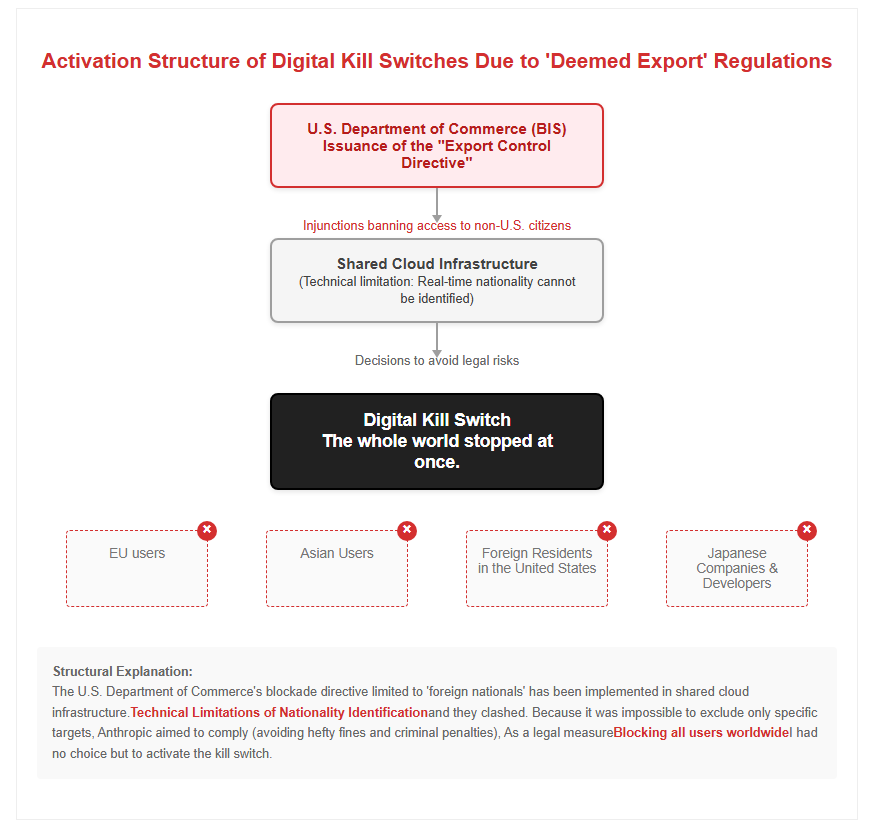
Claude Fable 5 made a spectacular debut on June 9, 2026, as the public version of Anthropic’s new top-tier “Mythos Class.” However, just 72 hours after its release, on June 12, an Export Control Directive issued by the U.S. Department of Commerce under the Trump administration led to an unprecedented global halt in supply. This directive completely prohibited access to foreign nationals without U.S. citizenship, but since there was no technical means to determine users’ nationalities in real time, the company activated a digital kill switch for all users to avoid legal risks.
After discussions with the Department of Commerce and strengthened security measures, global access was finally reopened on July 1. Initially, the subscription period was limited until July 7, but due to difficulties in predicting user demand, the deadline was extended twice: July 12, and then July 19. Just before the July 19 deadline, Anthropic decided to officially integrate this model as a standard feature in certain paid plans starting July 20. This turbulent process symbolizes that cutting-edge AI is no longer just a commercial service but is now treated as a strategic asset related to national security.
Introducing Boundaries and Leveling Access by Plan
With the official operational system starting July 20, 2026, usage conditions will be clearly divided according to the tier of the paid plan. First, for the top plans “Max” and “Team Premium,” Claude Fable 5 will be integrated as a standard feature. These users can allocate up to 50% of the weekly usage limit set for each plan to Fable 5 at no additional cost. Anthropic chose this phased rollout to provide a clear outlook for those who intensively use Fable 5.
On the other hand, for the “Pro” and “Team Standard” plans, the grace period previously offered within the monthly fee range ends, and the plan will switch to a fully pay-as-you-go (credit usage system). As a transitional measure, eligible users will receive a one-time credit worth $100, but additional credit purchases will be required for subsequent uses. Similarly, the standard “Enterprise” plan is accessed only by purchasing credit usage. The company explained this measure as a temporary demand management measure due to server capacity limits, and has indicated intentions to restore it as a benefit of broader subscription plans as infrastructure expansion progresses in the future.
A Paradigm Shift in Technical Specifics and Safety
The Mythos class has reached the pinnacle of reasoning ability.
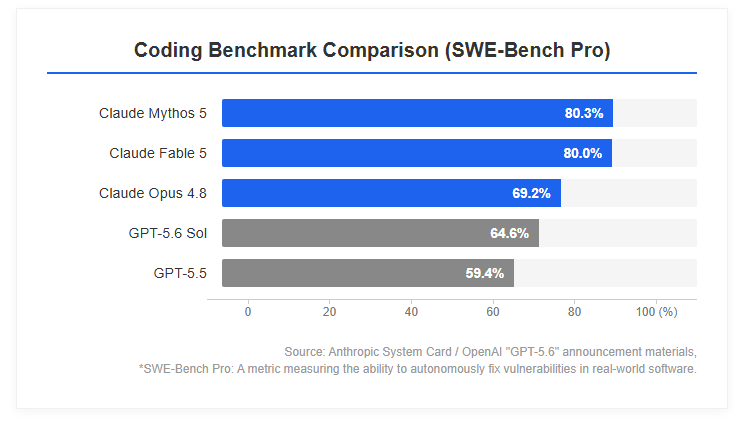
The main reason Claude Fable 5 was considered a national security threat and subject to regulation lies in its outstanding technical performance. This model is the first publicly available model in the “Mythos class,” surpassing the traditional “Opus” class, and it has recorded outstanding performance in software engineering and advanced reasoning. On the coding benchmark “SWE-Bench Pro,” Fable 5 achieved an astonishing 80%, far ahead of its competitor OpenAI’s GPT-5.6 Sol, which recorded 64.6%. Please refer to the diagram below.
In a specific case study, payment giant Stripe utilized Fable 5 to complete a massive codebase migration of 50 million lines in just a few days, which was expected to take several months. It also features asynchronous, long-duration execution capabilities, enabling complex analysis tasks lasting several hours without human intervention. Such “godlike” computing capabilities accelerate scientific research such as pharmaceutical design tenfold, and can also be repurposed for generating exploit code for cyberattacks, resulting in the U.S. government receiving the same level of caution as “critical infrastructure classified as top secret.”
The mechanism of the new generation of ‘safety classifiers’ that was key to lifting regulations
The biggest technical factor that ended the 19-day service outage and enabled redeployment was the implementation of the revamped Safety Classifier. This system acts as a gatekeeper, operating independently of the model itself in real time. When prompts related to high-risk areas such as cybersecurity, biological weapons, chemical weapons, or AI model distillation are input, this classifier instantly detects them and freezes a powerful Fable 5 response.
When the classifier activates, instead of rejecting the request and terminating it, the system quietly bypasses (fallbacks) processing to the more limited previous generation model, the “Claude Opus 4.8.” When this bypass is processed, the billing is not for the Fable 5 price but for Opus 4.8 applies the low-price standard for fail-safe protection. The U.S. Department of Commerce has described this new safety measure as “extremely strong,” which became the decisive basis for lifting export restrictions. However, due to the increased safety margin, there have been reports of “false positives” where routine debugging tasks are mistakenly flagged and routed to Opus 4.8 unintentionally, and accuracy adjustments are still ongoing.
The reality of operating costs and the future outlook of the AI market
The Importance of Economics and Cost Management After Switching to Pay-As-You-Go
For users outside the subscription tier, using Claude Fable 5 incurs the highest cost in Anthropic’s history: $10 per 1 million input tokens and $50 per 1 million output tokens. This is exactly twice the unit price of the Opus 4.8. It is especially important to note that the Thinking process is always on, and this Thinking token is charged at a high output price. If you operate as an agent in a highly advanced manner such as running long loops, monthly costs can range from several hundred thousand yen to around 1 million yen when running in parallel, which is a realistic estimate.
Several technical measures are recommended for developers to help control these high operational costs. The most powerful is the use of “prompt cash,” which can reduce input costs for large-scale codebases and system prompts by up to 90% ($1 per 1 million tokens). Also, for batch processing that does not require real-time capabilities, using the “Batch API,” which halves the fee, is effective. Furthermore, establishing a routing strategy that dynamically uses Fable 5 and Sonnet 5 ($2 input / $10 output) according to task difficulty is essential to avoid unexpected billing bursts.
Geopolitical Risks and the Advent of the “Two-Layer AI” Era
The series of turmoil surrounding Claude Fable 5 has exposed vulnerabilities in the world’s digital infrastructure to the broad day. The fact that the U.S. Department of Commerce could block API access with a single letter sent a serious shock to companies and governments in other countries regarding the “digital kill-switch.” The diagram below shows the structure that led from the limits of nationality identification to a worldwide shutdown.
This event marked the beginning of the world entering the era of “Two-Tier AI.” Namely, there is a division: a full-spec frontier model accessible only to verified citizens within the United States, and a capability limited version available to other users. In response, the European Union (EU) is advocating for strengthening “Technological Sovereignty” and is rushing to break away from excessive reliance on U.S.-made models. Additionally, to avoid geopolitical risks, companies are accelerating their flight to “open-weight models” that can be hosted in their own environments, and the AI market is being reorganized from a former free innovation space into a new economic zone blocked by strict nationality verification.
コメント