SIGQ Inc. and GetWorks Inc. have announced the joint rollout of an autonomous incident response platform featuring a “closed network × local LLM” architecture that prevents confidential data from leaving the premises. This comes in response to challenges in enterprise sectors requiring strict security standards—such as finance, public services, and social infrastructure—where risks of confidential data leaks and data sovereignty issues have hindered AI adoption.
- Aims of the Joint Demonstration and Collaboration Starting in August 2026
- How the AI Agent “Incident Lake” Transforms On-Site Decision-Making
- Getworks Supports Liquid-Cooled GPUs and Container Data Centers
- Learning from Data Breaches: The Importance of “Sovereign AI”
- The rapid growth of the AI market and the shift toward “task-execution buddies”
- Strategies to Avoid 95% of Failed AI Implementations
- Secure Connections Enabled by the “GWX” Private Network Gateway Service
- Future Outlook: Operational Automation with AI Ops and Contribution to Society
Aims of the Joint Demonstration and Collaboration Starting in August 2026
On August 10, 2026, SIGQ Inc., headquartered in Tsukuba, Ibaraki Prefecture, and GetWorks Inc., based in Chiyoda-ku, Tokyo, announced a strategic partnership for the provision of “Incident Lake,” an autonomous AI in the incident management domain. The primary objective of this collaboration is to jointly build the local LLM (Large Language Model) and application operating environment used by Incident Lake, deploying a secure operational infrastructure within closed networks to the enterprise market. Beginning in August 2026, the two companies will launch joint verification tests to provide a fully domestic AI infrastructure that completely prevents external data leakage for enterprises in finance, public utilities, and social infrastructure sectors with stringent security requirements.
Please refer to the diagram below.
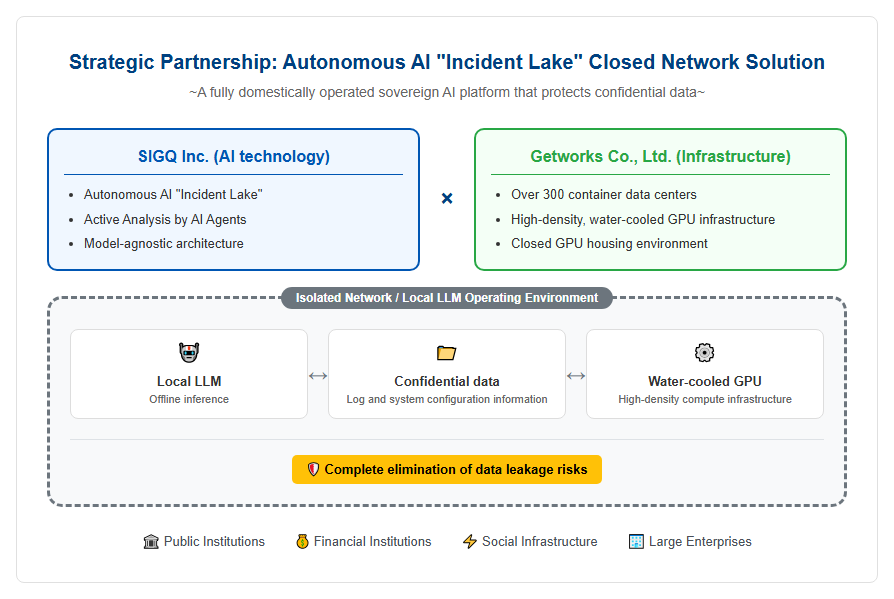
This initiative responds to the urgent operational need to handle highly confidential failure logs and configuration data—something that has been difficult to address with conventional cloud-based AI. By leveraging GetWorks’ track record of building over 300 containerized data centers and its know-how in operating water-cooled GPU infrastructure, companies with strict security policies that prohibit the use of public LLMs can now implement advanced incident response using autonomous AI. The combination of SIGQ’s autonomous AI technology and GetWorks’ physical infrastructure technology establishes a comprehensive domestic framework supporting everything from implementation to operation and maintenance.
How the AI Agent “Incident Lake” Transforms On-Site Decision-Making
Developed by SIGQ, “Incident Lake” is not merely a task-efficiency tool, but an autonomous AI system where AI agents proactively aggregate and analyze logs. When a system failure occurs, the AI instantly presents the shortest path to resolution. This frees operational managers from the burden of confirming “what is happening,” allowing them to focus on essential decision-making regarding “how to respond.” For SRE teams operating large-scale systems in particular, fragmented information and complex procedures impose a heavy burden, and market expectations are growing—evidenced by a pre-Series A funding round totaling 123 million yen in February 2026.
The core of this product lies in an architecture independent of any specific LLM. While incorporating cutting-edge reasoning capabilities from models like Google Gemini, OpenAI ChatGPT, and Anthropic Claude, it accumulates organization-specific “tacit knowledge” and “past lessons” as structured data, creating a mechanism where the organization’s unique decision-making accuracy improves the more it is used. This collaboration makes it possible to run this advanced intelligence within a closed network environment isolated from the internet, dramatically enhancing security when AI learns from and utilizes highly confidential operational data.
Getworks Supports Liquid-Cooled GPUs and Container Data Centers
Getworks Co., Ltd., which is responsible for the infrastructure side of the collaboration, is a top-tier Japanese company with a track record of building over 300 containerized data centers. The company specializes in operating liquid-cooling infrastructure to support high-density GPU servers and can construct various types tailored to site environments and specific needs. As of January 2026, it has deployed over 270 20-foot containers and more than 30 40-foot containers, with deliveries to demanding clients such as major corporations, electric power companies, and hospitals.
In this collaboration, SIGQ’s local LLM operating environment will be built on the liquid-cooled GPU infrastructure and private GPU housing environment provided by GetWorks. Their containerized data centers feature fully in-house design and domestic production, enabling short lead times and low costs, with the agility to deliver and make them operational in as little as 10 days from the initial request. Furthermore, the company has formed business partnerships with NTT Com and NTTPC, driving the development of network services and distributed IT platforms tailored for the AI era. This robust physical infrastructure serves as the foundation for securely operating autonomous AI.
Rising Security Demands and the Necessity of “Closed Networks × Local LLMs”
Learning from Data Breaches: The Importance of “Sovereign AI”
Security risks in AI adoption have already materialized as real threats. In March 2023, an engineer at a major electronics manufacturer entered confidential information into a generative AI tool, resulting in the leakage of source code and meeting contents. The leaked information could not be recovered, severely damaging the company’s reputation. Against this backdrop, particularly in fields handling highly sensitive data related to incident response—such as finance and social infrastructure—many companies are unable to feed data into public LLMs. As a result, the demand for “local LLMs” operating on self-managed infrastructure is rapidly growing.
Please refer to the diagram below.
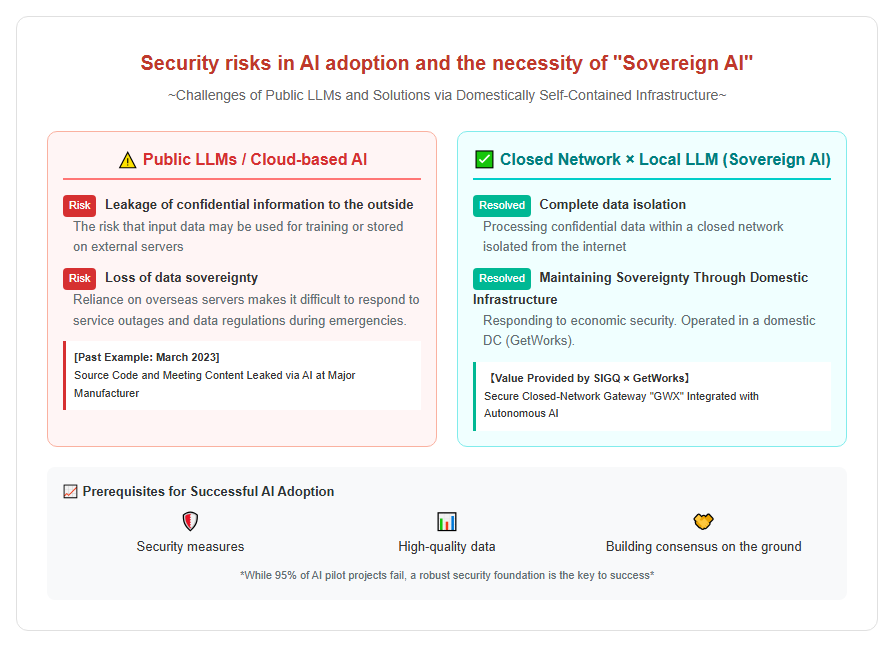
Furthermore, excessive reliance on LLMs running on overseas servers poses risks regarding data sovereignty and service continuity. To prevent service outages and data leaks overseas during emergencies, the concept of “Sovereign AI”—completing AI operations entirely on domestic infrastructure—is gaining importance. By keeping everything from infrastructure to applications within Japan, the collaboration between SIGQ and GetWorks aims to contribute to the realization of a secure and safe digital society aligned with economic security.
The rapid growth of the AI market and the shift toward “task-execution buddies”
The domestic AI market is projected to experience explosive growth over the next few years. According to IDC research, spending on the domestic AI market—which stood at 2.3725 trillion yen in 2025—will surge 2.9-fold to reach 6.8897 trillion yen by 2029, accounting for 20% of the entire IT market. 2026 is expected to be positioned particularly as the “inaugural year of practical business applications for AI agents,” marking a structural shift in how AI is utilized: moving from a conventional “work assistant” to a “business buddy” integrated directly into workflows.
AI agents, such as those provided by SIGQ, hold the key to this growth. The growth rate of the AI software market is projected to reach a compound annual growth rate (CAGR) of 48.9%, significantly outpacing the broader AI market. Meanwhile, an IDC enterprise user survey reveals that 60% of companies failed to achieve their expected results in Proofs of Concept (PoCs). To succeed, it is essential to move beyond auxiliary roles like translation and summarization, shifting use cases toward business automation and autonomy. SIGQ’s “Incident Lake” aims to bring this transition to life in an area directly tied to practical operations: incident response.
Strategies to Avoid 95% of Failed AI Implementations
According to a study by the MIT Media Lab, shocking data shows that 95% of generative AI pilot projects end in failure. The primary reasons for AI implementation failure include ambiguous goal-setting, poor data quality, and inadequate security measures. Particularly regarding security, a lack of proper rules and precautions can lead to unexpected data leaks and soaring management costs, significantly increasing the risk of the entire project collapsing.
SIGQ and GetWorks’ closed-network solutions provide a concrete answer for avoiding these typical failure patterns. Establishing a high-quality data infrastructure and robust security measures are prerequisites for successful AI adoption. By building a mechanism that keeps confidential data from leaving the network, organizations can deploy AI in practical operations while complying with regulations and internal policies. Furthermore, the draft update to the government’s AI business operator guidelines released in March 2026 once again emphasizes risk management for autonomous AI and the implementation of safety mechanisms, making this closed-network configuration precisely aligned with the demands of the times.
The Future Paved by Next-Gen Infrastructure “GWX” and AI Agents
Secure Connections Enabled by the “GWX” Private Network Gateway Service
Getworks has launched “GWX,” a closed-network Gateway service that serves as a crucial piece for securely processing critical data. This service builds a secure closed network between users and resources such as GPU servers within a container data center, enabling direct communication without going through the internet. As a result, companies that previously struggled to use external AI due to internal regulations or auditing reasons can now safely process their proprietary confidential and personal information using AI.
One of the major features of GWX is its flexible connection methods. In addition to dedicated line connections, it also offers wireless connectivity using multi-carrier SIM cards, allowing service to begin as early as the same day without the need for line installation work. This enables a phased rollout—such as starting small with SIM connections via laptops or Wi-Fi routers, and later building a low-latency environment by installing a dedicated line. While external network connections are blocked by default, it also supports fine-grained customization tailored to enterprise requirements, such as optionally permitting communication with a connection audit function.
Future Outlook: Operational Automation with AI Ops and Contribution to Society
The collaboration between SIGQ and GetWorks goes beyond merely delivering a single product; it envisions the realization of “AI Ops” to fundamentally transform data center operations. GetWorks is committed to automating and advancing data center operations through AI Ops, and is convinced that SIGQ’s “Incident Lake” is an exceptional solution that brings this vision to life. By allowing AI to autonomously detect incidents and support or automate responses, it is possible to enhance the reliability and resilience of the infrastructure itself.
In the future, the two companies plan to develop further value-added services centered around offerings in closed-network environments. Specifically, plans include inter-site quantum cryptographic communication, advanced audit logging features, and closed-network demos for image and video generation AI, accelerating the expansion of Japan’s AI and IT infrastructure. As AI evolves from a human “assistant” to a “buddy” and the domestic AI market approaches 7 trillion yen by 2029, establishing an environment to leverage AI on a secure and reliable foundation will serve as a crucial infrastructure strategy to support the international competitiveness of Japanese enterprises.
Reference page
-
【SIGQ Inc., developer of incident-management-focused Agentic AI “Incident Lake,” raises 123 million yen in first close of Pre-Series A round】https://prtimes.jp/main/html/rd/p/000000011.000149500.html
-
GetWorks Launches “GWX,” a Closed-Network Gateway Service for AI Usage
-
【IDC: Japan’s AI Market to Triple Over the Next 4 Years: Domestic AI Spending to Approach 7 Trillion Yen in 2029】https://www.idc.com/resource-center/blog/国内ai市場は今後4年で約3倍に成長:-2029年の国内ai市場/
[#AI #AutonomousAI #IsolatedNetwork #Security #EconomicSecurity #IncidentManagement #DX #DataCenter]
コメント