The development of next-generation autonomous driving semiconductors funded by public money is finally moving into full swing. Behind this initiative lies a massive national investment roadmap centered on economic security under the Takaichi administration, along with an ambitious growth strategy aimed at capturing a global share of the autonomous vehicle market.
- Tier IV Joins JST Project to Develop Custom SoC for Level 4
- Open Design Assets and TOSA Adoption to Streamline E2E Autonomous Driving AI
- Roadmap for AI and Semiconductor Investment Projected to Exceed 100 Trillion Yen by 2040
- National target aiming for a 25% global share in autonomous vehicles in the 2030s
- A new development framework directly connecting automakers and semiconductor makers
- Can they break away from public support and generate self-reliant value?
Tier IV Joins JST Project to Develop Custom SoC for Level 4
Under the Takaichi administration, a new national project has been launched to achieve self-reliance in Japan’s autonomous driving technology. It was revealed on August 21, 2026, that TIER IV, an autonomous driving software startup, will participate in a next-generation edge AI semiconductor R&D project promoted by the Japan Science and Technology Agency (JST). In this project, TIER IV will develop a software-defined system-on-chip (SoC) specialized for Level 4 autonomous driving—fully autonomous driving under specific conditions. In current autonomous driving development, a major challenge is the rising power consumption on the cloud side due to the surge in data processing volumes. Consequently, there is a pressing need for innovative, ultra-low-power in-vehicle AI semiconductors capable of advanced edge processing directly on the vehicle. The core of this initiative is to rapidly bridge academic expertise to industry in alignment with national strategies, establishing foundational technologies to support next-generation industries from the mid-2030s onward.
Open Design Assets and TOSA Adoption to Streamline E2E Autonomous Driving AI
TIER IV is participating in a research and development project led by Professor Yoshihiro Kawahara of the Graduate School of Engineering at the University of Tokyo, taking on the logical design of AI chips that streamline inference processing for end-to-end (E2E) autonomous driving AI. This project aims to develop a dedicated architecture that optimizes the processing of large-scale Transformer models—which seamlessly handle camera images and sensor data—by reducing data transfers with external memory.
The diagram below illustrates the system integration concept for next-generation edge AI semiconductor R&D.
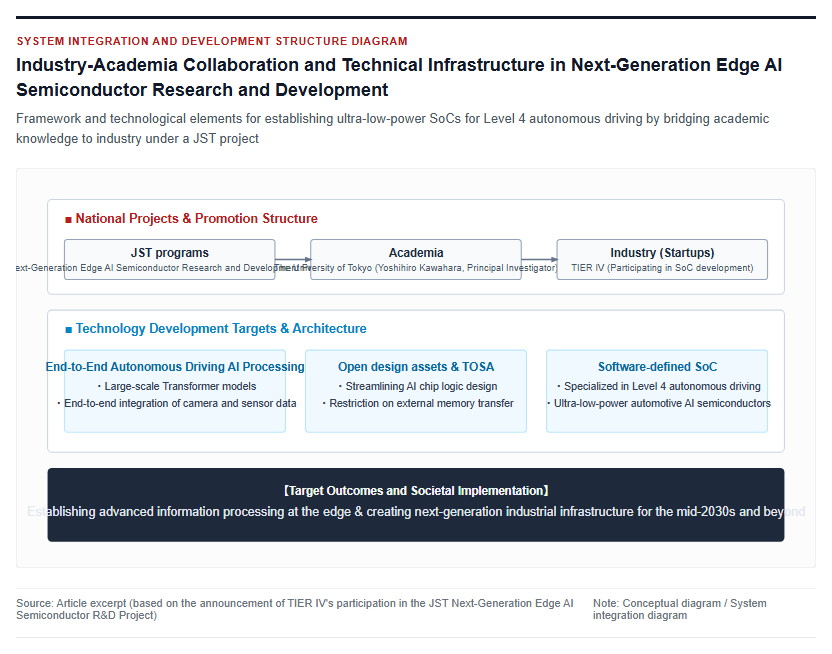
A key feature of this project is the open-sourcing of the toolchain—including logical design and compilers for AI chips compatible with Autoware, an open-source software for autonomous driving—thereby building an open ecosystem independent of specific semiconductor manufacturers. Furthermore, by introducing TOSA (Tensor Operator Set Architecture), a standardized intermediate representation between AI models and hardware, it realizes a flexible software-defined SoC capable of adapting to rapid advancements in AI technology solely through software updates.
Why This Matters Now: The Takaichi Administration’s Growth Strategy and Autonomous Driving Market Share Targets
Roadmap for AI and Semiconductor Investment Projected to Exceed 100 Trillion Yen by 2040
The allocation of national funds to the development of autonomous driving semiconductors is driven by the large-scale economic security and growth strategy advocated by the Takaichi administration. According to a public-private investment roadmap released in July 2026, the government has identified 17 strategic fields where Japan should find winning formulas for economic growth, anticipating a total of 370 trillion yen in public-private investment by fiscal 2040. Among these, the AI and semiconductor field, designated as a top-priority area, has been allocated a massive cumulative investment of 101.6 trillion yen by fiscal 2040. This 101.6 trillion yen breakdown consists of 10.5 trillion yen for physical AI—the foundation of robots and self-driving cars—68.0 trillion yen for semiconductors, which form the core of those systems, and 23.1 trillion yen for vertical AI, a domain-specific form of artificial intelligence.
The figure below shows the breakdown of the public-private investment roadmap for the AI and semiconductor fields toward 2040.
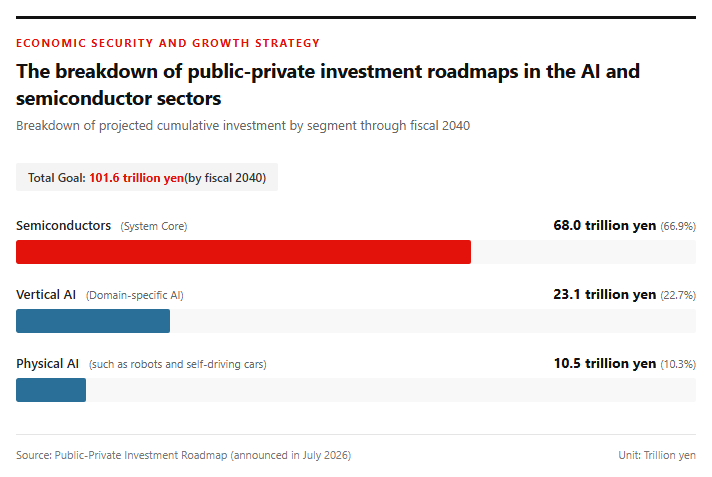
Thus, overwhelming financial and policy resources are being intensively invested as a national strategy into physical AI—which controls physical movement, including autonomous vehicles—and the creation of a rock-solid domestic semiconductor manufacturing base to power it.
National target aiming for a 25% global share in autonomous vehicles in the 2030s
The Japanese government views autonomous driving not merely as a subject of technological development, but as its greatest growth strategy in the digital and cybersecurity sectors. According to a draft roadmap presented by the Strategic Sector Subcommittee of the Japan Growth Strategy Council, the government has set an extremely ambitious goal of securing approximately 25% of the global market share in autonomous vehicle sales by the 2030s. Currently, the U.S. and China are ahead in terms of actual commercial services and business implementation for autonomous driving. However, Japanese automakers have historically maintained about a 25% share of global vehicle sales, building powerful sales networks and highly reliable manufacturing technologies worldwide. By maximizing these existing strengths and resolving mass-production bottlenecks—such as AI development investment for E2E autonomous driving systems, the establishment of computing infrastructure, and a shortage of driving data—through public-private collaboration, the plan is to rapidly catch up with the front-running U.S. and China.
The Path to Success: Learning from Industry Structural Changes and Past Lessons
A new development framework directly connecting automakers and semiconductor makers
To achieve autonomous driving, the traditional vertical pyramidal supply chain structure of the automotive industry must be fundamentally transformed. In the conventional structure, automakers sat at the top, followed by Tier 1 suppliers providing electrical systems, and Tier 2 suppliers providing semiconductors underneath them. However, developing advanced systems-on-chip (SoCs) for autonomous driving requires transitioning to a partnership triangle where automakers and semiconductor design and manufacturing companies directly join forces to rapidly coordinate specifications. To accelerate this transformation in Japan, 14 domestic companies—including automakers, electrical component manufacturers, and semiconductor-related firms—banded together on December 1, 2023, to establish the Advanced SoCs Research for Automotive (ASRA) association. ASRA is advancing joint research to adapt proven consumer-use chiplet technology for automotive applications, working to establish elemental technology with the aim of deployment in mass-produced vehicles by 2030 and beyond.
Can they break away from public support and generate self-reliant value?
Although autonomous driving semiconductor development is receiving substantial public support, Japan’s past semiconductor industry holds a somber lesson. Elpida Memory, which once boasted world-class miniaturization technology as the country’s only dedicated DRAM manufacturer, received a public fund injection in 2009. This bred a sense of complacency that the government would never let it fail. Lacking sweeping reforms and the financial and management strategies to weather economic downturns, it was forced into bankruptcy in 2012.
Meanwhile, Renesas Electronics, which faced a similar crisis, received public-private support while eliminating its internal blame-shifting culture and executing structural reforms without sacred cows under proper governance with client companies, successfully transforming into a highly profitable entity. In future autonomous driving semiconductor development, completely eradicating complacency driven by government backing and continuously maintaining unique technological value and strict managerial discipline will be the ultimate key to winning international competition and achieving true societal implementation.
Reference page
- 【Advanced SoC Research for Automotive (ASRA)】https://asra.jp/
- Ministry of Economy, Trade and Industry: AI and Semiconductor Industry Infrastructure Strengthening Framework
- [Public-Private Investment Roadmap for Key Products and Technologies in 17 Strategic Fields] https://www.cas.go.jp/jp/seisaku/nipponseichosenryaku/pdf/rm2026.pdf
【#AutonomousDriving #Semiconductors #TakaichiAdministration #EconomicSecurity #TierIV #Autoware #ASRA #GrowthStrategy】


コメント