
- The Impact of the Policy Rate Hike to 1.00% and Rising Government Bond Yields
- Trends in Fund Shifts from Deposits to Retail Government Bonds and “Repurchasing”
- Outflow of Funds from Regional Banks and the Rise of Internet Banks and Megabanks
- The Background Behind “Deposit-Deficit-Driven” Loan-to-Deposit Ratio Increases and Simultaneous Inspections by the Financial Services Agency
- Submission of the Member-Introduced “Government Bond NISA Bill” and Cautious Views Over Fairness
- Future Trends in Deposits and Loans and the Outlook for Risk Management in a World with Interest Rates
The Impact of the Policy Rate Hike to 1.00% and Rising Government Bond Yields
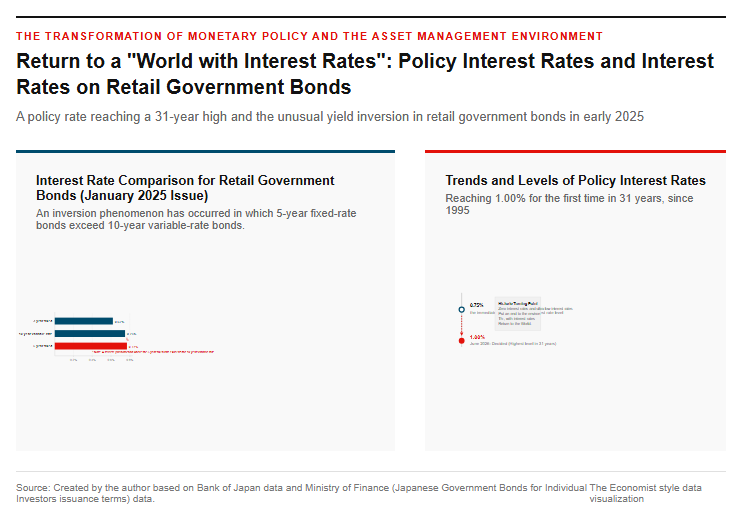
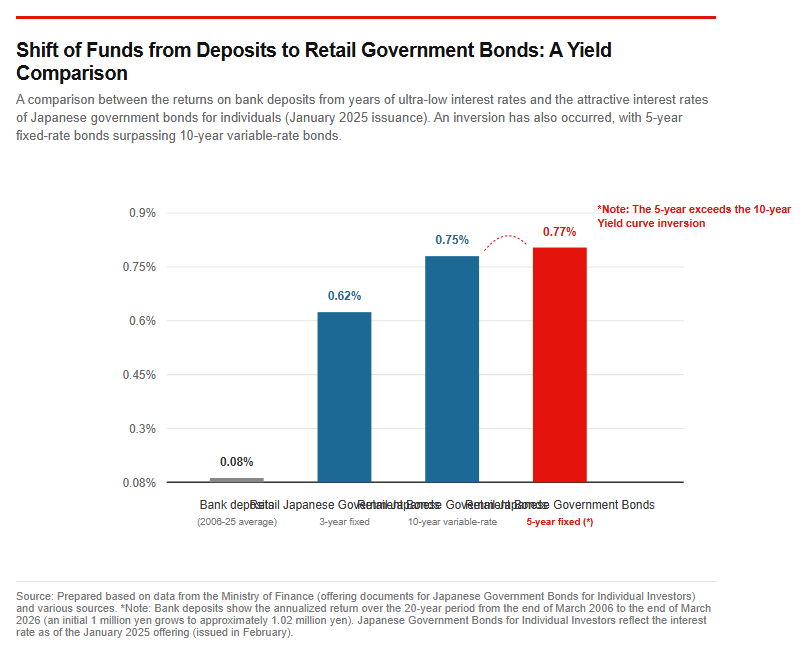
In June 2026, the Bank of Japan decided at its Monetary Policy Meeting to raise the policy rate from 0.75% to 1.00%. This is the highest level in 31 years, not seen since 1995, and marks a historic turning point that solidifies the return to a “world with interest rates” from the long-standing zero-interest-rate policy and ultra-low-interest-rate environment. Along with this historic rate hike, interest rates have also risen in the bond market, causing government bond yields to surge. For example, for Japanese Government Bonds for individual investors offered in January 2025 (issued in February), the interest rate for 3-year fixed-rate bonds was set at 0.62% per annum, and for 5-year fixed-rate bonds at 0.77% per annum. This interest rate level significantly exceeded the general over-the-counter fixed-term deposit rates offered by banks at the time. Furthermore, an interest rate inversion phenomenon occurred where the rate for the 5-year fixed bonds even surpassed the 0.75% per annum rate of the “10-year variable bonds.” As a result, safe government bonds for individuals backed by state principal and interest payments have rapidly emerged as an extremely attractive parking place for funds, replacing deposits, and are bringing about a major tectonic shift in individual asset allocation. Please refer to the figure below regarding the historical changes in Japan’s interest rate environment.
Trends in Fund Shifts from Deposits to Retail Government Bonds and “Repurchasing”
As the yield gap between bank deposits and Japanese Government Bonds (JGBs) for individual investors has become clear, the shift of funds from individual ordinary and time deposits into government bonds is accelerating in earnest. This asset reallocation goes beyond mere new additional purchases, manifesting as a noticeable change even among investors who already hold retail JGBs. Specifically, a savvy investment behavior is spreading where individuals deliberately early-redeem existing government bonds purchased during periods of extremely low interest rates—even paying the penalty of early redemption adjustment charges—to “rebuy” bonds subject to the currently higher interest rates. Behind such behavior lies the harsh reality that it has become difficult to sufficiently grow assets through deposits alone. The annualized return on bank deposits over the 20-year period from the end of March 2006 to the end of March 2026 stood at a mere 0.08%, meaning that depositing the same 1 million yen for 20 years would only yield about 1.02 million yen. Furthermore, amid concerns that the real value of money will diminish under inflation, the movement of individual investors shifting funds in pursuit of higher interest income is accelerating. Please refer to the figure below regarding individual trends concerning where assets are placed.
The “Deposit Outflow” Threatening the Banking Industry and the Crisis of Rising Loan-to-Deposit Ratios
Outflow of Funds from Regional Banks and the Rise of Internet Banks and Megabanks
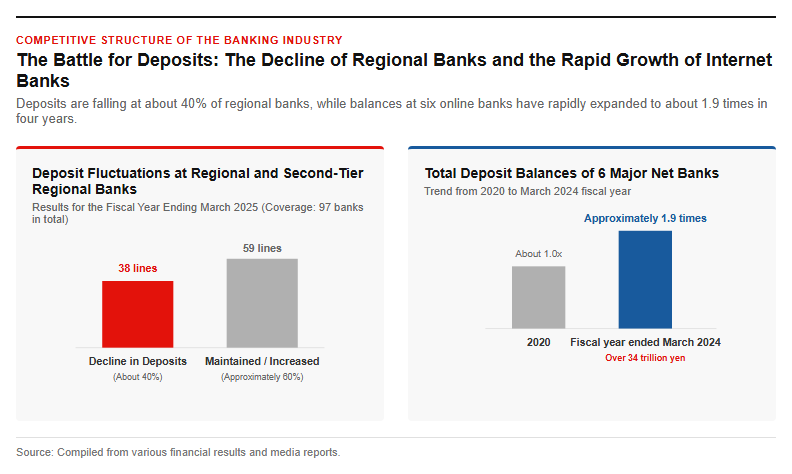
It has become clear that the conventional wisdom that all banks uniformly benefit from rising interest rates does not hold true in the current situation. Particularly among regional banks and second-tier regional banks, the serious challenge of declining deposits has come to the fore. In the financial results for the fiscal year ended March 2025, out of a total of 97 banks—consisting of 61 regional banks and 36 second-tier regional banks nationwide—38 banks, or roughly 40%, experienced a year-on-year decrease in deposit balances. Behind this lies a structural problem: due to inheritance resulting from the aging population in regional areas, deposits built up by local residents are moving to relatives living in urban areas, ultimately resulting in an outflow of funds to major city banks. Furthermore, the rapid rise of internet banks, whose strengths lie in highly convenient online services and attractive interest rates, poses a major threat. In fact, the total deposit balance of Japan’s six major internet banks surged approximately 1.9-fold between 2020 and 2024, exceeding 34 trillion yen in the fiscal year ended March 2024—a level that rivals the deposit scale of the largest regional banks. From regions to cities, and from brick-and-mortar to online, the battle for supremacy over deposit bases is being fought with unprecedented intensity. Please refer to the diagram below for the industry’s competitive landscape.
The Background Behind “Deposit-Deficit-Driven” Loan-to-Deposit Ratio Increases and Simultaneous Inspections by the Financial Services Agency
What many regional banks are facing is an increase in the loan-to-deposit ratio of the “deposit-shortage type,” where securing deposits cannot keep pace with loan growth. In the financial results for the fiscal year ending March 2026, the loan-to-deposit ratio rose at 79 banks—accounting for about 80% of all 101 banks—with 60 of those falling under this deposit-shortage type. Regional banks such as Mebuki Financial Group use the early 80% range for the loan-to-deposit ratio as a benchmark, but if the ratio rises too high, banks are forced to compress new lending volume in order to maintain their capital adequacy ratios and liquidity. Taking this management risk seriously, the Financial Services Agency (FSA) launched an unusual simultaneous inspection in July 2026 targeting about 100 institutions, including regional banks and second-tier regional banks, to examine the actual state of ALM (asset-liability management), which comprehensively manages assets and liabilities. What the FSA is extremely wary of is a “smartphone-era bank run” where, much like the 2023 collapse of Silicon Valley Bank in the U.S., massive amounts of deposits flow out in a short period through rumors on social media and internet banking. There is a current reality where the double punch of expanding unrealized losses on held government bonds due to rising interest rates and deposit outflows could sap the financial strength of many regional financial institutions.
The Debate Over “Preferential Treatment for Government Bonds” Shaking the Asset Management Nation Initiative and the Future Course of the Financial System
Submission of the Member-Introduced “Government Bond NISA Bill” and Cautious Views Over Fairness
As a policy-driven move to encourage a shift of funds from bank deposits to government bonds, the Government Bond NISA Bill was submitted as lawmaker-sponsored legislation on July 10, 2026. This bill not only adds interest and capital gains from Japanese government bonds to the tax-exempt categories of NISA, but also calls on the government to establish a framework that exempts government bonds held within NISA accounts even from inheritance tax. Amid rising interest rates and the Bank of Japan’s reduction of government bond purchases, this has a certain degree of rationality in terms of increasing the retail ownership ratio of government bonds to facilitate smooth issuance and providing households with an option for safe assets. However, strong caution and concerns regarding this concept have been expressed by experts. First, NISA is a system designed to support stable asset building through individuals’ long-term, diversified investment, and providing extreme tax preferential treatment exclusively to specific “government bonds” risks undermining financial neutrality with respect to municipal bonds, corporate bonds, and regular deposits. Second, strong concerns have been pointed out that the inheritance tax exemption would be more easily utilized by households wealthy enough to incur inheritance tax and capable of shifting their assets into government bonds before death, meaning the benefits of the system would tend to be skewed toward the wealthy.
Future Trends in Deposits and Loans and the Outlook for Risk Management in a World with Interest Rates
With the arrival of a “world with interest rates,” financial institutions are being forced to strategically navigate how to secure stable deposits and maintain an appropriate loan-deposit interest rate spread. According to a quantitative analysis of regional banks conducted by the Financial Services Agency, it was shown to be statistically significant that a 1 bps (0.01%) increase in deposit yields leads to an average increase of approximately 0.11% in deposit balances. This indicates that strategic interest rate setting is directly linked to customer acquisition, while also suggesting that the expansion of physical branch networks may still contribute to deposit gathering. For financial institutions, a multifaceted approach is indispensable—combining not only raising deposit yields to compete with the high interest rates of internet banks, but also strengthening face-to-face customer relationships and expanding digital services. Furthermore, to address risks such as unrealized losses on securities investments and liquidity risks, building an advanced ALM (Asset-Liability Management) system to comprehensively manage assets and liabilities is critically important. While a world with interest rates brings the benefits of breaking away from deflation, it also signifies the full-scale dawn of an era where differences in funding capabilities and risk management capacities directly lead to industry consolidation and sorting.
Reference page
- 【FSA Analytical Notes – Financial Services Agency】https://www.fsa.go.jp/common/about/pamphlet/analytical_notes.html
【#WorldWithInterestRates #RetailGovernmentBonds #DepositOutflows #RegionalBanks #GovernmentBondNISA #ALM】


コメント