- Basic Specifications and Integration Scheme of Iyogin HD and The Ehime Bank
- The Limits of Iyo Bank’s Loan-Deposit Balance Driving Integration
- The Massive Fortification Exceeding 2.1 Trillion Yen in Outstanding Ship Loans and the Industry Structure
- Environmental Regulations and Methane Slip Risks Standing in the Way of Ship Financing
- Discovery of Double Bookkeeping and Bankruptcy Risk Through Centralized Credit Management
- The Fear of Deposit Evaporation Spreading Across Shikoku and the Domino Effect of Regional Bank Consolidation
Basic Specifications and Integration Scheme of Iyogin HD and The Ehime Bank
Iyogin Holdings, based in Ehime Prefecture, and The Ehime Bank announced a basic agreement toward a business integration on July 24, 2026. This integration is planned to take place through a share exchange method by around April 1, 2027, with Iyogin Holdings becoming the sole parent company and The Ehime Bank the wholly owned subsidiary. Following the integration, simple combined total assets will reach 12.6 trillion yen, deposits will be approximately 10 trillion yen, and loans will reach a scale of about 8.2 trillion yen. This will result in the largest financial group in Shikoku, marking the birth of a massive regional banking group ranked 13th among regional banking groups nationwide. After the integration, the two banks will launch under a two-bank structure where both banks maintain their respective brands. Plans have been outlined to improve the efficiency of overlapping infrastructure by standardizing headquarters functions and systems. Behind this surprise integration lies a severe future population projection indicating that Ehime Prefecture’s population will plummet by nearly half, from approximately 1.26 million in October 2025 to about 660,000 by 2060. The primary goal is to avoid a war of attrition competing within the same prefecture over a limited pie and to maintain a sustainable regional financial infrastructure.
The Limits of Iyo Bank’s Loan-Deposit Balance Driving Integration
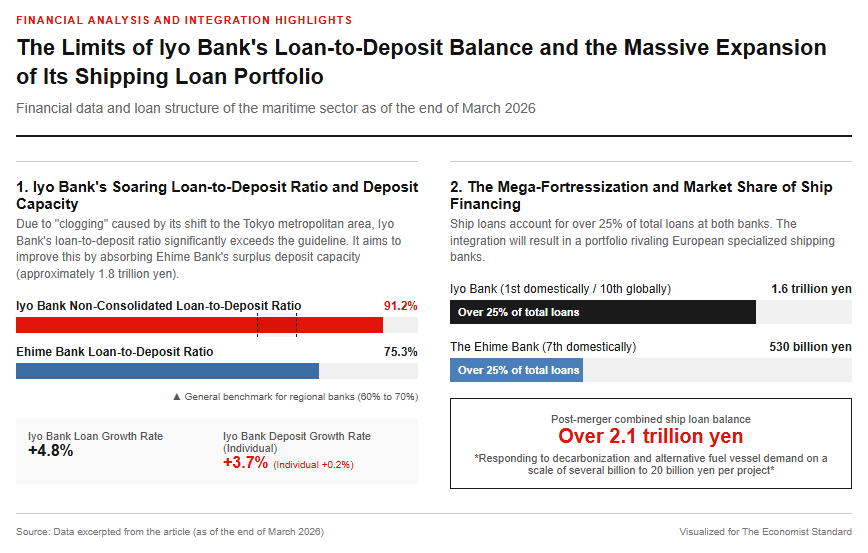
Beyond merely a sense of crisis regarding population decline, the financial factor that drove this integration lies in the limits of The Iyo Bank’s loan-to-deposit balance. As of the end of March 2026, Iyo Bank’s non-consolidated loan-to-deposit ratio reached 91.2%, significantly exceeding the 60% to 70% typically considered the benchmark for regional banks. An analysis of Iyo Bank’s financial data reveals that while the loan growth rate stood at +4.8%, the deposit growth rate was sluggish at +3.7% (with individual deposits seeing a mere +0.2%). The factor behind this soaring loan-to-deposit ratio lies in the “Tokyo shift” trap that regional banks easily fall into. Although the bank rapidly expanded its lending to large corporations and real estate in the Tokyo metropolitan area, the borrowed funds flowed into the Tokyo area and failed to flow back as deposits to the local region, creating a structural bottleneck. Left as is, the bank would have been forced to curb lending, facing the limit of losing profit opportunities. In contrast, The Ehime Bank’s loan-to-deposit ratio stands at 75.3%, holding an abundant surplus in deposits. Through this integration, Ehime Bank’s approximately 1.8 trillion yen in deposit capacity can be utilized as the funding base for the entire group, making it possible to dramatically improve the loan-to-deposit balance.
The Growth of Ship Finance and Concerns Over Decarbonization Regulations
The Massive Fortification Exceeding 2.1 Trillion Yen in Outstanding Ship Loans and the Industry Structure
The area centered around Imabari City, Ehime Prefecture, is one of the world’s leading maritime cities, and both The Iyo Bank and The Ehime Bank have strong track records in ship finance. As of the end of March 2026, Iyo Bank’s ship finance balance stands at 1.6 trillion yen, ranking first among domestic regional banks (10th globally), while Ehime Bank stands at 530 billion yen, ranking seventh domestically. For both banks, the proportion of ship finance in total loans exceeds 25%. Through the integration, the combined ship finance balance will exceed 2.1 trillion yen, creating a colossal ship finance portfolio comparable to European maritime-focused banks. Currently, in the shipping industry, amid tightening emission regulations by the International Maritime Organization, the transition from heavy oil-fueled ships to liquefied natural gas (LNG)-fueled vessels and alternative-fueled ships is rapidly accelerating. Furthermore, due to larger hull sizes and soaring material prices, ship prices have skyrocketed from several billion yen to a scale of 10 billion to 20 billion yen. Because the required loan amount per project has become massive, it is becoming increasingly difficult for a single bank to undertake the risk on its own. Establishing a robust financial foundation through integration and enhancing the capability to arrange syndicated loans as a lead manager will be a powerful weapon to compete in the global market.
Environmental Regulations and Methane Slip Risks Standing in the Way of Ship Financing
The growing scale of ship financing also brings new medium- to long-term risks for banks. In decarbonization scenarios for the shipping sector, transitioning to alternative fuels such as ammonia, hydrogen, biofuels, and methanol is considered essential to achieving net-zero emissions by 2050, accounting for approximately 70% of the reductions. However, the introduction of alternative-fuel vessels faces numerous challenges regarding stable supply systems and costs, prompting companies to respond by expanding LNG-fueled vessels through 2030 as a short- and medium-term emission reduction measure. The concern here is the “methane slip” issue, in which LNG releases methane at multiple stages of fuel production and combustion. It has also been pointed out that, depending on changes in environmental regulatory frameworks, the introduced LNG vessels risk becoming stranded assets. For the integrated group, trends in maritime environmental regulations will be the greatest factor of uncertainty directly affecting financial health. The following figure illustrates the roadmap for introducing alternative-fuel vessels and projected future responses to environmental regulations.
Impact on Local Communities and Medium- to Long-Term Outlook
Discovery of Double Bookkeeping and Bankruptcy Risk Through Centralized Credit Management
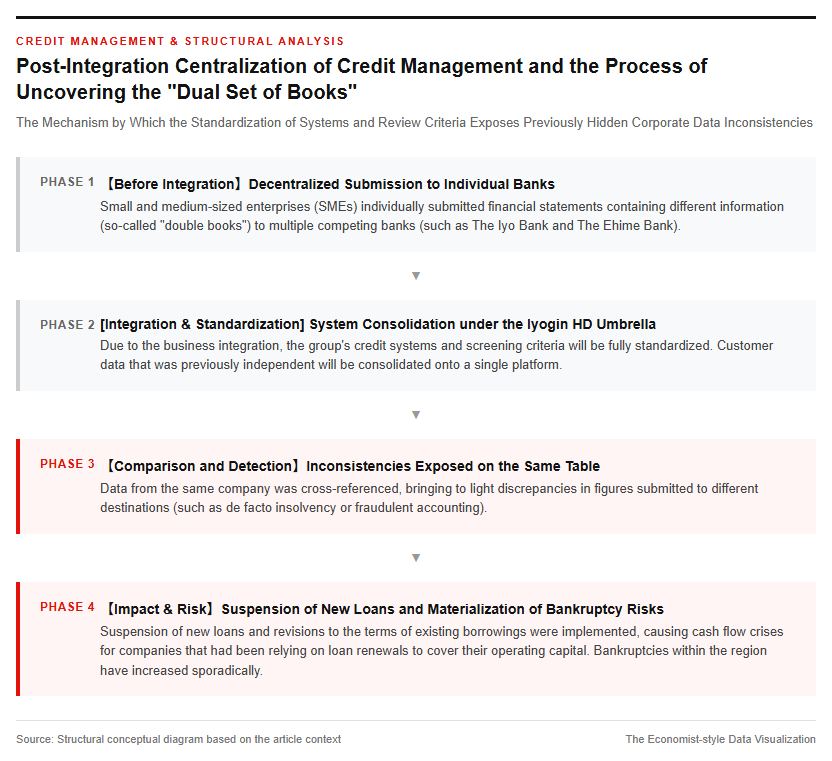
As the merger pushes the prefectural market share over 70%, concerns are also growing regarding unignorable side effects on the local economy. It is estimated that a certain percentage of small and medium-sized enterprises (SMEs) dealing with multiple banks submit “double-book” financial statements with differing contents to each recipient in order to secure loans. Until now, this issue has not surfaced because competing banks did not cross-check credit information or financial statements. However, once credit systems and screening standards are standardized under the umbrella of Iyogin Holdings, inconsistent financial statements from the same company will be placed on the same table, exposing the discrepancies. If substantial insolvency or window-dressing is uncovered, strict measures such as the suspension of new loans and the revision of conditions for existing borrowings will be taken. For companies that have been surviving on working capital through loan renewals, this directly leads to a cash flow deadlock, raising concerns that SME bankruptcies may increase sporadically in Ehime Prefecture for a certain period following the merger. The following diagram illustrates the process by which double-book data of the same company is cross-checked and exposed through the unification of credit management after the merger.
The Fear of Deposit Evaporation Spreading Across Shikoku and the Domino Effect of Regional Bank Consolidation
The operating environment surrounding regional finance in Shikoku is extremely severe, with a continued serious outflow of personal deposits. Looking at the growth rate of personal deposits over the past 15 years (from March 2011 to March 2026), Tokushima Prefecture saw an increase of 23.5% (4th worst in the country), Kagawa Prefecture 22.7% (3rd worst), and Kochi Prefecture 11.8% (worst in the country), remaining conspicuously low. In the most recent two years, personal deposits have turned to a decline in Kagawa and Kochi prefectures, and The Kochi Bank’s deposit balance for fiscal 2025 fell by 2.1% year-on-year, plunging into a severe deposit outflow. Due to the mega-merger in Ehime Prefecture, Kochi Prefecture (The Shikoku Bank and The Kochi Bank) is now the only prefecture in Shikoku that has two local regional banks, both of which continue to operate independently. As deposits evaporate due to depopulation and aging, it is difficult for two banks to survive independently, and this merger in Ehime serves as a final ultimatum for Kochi’s regional banks as well, exposing the limits of independent management. Moving forward, the scenario in which Shikoku’s entire financial sector is consolidated into two major groups, Iyogin Holdings and Tomoni Holdings, is becoming increasingly realistic.
Reference Page
- [Japanese Shipowners’ Association, “Japanese Shipping: The Challenge toward 2050 Net Zero”] https://www.jsanet.or.jp/report/nenpo/nenpo2021/text/shiryo9-2-2.pdf
- 【2023 IMO Strategy on Reduction of GHG Emissions from Ships】https://www.imo.org/en/OurWork/Environment/Pages/2023-IMO-Strategy-on-Reduction-of-GHG-Emissions-from-Ships.aspx
【#RegionalBanks #BusinessIntegration #ShipFinance #RegionalEconomy #EhimePrefecture #CashFlow #FinancialRestructuring】

コメント