The government has finalized a policy to drastically strengthen safety regulations for mobile batteries and make inspections by third-party organizations mandatory. To prevent the frequent ignition accidents occurring in recent years, the aim is to transition the inspection system away from conventional voluntary checks and prevent the distribution of substandard products.
- Key point of the event: Government-initiated mandatory inspection by a third-party organization
- Background of Stricter Regulations: The Rapid Increase in Fire Incidents and the Limits of Voluntary Inspections
- Distribution and Manufacturing Realities: Markets Dominated by Made-in-China Goods and Quality Control Challenges
- Impact on the Industry: Rising Inspection Costs and the Looming Manufacturer Shakeout
- Impact on Consumers and Daily Life: New Rules for Air Travel and Safe Operations in Everyday Life
- Future Outlook and Key Points: Full Mandating of Regulations and Transition to Next-Generation Batteries
Key point of the event: Government-initiated mandatory inspection by a third-party organization
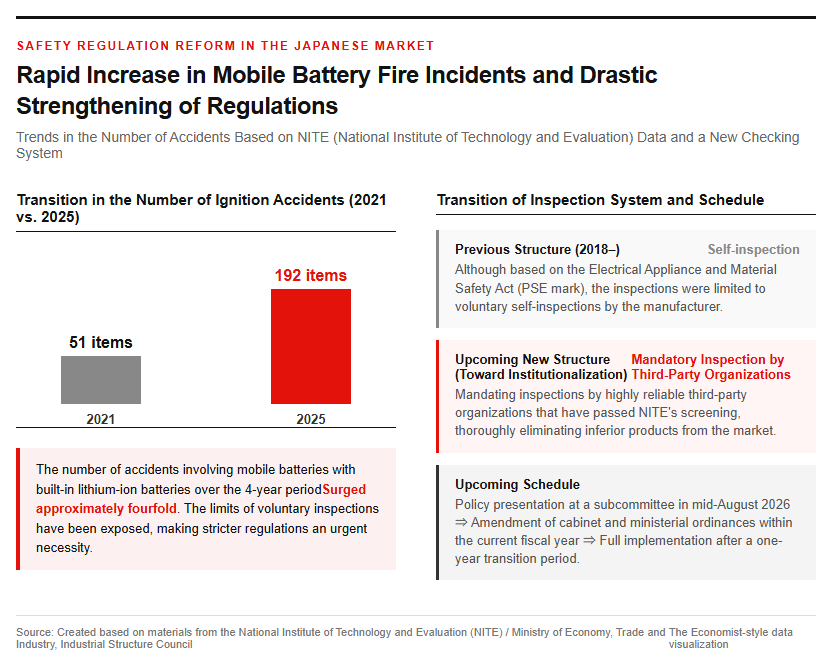
Taking the frequent ignition accidents involving mobile batteries seriously, the government has decided to embark on a drastic reinforcement of safety regulations. It plans to present the policy at a subcommittee of the Industrial Structure Council as early as August 2026, aiming for the revision of cabinet and ministerial ordinances and institutionalization within the current fiscal year. Following the revision, the new rules are scheduled to be fully enforced after a one-year transitional period.
The core pillar of this new regulation is making inspections by third-party organizations mandatory. Mobile batteries have been regulated under the Electrical Appliance and Material Safety Act since 2018, and the sale of products lacking the PSE mark—which indicates compliance with safety standards—is already prohibited. However, under current regulations, these inspections are limited to voluntary self-inspections by manufacturers.
Going forward, the checking mechanism at the manufacturing stage will be significantly reinforced by mandating inspections by highly reliable third-party organizations that have met the screening requirements of the National Institute of Technology and Evaluation (NITE). This aims to establish a system—similar to specified electrical appliances such as electric water heaters—where only safe products bearing a high-standard PSE mark, having passed rigorous inspections, are distributed in the Japanese market, thereby thoroughly eradicating substandard products from the market.
Background of Stricter Regulations: The Rapid Increase in Fire Incidents and the Limits of Voluntary Inspections
Behind the urgent need to strengthen legal safety regulations is a sharp increase in fire accidents caused by mobile batteries. According to data compiled by the National Institute of Technology and Evaluation (NITE), the number of accidents involving mobile batteries with built-in lithium-ion batteries has skyrocketed about fourfold, jumping from 51 cases in 2021 to 192 cases in 2025.
Furthermore, in the fiscal 2025 accident information collection report, the number of accidents involving chargers, including mobile batteries, surpassed that of batteries alone, making it the highest number of accidents by product category. In August 2026, a mobile battery ignited inside a train on the Osaka Metro Midosuji Line, temporarily halting operations and causing serious accidents that genuinely endangered many lives. Moreover, regarding the Electrical Appliance and Material Safety Law, which was revised and implemented back in 2001, confusion surrounding the interpretation of regulations on the sale of secondhand goods developed into a major social issue leading up to 2006. Behind this latest strengthening of regulations is a strong backdrop: in light of past lessons and the upward trend in accidents, there was a fundamental need for the government to take responsibility by implementing thorough quality-assurance measures to proactively prevent product defects that could lead to catastrophic disasters.
Distribution and Manufacturing Realities: Markets Dominated by Made-in-China Goods and Quality Control Challenges
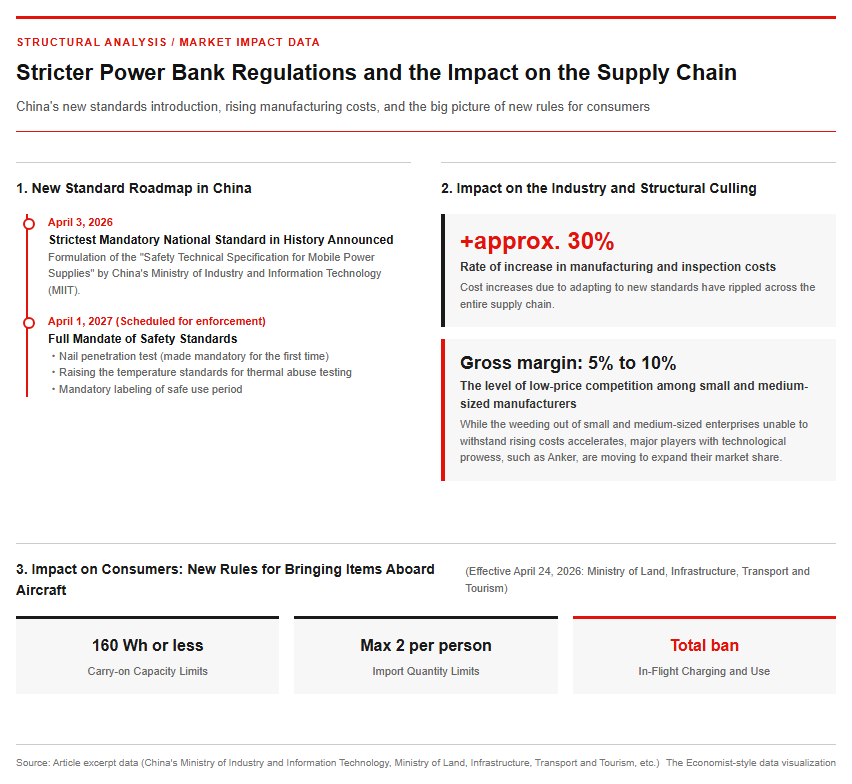
The vast majority of mobile batteries distributed within Japan are made in China. Many of the products involved in accidents catch fire when left in high-temperature environments or subjected to strong impacts, but the root cause is strongly pointed out to be quality control issues on the manufacturer’s side, such as electrode misalignment during the manufacturing process or the contamination of foreign objects. In response to this situation, major movements are underway in China, the largest supplier. On April 3, 2026, China’s Ministry of Industry and Information Technology announced the safety technical specification for mobile power sources, which is considered the strictest mandatory national standard in history. This new standard is scheduled to take effect on April 1, 2027. It includes the first-ever mandatory requirement for a nail penetration test—where a steel needle is driven through the battery to prevent ignition and explosion—along with raising the temperature criteria for thermal abuse testing and mandating the display of the safe service life. With this move by China coinciding with Japan’s tightening of regulations, management systems for the entire manufacturing process of mobile batteries are expected to become stricter in both Japan and China, leading to a strict crackdown on fraudulent practices that have been rampant until now, such as the use of recycled batteries and capacity falsification.
Significant Impact on Markets, Industries, and Consumers
Impact on the Industry: Rising Inspection Costs and the Looming Manufacturer Shakeout
The mandatory third-party inspection will bring about a major upheaval in the balance of power among domestic and international mobile power bank manufacturers and the market as a whole. With the addition of strict inspection processes by third-party organizations, ranging from the manufacturing process to raw material management, a significant increase in manufacturing and inspection costs on the manufacturer side is inevitable. In China’s preceding new standards, it is estimated that manufacturing costs will rise by approximately 30% to comply, and a similar cost increase is anticipated for product development targeting Japan. This cost increase will deal a decisive blow to small and medium-sized manufacturers that rely on assembly plants and have survived in a low-price competition with gross profit margins of about 5% to 10%, accelerating their elimination from the market. On the other hand, for major companies with high technological capabilities such as Anker, it will be a major growth opportunity to appeal their reliability and further expand their market share. However, even major brands cannot rest easy. Looking at current voluntary recall cases, multiple well-known domestic manufacturers announced voluntary recalls and replacements regarding safety in 2025, and moving forward, all businesses—regardless of brand recognition—will be required to clear extremely high safety standards.
Impact on Consumers and Daily Life: New Rules for Air Travel and Safe Operations in Everyday Life
The tightening of regulations also requires direct changes to the daily lives of consumers who routinely use mobile batteries. As of April 24, 2026, the Ministry of Land, Infrastructure, Transport and Tourism has already implemented new, strict rules regarding bringing mobile batteries on board aircraft. Carry-ons are limited to a maximum of two per person with a capacity of 160Wh or less, and charging or using them in flight is completely prohibited. These are the new rules for carry-on items outlined by the Ministry of Land, Infrastructure, Transport and Tourism.
Furthermore, as a legal risk, if someone violates rules and causes a fire accident, they may be deemed guilty of gross negligence if it is determined that they neglected safety management. This could exclude them from liability exemptions under the Fire Responsibility Act, potentially resulting in massive damages liability as well as the risk of facing criminal charges. Therefore, consumers must not choose products simply based on price or capacity, but rather make reliable product choices that prioritize safety. Specifically, choosing products that utilize lithium iron phosphate batteries—which boast high thermal stability and are resistant to thermal runaway—or next-generation safety technologies such as semi-solid-state batteries with a low risk of liquid leakage, alongside practicing proper operational habits such as avoiding charging while sleeping, will become essential routines for maintaining a safe lifestyle moving forward.
Future Outlook and Key Points: Full Mandating of Regulations and Transition to Next-Generation Batteries
The new safety inspection system for mobile batteries will see the implementation of revised cabinet and ministerial ordinances within the current fiscal year, followed by full enforcement after a one-year transitional period. Once the transitional period ends, the distribution of any products other than those bearing the high-standard PSE mark—having passed third-party organization inspections—will be strictly prohibited. Consequently, Japan’s mobile battery market is expected to transform into a healthy market where only higher-quality, safer products survive. In tandem with this trend, the generational shift in batteries is projected to accelerate even further. Major manufacturers, among others, are actively developing and rolling out lithium iron phosphate batteries, which offer a long lifespan of 2,000 to 3,000 charge-discharge cycles, and semi-solid-state batteries that combine high energy density with non-flammability, replacing conventional lithium-ion batteries. Consumer preferences are also likely to shift toward safety-oriented models equipped with these next-generation technologies. In an era where we carry safety in our hands, the government’s mandate for third-party inspections will undoubtedly be a crucial milestone in ensuring that mobile batteries can be used with complete peace of mind as essential infrastructure.
Reference Page
- Regarding New Rules for Bringing Portable Batteries Aboard Aircraft ~ New rules to be applied starting April 24 – Ministry of Land, Infrastructure, Transport and Tourism
- 【FY2025 Accident Information Collection Report – National Institute of Technology and Evaluation】https://www.nite.go.jp/data/000161570.pdf
[#MobileBattery #SafetyRegulation #METI #ElectricalApplianceAndMaterialSafetyLaw #LithiumIonBattery #ThirdPartyOrganization #PSE_Mark #Economy]


コメント