Waymo, a leader in autonomous driving development, has unveiled its custom-designed 5-nanometer chip for its latest robotaxis. Behind its move to break away from reliance on third-party semiconductors—such as those from NVIDIA—and aim for cost reduction and optimized real-time processing lies the vertically integrated business strategy of its parent company, Alphabet.
- Section 1-1: The Full Story Behind Waymo’s First Custom-Developed ASIC Announcement
- Section 1-2: Computing Performance Exceeding 1000 TOPS and the Aims of Development
- Section 2-1: 5nm process compliant with automotive standards and advanced sensor processing
- Section 2-2: Durability Through Thorough Redundant Design and Liquid Cooling Systems
- Section 3-1: Migration to 6th-Generation Systems and Dramatic Cost Reduction
- Section 3-2: Service Area Expansion and Strategic Differences with Rival Tesla
Section 1-1: The Full Story Behind Waymo’s First Custom-Developed ASIC Announcement
On August 20, 2026, Waymo, the autonomous driving company under Alphabet, announced that it has equipped its latest robotaxi vehicles with custom semiconductors designed in-house. This newly developed application-specific integrated circuit (ASIC) replaces some of the general-purpose chips from companies like NVIDIA and Advanced Micro Devices that the company has previously used in its self-driving vehicles. By developing hardware specialized for its proprietary autonomous driving software, Waymo has successfully reduced its reliance on third-party chips and eliminated the high supplier margins it previously paid. This initiative by Waymo is an extension of the strategy employed by its parent company, Google, which has developed its own Tensor Processing Units (TPUs) for data centers. By expanding massive capital investments down to the vehicle’s computing infrastructure, Waymo is attempting to establish a unique procurement structure that other autonomous driving competitors cannot easily replicate.
Section 1-2: Computing Performance Exceeding 1000 TOPS and the Aims of Development
The newly introduced custom ASIC boasts a processing capacity of over 1,000 TOPS, capable of executing more than 1 quadrillion operations per second. This astonishing performance rivals the computing power of NVIDIA’s latest-generation automotive platform for autonomous driving. The primary reason for developing this custom ASIC is to minimize decision-making latency in autonomous driving to the absolute limit. For robotaxis to react instantaneously to surrounding pedestrians and obstacles, the onboard computer must read and assess situations in milliseconds. Unlike general-purpose chips, the custom ASIC thoroughly eliminates unnecessary computational overhead and is optimized to execute Waymo’s proprietary neural network models with maximum efficiency. As a result, it reduces power consumption to extend the driving range of the electric vehicle while accelerating safe driving decisions for robotaxis in complex urban environments.
[Technical Superiority and Design] A Computing Infrastructure That Survives Harsh Public Road Environments
Section 2-1: 5nm process compliant with automotive standards and advanced sensor processing
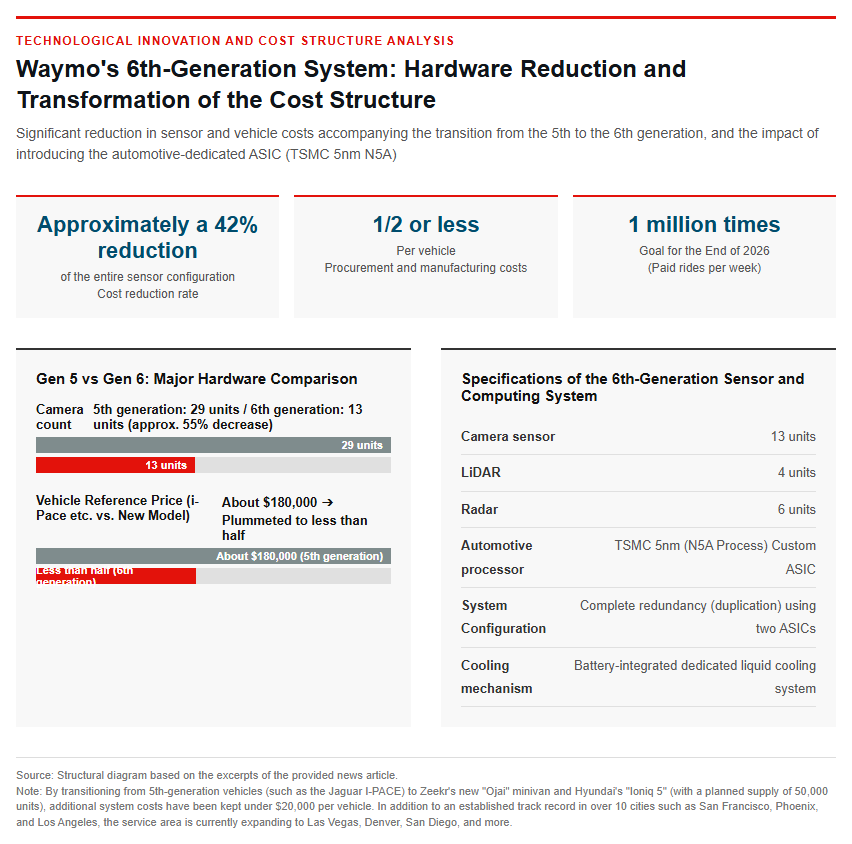
This custom ASIC is manufactured using the 5-nanometer process of Taiwan Semiconductor Manufacturing Company (TSMC), the world’s largest semiconductor foundry. What is notable here is that, rather than the latest ultra-fine process, the 5-nanometer N5A process optimized for automotive applications was chosen. The N5A process meets the automotive industry’s stringent reliability standards to minimize the risk of manufacturing defects and withstand harsh temperature fluctuations and vibrations. The custom ASIC processes in real time the massive amounts of data fed from a sixth-generation sensor suite consisting of 13 cameras, 4 LiDARs, and 6 radars. In particular, it is specifically designed for advanced AI inference models, such as sensor fusion—which integrates data from disparate sensors to create a single high-precision environmental data set—and temporal noise reduction, which removes noise in low-light conditions.
Section 2-2: Durability Through Thorough Redundant Design and Liquid Cooling Systems
To ensure the durability and reliability required to withstand harsh real-world operations, Waymo’s in-vehicle computing modules are equipped with two custom ASICs running in parallel. This is to adopt a fully redundant configuration where, in the event of a malfunction or hardware error in the primary semiconductor, a backup chip can instantly take over processing. Since a failure of the self-driving system on public roads directly leads to fatal accidents, this dual design is essential for ensuring safety. In addition, a proprietary liquid cooling system has been introduced to control the heat generated by the semiconductors, which undergo continuous high-load processing. This is integrated with the vehicle’s own battery and engine cooling systems to maintain optimal operating temperatures even under rising outside temperatures or continuous operation. In this way, Waymo’s custom semiconductors are engineered to stably operate data center-level processing power within the confined space of a vehicle’s trunk.
[Management Strategy and Future Outlook] Cost Reduction and Business Expansion Toward Robotaxi Supremacy
Section 3-1: Migration to 6th-Generation Systems and Dramatic Cost Reduction
Waymo is currently transitioning its vehicle platform to its 6th-generation system. In this latest generation, the company has reduced its overall expensive sensor configuration by approximately 42 percent, including cutting the number of cameras by about 55 percent from 29 to 13 compared to the previous 5th-generation system. Furthermore, by utilizing the newly announced custom ASICs, Waymo aims to cut procurement costs for expensive third-party GPUs and keep the additional cost of the overall system to under approximately $20,000 per vehicle. While vehicles equipped with the 5th generation, such as the Jaguar I-Pace, were expensive at around $180,000, integrating the 6th-generation system into ZEEKR’s new minivan “Ojai” and Hyundai’s Ioniq 5—slated for a supply of 50,000 units—will drastically reduce procurement and manufacturing costs per vehicle to less than half. This overwhelming cost reduction effect is the core of the business strategy that will enable the mass deployment of robotaxis moving forward.
Section 3-2: Service Area Expansion and Strategic Differences with Rival Tesla
Waymo has set a major goal of providing 1 million paid rides per week by the end of 2026. The company’s robotaxi service, “Waymo One,” operates in more than 10 cities, including San Francisco, Phoenix, and Los Angeles, with further expansion announced for areas such as Las Vegas, Denver, and San Diego.
Please refer to the following figure, which shows the progression of Waymo’s autonomous robotaxi service area expansion.
While its competitor Tesla adopts a low-cost autonomous driving approach that relies solely on camera images without using LiDAR, Waymo has chosen a careful and steady approach based on sensor fusion, custom ASICs, sensor fusion technology focused on precision and reliability, and high-precision mapping for each city. Although its parent company Alphabet upwardly revised its cap on AI-related capital expenditures for 2026 to $20.5 billion, causing its stock price to temporarily drop by about 7 percent amid concerns over short-term cash flow deficits, this custom chip development and aggressive service rollout can be described as a rock-solid foundation for securing long-term dominance in the autonomous driving market.
Reference Page
- [Waymo Official Blog] https://waymo.com/blog/2026/08/look-under-our-trunk/
- [Waymo Official Website] https://waymo.com/
[#AutonomousDriving #Robotaxi #Waymo #CustomChip #Semiconductors #Alphabet #NVIDIA]


コメント