In Vietnam’s corporate lending market, attention is being drawn to the practice of extending large-scale loans exceeding 1 trillion dong at high interest rates, such as 12% per annum. This trend is driven by severe cash flow deterioration stemming from the real estate crisis and a sharp surge in non-performing loans at domestic banks, forcing the government to navigate the difficult task of balancing an effective reduction in lending rates with strengthened risk management.
- Key Points and Realities of High-Interest Lending in the Loan Market
- Government Restrictions on Corporate Loans and Instructions to Lower Interest Rates
- Crackdown on Illegal Corporate Bond Issuance and Real Estate Developer Funding Shortfalls
- The Massive Embezzlement Scandal and the Saigon Commercial Bank Rescue Drama
- Surge in Non-Performing Loans at Domestic Banks and Stricter Loan Screening
- Loan Structuring for Overseas Subsidiaries Following Revisions to Transfer Pricing Regulations
Key Points and Realities of High-Interest Lending in the Loan Market
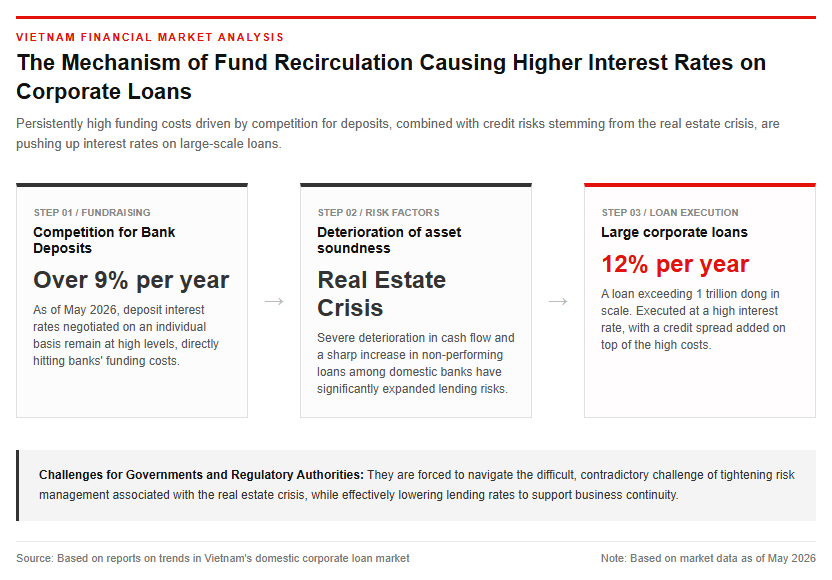
In Vietnam’s financial market, the corporate funding environment is becoming increasingly tight, with growing attention on instances where large-scale loans exceeding 1 trillion dong are transacted at high interest rates of around 12% per annum. The primary driver behind these high interest rates is the intensifying competition for deposits within the domestic banking sector. According to market trends as of May 2026, cases have been reported where individually negotiated deposit rates by domestic banks exceed 9% per annum, keeping the banks’ own funding costs at a high level. For high-risk loans, banks are forced to add a certain credit spread on top of their high funding costs, which is a direct factor pushing up corporate borrowing rates. Developers and ordinary companies in need of funds are being driven into a situation where they must secure immediate liquidity and business continuity funds, even if it means accepting high interest rates. The following diagram illustrates the complex flow of funds in Vietnam’s financial market.
Such tightening of lending standards and persistently high interest rates raise concerns that they will significantly weigh on corporate profitability over the medium to long term, creating a vicious cycle that further increases the risk of corporate default.
Government Restrictions on Corporate Loans and Instructions to Lower Interest Rates
The Vietnamese government is growing increasingly alarmed by this high-interest-rate environment. At a meeting held on August 13, 2026, to evaluate monetary policy management for the first seven months of the year, Prime Minister Le Minh Hung strongly urged the State Bank of Vietnam and all credit institutions to stabilize interest rate levels and substantially lower lending rates. Comparing the monetary and banking system—the lifeblood of the economy—to a major artery, the Prime Minister emphasized that sharing the pain with citizens and businesses is necessary to sustain double-digit economic growth targets. He also noted that credit growth targets should not be managed as rigid, permanent caps, but rather handled flexibly in response to actual market conditions. In his directives, he called for the establishment of mechanisms to prevent capital from flowing into purely speculative sectors and to focus allocation on priority areas such as manufacturing and processing, exports, high technology, social housing, core infrastructure, and national key projects. Furthermore, he asked financial authorities to conduct a comprehensive review of regulations and strictly advance supervision of compliance with safe operation rules and the handling of violations.
Lessons from the Real Estate Crisis and Financial Market Turmoil
Crackdown on Illegal Corporate Bond Issuance and Real Estate Developer Funding Shortfalls
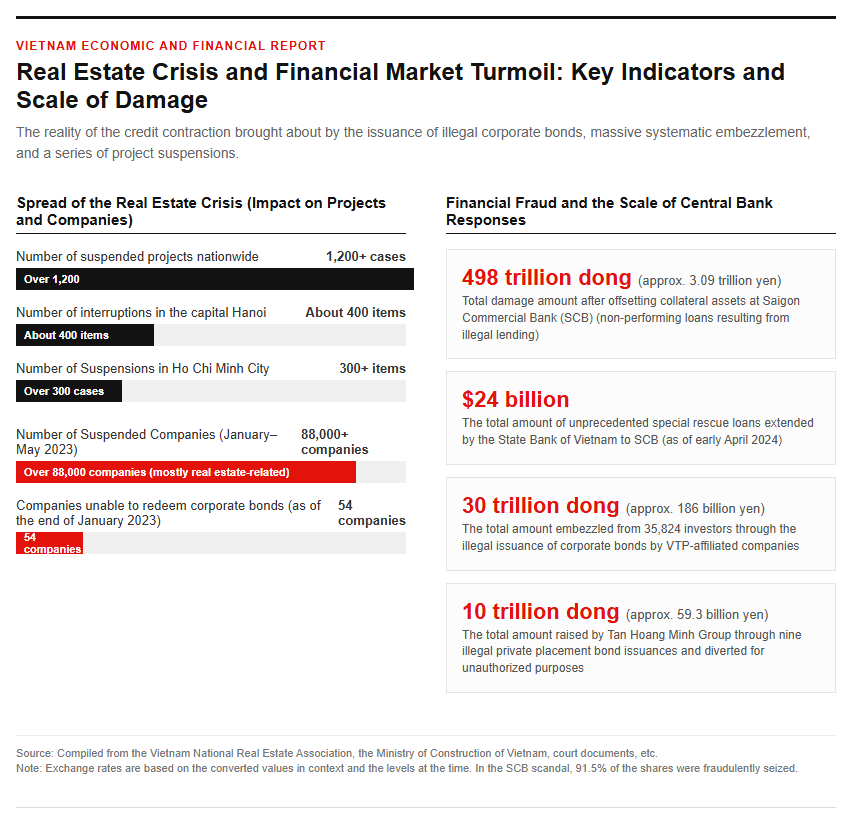
A contributing factor behind the high-interest loans in Vietnam in recent years is the real estate crisis, which stemmed from the loss of credibility of real estate developers. In Vietnam, a large number of real estate development projects have been suspended, and according to the industry body Vietnam Real Estate Association, there is no end in sight to the crisis. Projects where construction has completely stopped number approximately 400 in the capital Hanoi and over 300 in the largest city, Ho Chi Minh City, with more than 1,200 plans suspended nationwide. According to data from the Vietnamese Ministry of Construction, between January and May 2023, more than 88,000 companies nationwide were forced to suspend operations, the majority of which were companies engaged in real estate development and sales. The catalyst for this crisis was a financial fraud case by major real estate developer Tan Hoang Minh Group, which was exposed in April 2022. Between July 2021 and March 2022, the group illegally issued private placement bonds nine times, raising a total of over 10 trillion dong (approximately 59.3 billion yen) and misappropriating it for purposes different from the bond issuance plans. As this was exposed, authorities intensified their supervision of the corporate bond market, cutting off companies’ routes to self-financing. As a result, the number of companies unable to redeem corporate bonds as agreed reached 54 by the end of January 2023.
The Massive Embezzlement Scandal and the Saigon Commercial Bank Rescue Drama
The unhealthy collusion between real estate developers and financial institutions developed into the largest scandal in Vietnam’s financial history. Truong My Lan, former chairwoman of major ethnic-Chinese real estate conglomerate VTP Group, effectively seized 91.5% of the shares of Saigon Commercial Bank (SCB) by using forged identities of individuals and corporations. While Lan did not directly participate in the bank’s management, she repeatedly and illegally disbursed loans to a group of over 1,000 affiliated shell companies without conducting any collateral reviews, utilizing close associates placed in key positions. This default left SCB with massive non-performing loans, and the total damage after offsetting collateral assets reached 498 trillion dong (approximately 3.09 trillion yen). Additionally, VTP-affiliated companies illegally issued bonds 25 times between 2018 and 2019, embezzling 30 trillion dong (approximately 1860 billion yen) raised from 35,824 investors. To prevent this unprecedented collapse, the State Bank of Vietnam was forced to execute an unprecedented special rescue loan totaling 24 billion dollars to SCB by early April 2024. Subsequently, in an appellate court ruling in December 2024, Lan was sentenced to death, and Do Thi Nhan, a former central bank department head who accepted a 5.2 million dollar bribe and connived at the incident, was sentenced to life imprisonment.
The following figure is an image showing the psychological impact that the massive embezzlement case had on the banking industry.
Strengthening Loan Risk Management and Interest Rate Strategies for Global Companies
Surge in Non-Performing Loans at Domestic Banks and Stricter Loan Screening
The series of fraudulent lending scandals and halted real estate development projects is actively continuing to deal a severe blow to the financial health of domestic Vietnamese banks. According to the Q1 2026 (January–March) consolidated financial statements of 27 major domestic banks in Vietnam, the total balance of non-performing loans classified into Groups 3 to 5 increased by nearly 30 trillion dong from the end of the previous year, swelling to over 292 trillion dong (approximately 1.74 trillion yen). According to academic research titled “CEO power and bank risk-taking”, while the presence of a CEO with strong authority tends to reduce bank risk-taking, cases have been pointed out where the lack of outside directors and independent monitoring functions spurs excessive risk selection. Especially in emerging market countries like Vietnam, where external monitoring systems and information disclosure legislation are still in developmental stages, the erosion of internal governance easily leads to severe defaults. Consequently, domestic banks are currently dramatically tightening their loan screening rules to improve unhealthy non-performing loan ratios, making them hesitant to easily disburse loans to companies with poor liquidity. This, in turn, is becoming a factor that increases the number of companies forced to rely on extreme financing methods such as 12% interest rates.
Loan Structuring for Overseas Subsidiaries Following Revisions to Transfer Pricing Regulations
These stringent lending environments and changes to interest rate setting rules have also immediately impacted financing transactions between multinational corporations operating locally, Japanese parent companies, and their Vietnamese local subsidiaries. Conventionally, when a Japanese parent company lent money to its Vietnamese local subsidiary, an internal practice was commonly used to set extremely low interest rates by adding a slight margin of about 0.25% to the parent company’s procurement rate. However, with the revision of the administrative operation guidelines in 2022, the rules regarding transfer pricing taxation changed dramatically. Under the current tax regulations, it is safe and mandatory for all parent-subsidiary loans to be determined at “an interest rate consisting of a base rate, including the risk-free rate, plus a spread corresponding to the borrower’s own credit risk.” The spread here must be a reasonable margin set by independent third-party banks in consideration of actual financial conditions and credit ratings; if the interest rate is too low, the authorities may deem the transaction overly favorable to the Vietnamese local entity, risking taxation penalties for transfer pricing manipulation. Therefore, in the modern era of tightening fundraising regulations in the Vietnamese market, extremely precise interest rate design that addresses both local high-interest-rate risks and tax risks is indispensable for all fund-provision transactions, excluding short-term advances and accounts receivable.
Reference Page
- 【CEO power and bank risk-taking: A revisit in an emerging market context】https://www.aimspress.com/journal/QFE
- 【State Bank of Vietnam Official Website】https://www.sbv.gov.vn
【#VietnamEconomy #CorporateLending #FinancialMarkets #RealEstateCrisis #InterestRatePolicy #RiskManagement #TransferPricing】

コメント