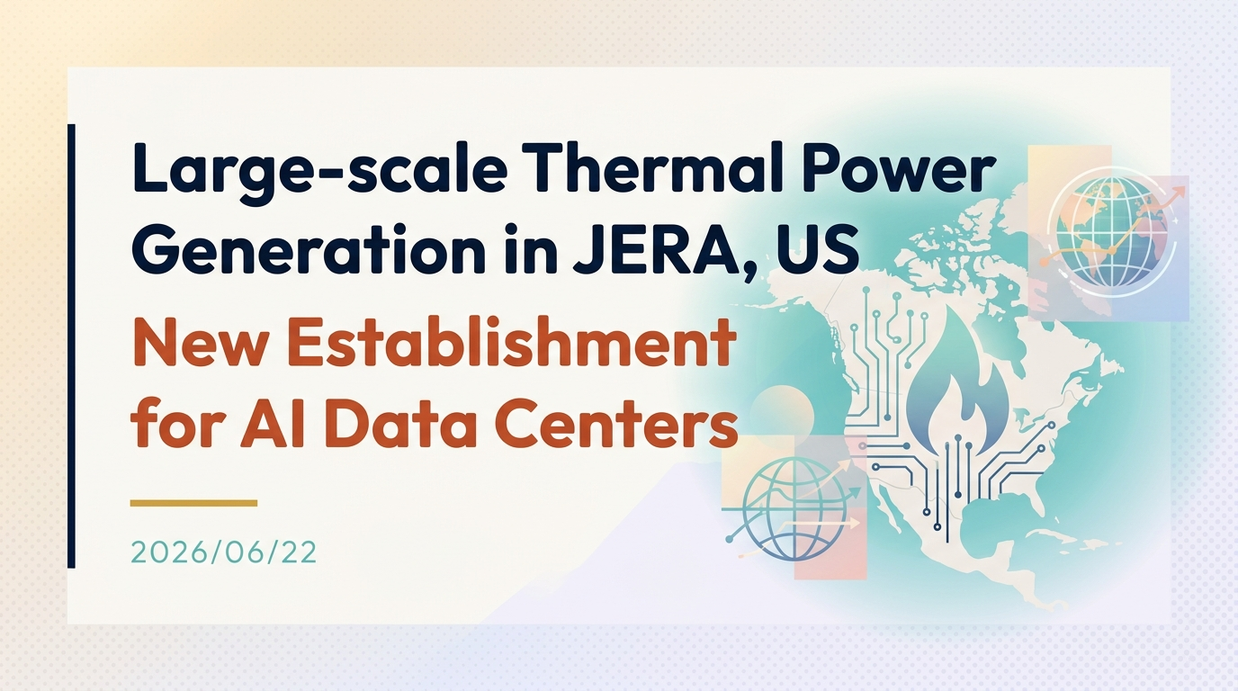
JERA, Japan’s largest power producer, has reported that it will build a large gas-fired power plant for AI data centers in the United States. The company aims to capture the rapidly growing AI-related electricity demand, but the company states that no decision has been made at this time,,,。
- Key Points of the Event: New Construction Project with an AI Data Center
- JERA’s response to news coverage and current stance
- Accelerating “watt-bit integration” with the spread of AI
- Reevaluation of Gas-Fired Power in the U.S. Market
- The Future of JERA’s ‘Smart Transition’ Strategy
- Judicial Risks and Uncertainty in the Regulatory Environment
- Focus on the transition to a decarbonized society and economic rationality
Key Points of the Event: New Construction Project with an AI Data Center
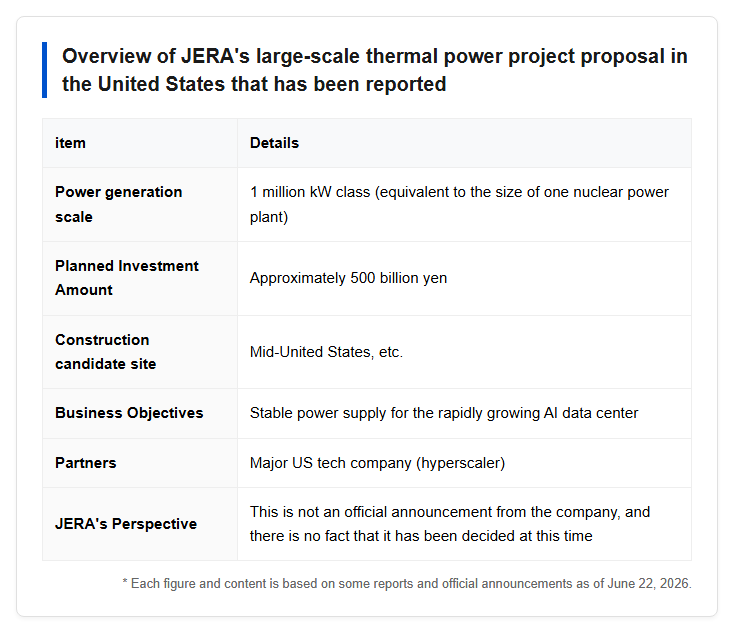
On June 22, 2026, some media reported that JERA, the largest domestic thermal power producer, plans to build a large gas-fired power plant in the United States attached to an artificial intelligence (AI) data hub,,。 According to reports, the scale of this power plant is equivalent to one nuclear power plant at around 1 million kW, with an investment estimated to reach around 500 billion yen. This is the first attempt by a Japanese power producer to develop a data center-attached power plant in the United States, and in collaboration with major U.S. tech companies, there are plans to build them in regions such as the Midwest, where electricity demand is rapidly surging. This is driven by the severe shortage of power infrastructure caused by unprecedented AI investments by U.S. tech companies, and the growing attention on gas-fired power plants with stable supply capacity.
Please refer to the diagram below.
JERA’s response to news coverage and current stance
In response to these reports, JERA issued an official announcement dated June 22, 2026, stating that the announcement was not made by its own company. The company explained that its mission is to provide cutting-edge solutions to global energy issues and is conducting various business discussions in global markets, including the United States, but at this time, no decisions have been made regarding this matter. Meanwhile, JERA has long been actively optimizing its assets in the U.S. market, continuing to flexibly restructure its portfolio in response to market changes, such as transferring its stake in a gas-fired power project jointly operated with Tenasca on September 22, 2025. This report suggests that this may be an extension of the company’s global strategy.
Market Background: AI Demand and Transformation of Power Infrastructure
Accelerating “watt-bit integration” with the spread of AI
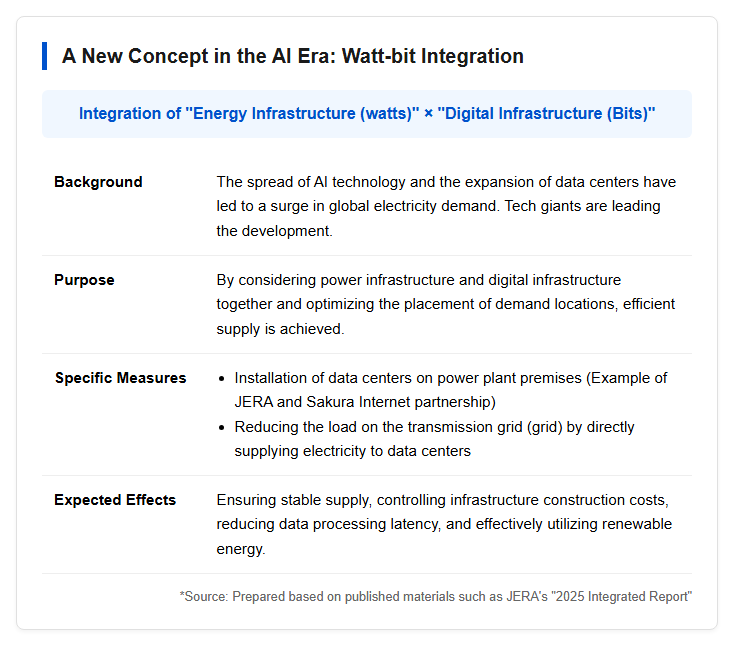
The rapid adoption of AI technology and the expansion of data centers are driving up electricity demand worldwide. According to JERA’s strategic materials, U.S. tech companies with vast financial resources are leading data center development, and the increase in electricity consumption has reached an undeniable level. In this context, the concept of “watt-bit integration,” which combines energy infrastructure and digital infrastructure to optimize the allocation of demand locations, has emerged. JERA has also partnered with Sakura Internet in Japan to begin efforts to install data centers on power plant sites, and the concept of an attached power plant in the United States can be seen as part of the global rollout of this latest infrastructure optimization model.
Please refer to the diagram below.
Reevaluation of Gas-Fired Power in the U.S. Market
In the United States, while the adoption of renewable energy is progressing, gas-fired power is being reevaluated as a stable source of power that is not affected by weather conditions. In regions such as Texas and the Northeast, there is a trend to prioritize the establishment of new gas-fired power plants and grid connections amid tight electricity supply and demand. According to a July 2025 report, concerns about power shortages have surfaced, such as the U.S. Department of Energy (DOE) ordering the continued operation of aging coal-fired power plants to ensure stable supply during the summer. Although the capacity of renewable energy and storage batteries is also increasing, gas-fired power still plays an indispensable role as a large-scale coordinator capable of handling sudden load fluctuations. The model of directly supplying power to high-load equipment like data centers is expected to be a practical solution to reduce the burden on the transmission grid.
Future Developments and Highlights
The Future of JERA’s ‘Smart Transition’ Strategy
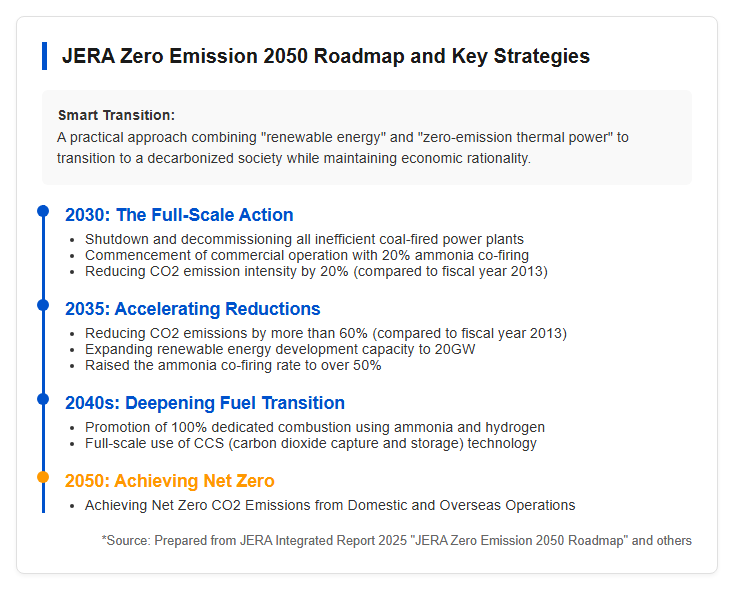
JERA has set a goal to achieve net zero carbon dioxide (CO2) emissions from domestic and overseas operations by 2050. The key to achieving this ambitious goal is the “Smart Transition” strategy, which combines renewable energy with zero-emission thermal power. In the United States, hydrogen co-firing is already being introduced at plants like Linden Power Plant, and it is expected that the newly reported power plants will eventually be premised on fuel conversion to hydrogen or ammonia, or the use of carbon capture and storage (CCS) technologies,,。 Balancing economic rationality and decarbonization is an extremely challenging challenge, but whether the phased introduction of cutting-edge technologies can achieve stable supply while minimizing environmental impact will likely determine the success or failure of future projects.
Please refer to the diagram below.
Judicial Risks and Uncertainty in the Regulatory Environment
In the U.S. power industry, trends related to judiciary and regulation cannot be ignored. Disputes over the nature of regulations continue, with attorneys general from 25 states seeking a halt to enforcement in response to emissions regulations imposed by the Environmental Protection Agency (EPA). Regulators are calling for the introduction of CCS technologies and similar technologies, but power producers point out that commercialization of the technology is immature and that capital investment more than doubles in size, leading to soaring electricity prices. If JERA is newly established in the United States, it will also need to carefully assess the direction of such judicial decisions and policy risks such as the future introduction of a carbon tax. In particular, infrastructure costs such as pipeline construction required for CCS can be enormous, significantly impacting project profitability.
Focus on the transition to a decarbonized society and economic rationality
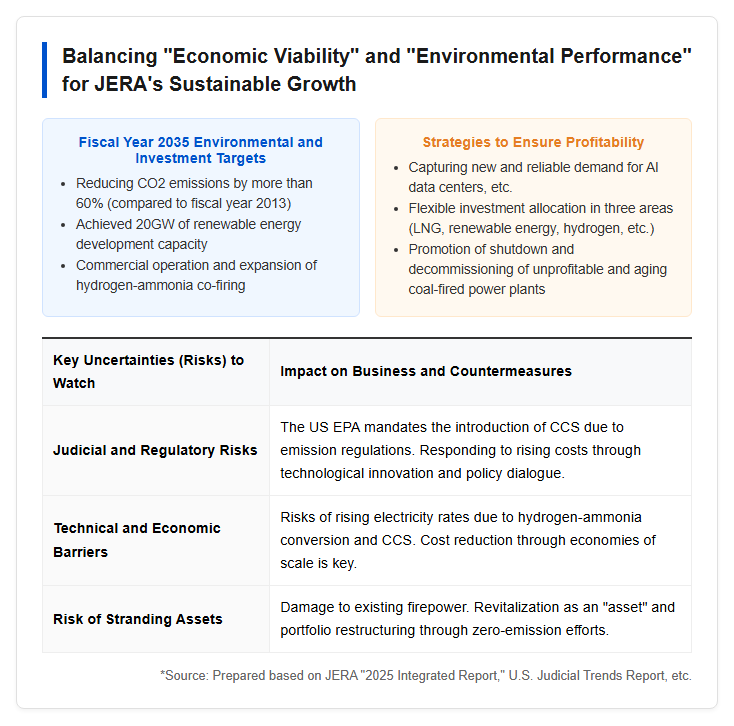
As the final section, the focus going forward will be on “balancing environmental goals and investment efficiency.” JERA plans to make massive investments toward expanding renewable energy and decarbonizing thermal power generation toward 2035. On the other hand, as some coal-fired power plants lose economic rationality and are forced to shut down, the question is how newly established gas-fired power plants can secure long-term profitability. The strategy of securing reliable AI data centers as a reliable customer base is an effective way to mitigate investment risks, but it remains unclear to what extent additional investment in decarbonization will squeeze profits. Investors and stakeholders are closely watching how JERA will optimize its assets and achieve sustainable growth in an uncertain global market.
Please refer to the diagram below.
[#JERA #火力発電 #AI #データセンター #エネルギー戦略 #米国経済 #脱炭素 #投資]

コメント