- Section 1-1: Invisible Gaps in Secondary Transit at Tourist Gateways
- Section 1-2: A Shrinking Public Transit Network Threatening Daily Life
- Section 2-1: A Three-Year Intensive Campaign Backed by a 76.5 Billion Yen Budget
- Section 2-2: Empowering Municipalities through Five Comprehensive Support Pillars
- Section 3-1: Recovering Annual Economic and Social Losses of 10 Trillion Yen
- Section 3-2: Diversified Mobility Solutions and the Outlook for Autonomous Driving
Section 1-1: Invisible Gaps in Secondary Transit at Tourist Gateways
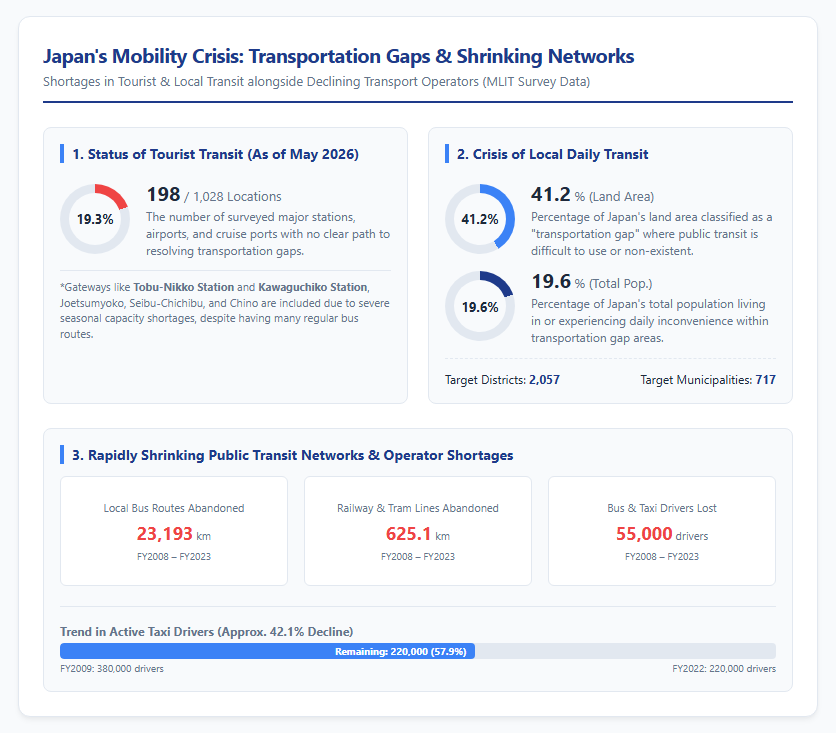
According to a nationwide survey on tourist transit conducted by the Ministry of Land, Infrastructure, Transport and Tourism, as of May 2026, 198 out of 1,028 major stations, airports, and cruise ports across Japan have no clear resolution in sight for their transportation gaps. Specifically, famous gateways such as Tobu-Nikko Station, Kawaguchiko Station, Joetsumyoko Station, Seibu-Chichibu Station, Chino Station, Shizuoka Airport, and Nagasaki Airport have been singled out. Although these stations host numerous local bus routes and appear well-served at first glance, the ministry’s new definition of transportation gaps for tourism extends beyond a complete lack of transit options. It also encompasses severe supply shortages during peak tourist seasons and conditions that make transit extremely difficult for international visitors to navigate. This seasonal undercapacity directly leads to traveler frustration and lost opportunities for regional economic consumption. Tackling these gaps requires new support mechanisms that move beyond traditional depopulated area assistance. Please refer to the figure below.
Section 1-2: A Shrinking Public Transit Network Threatening Daily Life
Parallel to the shortage of tourist transit, the local transportation sustaining residents’ daily lives is facing an existential crisis. The ministry’s transportation gap listing survey revealed that 2,057 districts across 717 municipalities currently qualify as transportation gap areas, where public transit is either extremely difficult to use or non-existent. This expansive issue affects 19.6% of Japan’s total population and covers 41.2% of its landmass. The underlying cause is the sharp decline in regional transit users due to a shrinking, aging population and the heavy concentration of people in urban centers. Data shows that between FY2008 and FY2023, 23,193 km of local bus routes and 625.1 km of railway and tram lines were abandoned. During the same period, the number of bus and taxi drivers plummeted by 55,000. This downward spiral of reduced service leading to fewer users has severely impacted elderly residents and those who surrendered their driver’s licenses, cutting off essential access to hospitals, shopping, and schools.
Chapter 2: Central Government Initiatives and Financial Support to Bridge the Gaps
Section 2-1: A Three-Year Intensive Campaign Backed by a 76.5 Billion Yen Budget
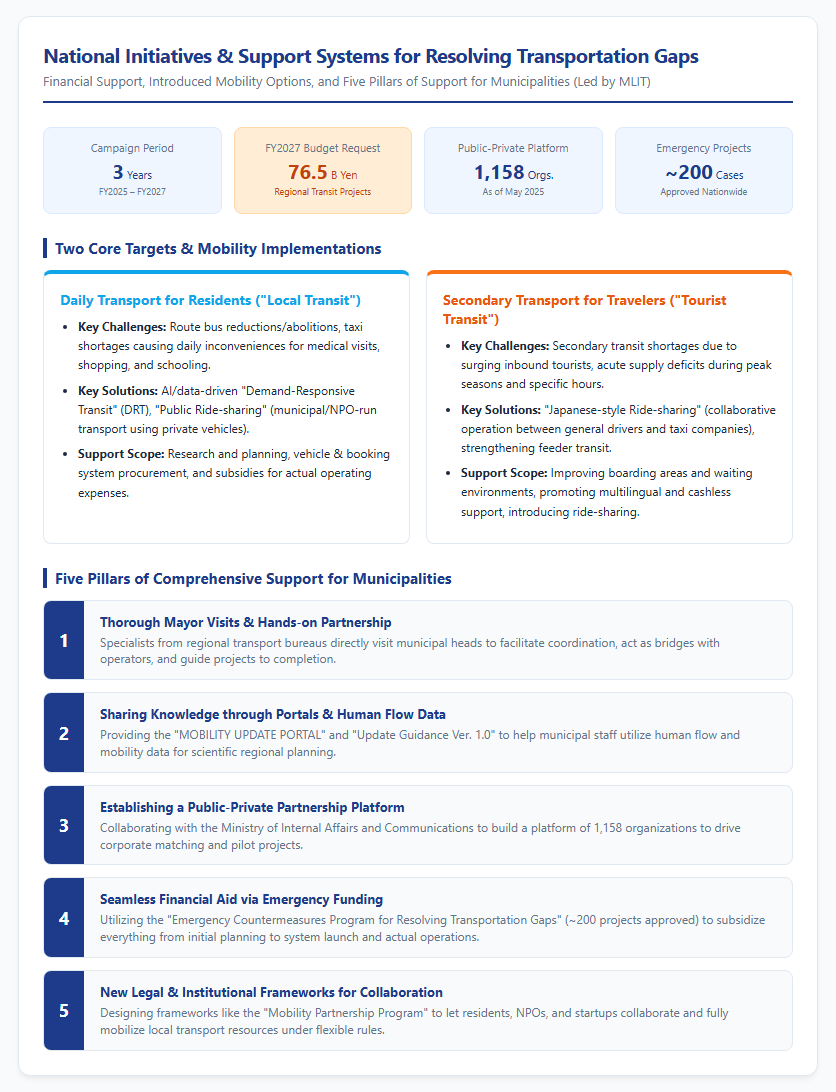
To avert the collapse of regional public transit, the Ministry of Land, Infrastructure, Transport and Tourism has designated FY2025 through FY2027 as an Intensive Campaign Period for Resolving Transportation Gaps, aiming to clear a path to resolution for approximately 3,000 target areas nationwide. Backing this ambitious agenda, the ministry requested a total of 76.5 billion yen in its FY2027 budget request for projects dedicated to rebuilding regional transit and bridging these gaps. The budget will be comprehensively allocated to secure both daily transport for residents and secondary transit for travelers. Specifically, the funding supports the swift introduction of public ride-sharing (paid passenger transport using private vehicles run by municipalities or NPOs), Japanese-style ride-sharing (utilizing private cars and drivers under the management of taxi operators), and AI-driven demand-responsive transit. Rather than just planning, the support covers everything from purchasing vehicles and booking systems to subsidizing actual operating costs.
Section 2-2: Empowering Municipalities through Five Comprehensive Support Pillars
Beyond financial aid, the ministry is actively backing local governments through Five Comprehensive Support Pillars. First, specialists from regional transport bureaus directly visit municipal heads to facilitate coordination and provide hands-on partnership. Second, the ministry shares knowledge through tools like the MOBILITY UPDATE PORTAL and the Update Guidance Ver. 1.0, which outlines diagnostic steps using human flow and mobility data. Third, in collaboration with the Ministry of Internal Affairs and Communications, the ministry established the Transportation Gap Resolution Public-Private Partnership Platform, counting 1,158 member organizations as of May 2025 to drive matching with private businesses. Fourth, the ministry is aggressively rolling out financial aid, selecting about 200 projects under the Emergency Countermeasures Program for Resolving Transportation Gaps. Fifth, through the Mobility Partnership Program, it is building new legal and regulatory frameworks to help local residents, NPOs, and startups collaborate and fully mobilize local transport resources. Please refer to the figure below.
Chapter 3: The Massive Economic Benefits of Closing Gaps and Next-Generation Mobility
Section 3-1: Recovering Annual Economic and Social Losses of 10 Trillion Yen
Securing regional transport is no longer viewed as a welfare expense requiring continuous public subsidies; instead, it is being reframed as a growth investment that unlocks regional and individual potential. A study and estimation by EY Japan revealed that the economic and social losses resulting from Japan’s transportation gaps reach approximately 10 trillion yen annually. The largest driver of this loss is the burden of family caregiving and chauffeuring. The opportunity cost of working-age adults spending their time driving elderly family members or children—thereby losing employment, training, or local participation opportunities—is estimated at approximately 5.8 trillion yen, over half of the total loss. Additionally, restricted mobility causes 1.2 trillion yen in lost daily retail consumption and 2.3 trillion yen in lost regional tourist spending from international visitors who give up on traveling further due to lacking secondary transit. Resolving these gaps is a high-return investment that returns disposable time to the workforce and funnels lost consumption back to regional communities.
Section 3-2: Diversified Mobility Solutions and the Outlook for Autonomous Driving
At the 6th meeting of the Transportation Gap Resolution Headquarters held on June 10, 2026, the ministry finalized the Action Plan 2026 for Resolving Transportation Gaps, defining these gaps as an invisible wall robbing individuals and regions of growth opportunities. Looking ahead, the focus is on the sustainable, localized implementation of diverse mobility options. For instance, in 2022, Nikko City introduced Green Slow Mobility—low-speed electric vehicles operating under 20 km/h—to connect the World Heritage area to scattered, steep spots, vastly improving visitor circulation. While short-term supply shortages are filled via ride-sharing and demand-responsive transit, the mid-to-long-term game changer is autonomous driving. The revised Road Traffic Act enacted in April 2023 established a permission system for Level 4 specific automated driving without a driver. Seamlessly integrating traditional public transit, ride-sharing, and driverless vehicles based on localized needs is the ultimate goal.
Chapter 4: Reference Pages
- 【Resolving Transportation Gaps Initiatives | Ministry of Land, Infrastructure, Transport and Tourism】https://www.mlit.go.jp/sogoseisaku/transport/sosei_transport_tk_000237.html
【#TransportationGaps #TourismTransit #MLIT #RegionalRevitalization #JapaneseRideshare #AutonomousDriving】


コメント