Reports suggest that Japan’s major book distributor Nippan has signed a deal to sell a massive volume of books to US AI startup Anthropic for AI training. This unprecedented move is driven by a severe financial crisis threatening Japan’s traditional publishing distribution system, alongside AI developers’ urgent need for high-quality, “clean” data to avoid the trap of “AI slop.”
- Key Takeaways and the Catalyst Behind the Deal
- The Logistic and Financial Crisis in Japanese Publishing Distribution
- Escaping Piracy and the Genesis of “Project Panama”
- The U.S. Fair Use Paradigm and the Shift to Legal Acquisition
- Japan’s “Principle Code” and the Drive for Transparency
- Future Outlook: Challenges and Sovereignty in Japanese Publishing
Key Takeaways and the Catalyst Behind the Deal
In September 2026, it was revealed that Nippon Shuppan Hanbai (Nippan), one of Japan’s largest publishing distributors, had entered into an agreement to sell a vast volume of physical books to the US-based artificial intelligence startup Anthropic. Traditionally, generative AI companies have relied on web-scraping to gather massive datasets. However, as the internet becomes increasingly saturated with low-quality, AI-generated content—often referred to as “AI slop”—developers are facing a severe degradation in training data quality. To combat this, tech companies are reassessing the value of books: highly curated, professionally edited repositories of human thought. Books published prior to 2022 are considered particularly pristine, as they are completely free of synthetic text. By securing high-quality Japanese-language texts through legal channels, Anthropic aims to refine its large language models while mitigating the risk of copyright infringement.
The Logistic and Financial Crisis in Japanese Publishing Distribution
This transactional shift comes at a time when Japan’s traditional book distribution network is facing unprecedented systemic collapse. In May 2026, Tsuyoshi Togashi, president of Nippan Group Holdings, admitted during an earnings press conference that the firm might have to consider withdrawing from the distribution business entirely if current conditions persist. This was not hyperbole: for the fiscal year ending March 2026, Nippan’s distribution division posted an ordinary loss of 3.6 billion yen, while its chief rival, Tohan, slid into an 1.1 billion yen net loss. The crisis is largely structural, exacerbated by soaring fuel and labor costs. Historically, Japan’s publishing industry has relied on a delicate triad of practices: the resale price maintenance system (which mandates fixed retail prices), the consignment sales system (which allows bookstores to return unsold inventory), and “pattern distribution” (automatic allocation of inventory based on historical sales). While this shielded small bookstores from financial risk and ensured equal book access nationwide, it forced distributors to absorb the double shipping costs of returns—which average 30% for books and 50% for magazines. Desperate to offset these compounding deficits, book distributors have turned to AI firms as a lucrative new revenue stream.
Anthropic’s Content Strategy: From Piracy to “Project Panama”
Escaping Piracy and the Genesis of “Project Panama”
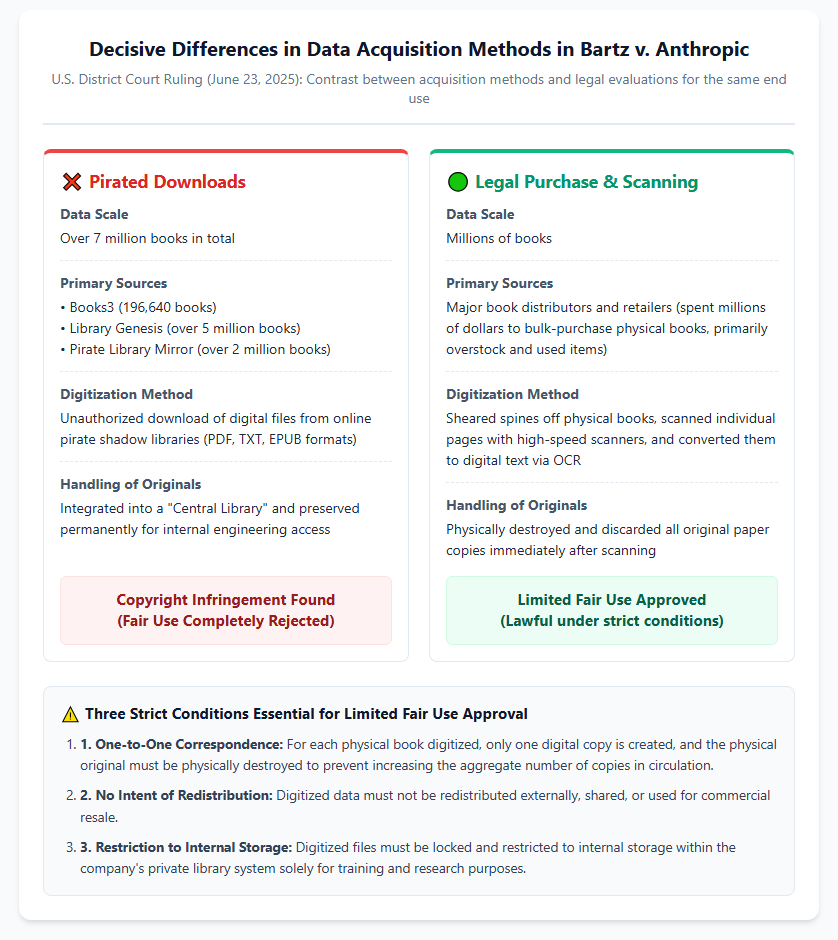
Before turning to legal paper acquisitions, Anthropic’s search for high-quality training data was mired in controversy. In its early development stages, the developer of Claude built massive text databases by scraping notorious shadow libraries, including Books3, Library Genesis, and Pirate Library Mirror, accumulating over 7 million pirated books. This practice triggered massive backlash and class-action lawsuits from authors and rights holders. To bypass the legal quagmire, Anthropic initiated a pivot toward acquiring and digitizing physical books under a highly structured initiative internally dubbed “Project Panama.” Under this program, the company purchased millions of used and overstock physical books, systematically sheared off their spines, ran the loose pages through high-speed scanners, and converted them into machine-readable text via Optical Character Recognition (OCR). This industrial-scale digitization cost the company millions of dollars but allowed it to amass a formidable repository of clean, legally obtained text.
The U.S. Fair Use Paradigm and the Shift to Legal Acquisition
Anthropic’s pivot to the “slice-and-scan” method was heavily influenced by a landmark legal ruling in the United States. On June 23, 2025, Judge William Alsup of the U.S. District Court for the Northern District of California issued a pivotal ruling in Bartz v. Anthropic PBC. The court drew a sharp, legally binding line between data acquisition methods: it completely rejected fair use defenses for books sourced from pirate databases, establishing clear copyright liability. Conversely, the court ruled that digitizing legally purchased physical books constitutes a permissible “format shift” and falls under limited fair use, provided strict conditions are met. These include maintaining a strict one-to-one correspondence (destroying the original physical book so no extra copies are introduced to the market), avoiding public redistribution, and restricting the data to internal research. This legal distinction left AI developers with a clear mandate: abandon pirate databases and negotiate bulk-purchase or licensing agreements with legitimate distributors like Nippan. Refer to the diagram below for a conceptual breakdown.
Navigating Japan’s AI Intellectual Property Rules and the Future of Publishing
Japan’s “Principle Code” and the Drive for Transparency
In Japan, the legal and ethical boundaries surrounding AI training have also begun to solidify. On August 25, 2026, the Cabinet Office’s Intellectual Property Strategy Headquarters and the Council on Intellectual Property Rights in the AI Era officially released the “Principle Code on the Protection of Intellectual Property and Transparency for the Appropriate Utilization of Generative AI.” Although designed as a non-binding “soft law,” the code operates on a “comply or explain” framework, forcing AI developers to either adhere to its tenets or publicly justify their non-compliance. Under Principle 1, AI developers and providers must disclose their training data profiles, web-crawling policies, and the preventative measures they employ to avoid scraping pirated content. The timing of Nippan’s deal with Anthropic, coming right on the heels of this major regulatory announcement, underscores how critical procedural transparency and data provenance have become for companies seeking to operate legitimately in the Japanese market.
Future Outlook: Challenges and Sovereignty in Japanese Publishing
While the deal represents a lifesaver for struggling distributors, it has ignited a fierce debate within the broader creative community. On October 31, 2025, a coalition of 19 major publishers and creative associations, including Kodansha and KADOKAWA, issued a joint statement demanding strict transparency, upfront licensing (opt-in protocols), and fair compensation for creators. Many fear that bulk-selling physical books bypasses the consent of copyright owners, leaving authors uncompensated while their life’s work is ingested by algorithms. Furthermore, because international class-action settlements often only compensate authors whose works are registered with the U.S. Copyright Office, Japanese creators risk being left entirely empty-handed. Moving forward, the industry must transition from one-off bulk book sales to sustainable, ongoing licensing frameworks—such as Retrieval-Augmented Generation (RAG) commercial partnerships—and robust opt-out mechanisms. Establishing unified royalty distribution platforms will be essential if Japan is to protect its literary culture and maintain linguistic sovereignty in the age of artificial intelligence.
References
- 【District Court Order on Fair Use in Bartz v. Anthropic PBC (June 23, 2025)】https://fingfx.thomsonreuters.com/gfx/legaldocs/jnvwbgqlzpw/ANTHROPIC%20fair%20use.pdf
- 【Cabinet Office of Japan: Principle Code on the Protection of Intellectual Property and Transparency for Generative AI (August 25, 2026)】https://www.cas.go.jp/jp/seisakukaigi/titeki2/ai_kentoukai/kaisai/pdf/ai_principle_code.pdf
【#AITraining #Anthropic #PublishingIndustry #CopyrightLaw #PrincipleCode #TechPolicy】
コメント