The Japanese yen surged rapidly as speculation for further interest rate hikes intensified alongside a strengthening yen. This sudden appreciation of the USD/JPY rate was driven by mounting concerns over a narrowing US-Japan interest rate differential due to hawkish comments from BoJ officials, coupled with a massive unwinding of accumulated yen carry trades.
- Hawkish Remarks by BoJ Officials and the Rapid Appreciation of the Yen
- The Structure of the Yen Carry Trade and the Unwinding Mechanism
- Analyzing the “Reiwa Black Monday” of August 2024
- Global Credit Cycles and Spillover to Non-Bank Financial Sectors
- The Path of Interest Rate Differentials and BoJ Forward Guidance
- Shifting Investment Environments: Sector Impacts and Risk Management
Hawkish Remarks by BoJ Officials and the Rapid Appreciation of the Yen
Speculation regarding further interest rate hikes by the Bank of Japan (BoJ) is rapidly intensifying among market traders. In September 2026, ahead of the Monetary Policy Meeting, BoJ Governor Kazuo Ueda and Policy Board Member Hajime Takata made successive hawkish statements. In particular, Takata noted that when considering future rate hikes, the BoJ should not limit itself to a conventional 0.25-percentage-point increase, but should remain flexible and consider a wide range of options. This remark had a powerful impact on the market, serving as a trigger that reinforced rate hike expectations. In the foreign exchange market, the unwinding of the yen carry trade—where investors who had borrowed low-yield yen rushed to buy them back to repay their debts—accelerated sharply. Consequently, the yen surged by over 2% against the dollar on September 3, 2026, and maintained most of those gains on the 4th. This appreciation brought the currency close to the high-yen levels seen in May 2026, when the Ministry of Finance conducted large-scale FX interventions, heightening vigilance among market participants.
The Structure of the Yen Carry Trade and the Unwinding Mechanism
The yen carry trade is an investment strategy where investors borrow Japanese yen—the currency with the lowest interest rate in the world—at virtually zero cost, sell those yen for higher-yielding currencies like the US dollar, and invest the proceeds in higher-yield assets such as US equities, high-coupon bonds, or emerging market assets. In this transaction, the yen serves as the “funding currency,” and global investors and hedge funds have accumulated massive positions in it over many years. This trade operates on two key assumptions: that the interest rate differential between Japan and other major economies remains wide, and that the yen remains weak. However, when expectations rise that the US-Japan interest rate gap will shrink—such as when the BoJ hikes rates while the US Federal Reserve begins cutting them—this premise collapses. Furthermore, if the exchange rate shifts toward a stronger yen, the borrowing and repayment costs in yen inflate, prompting investors to simultaneously buy back yen to close their positions and avoid losses. This herd behavior triggers the yen carry trade unwind, creating a self-reinforcing spiral where a stronger yen drives even more yen buying.
Lessons from Historic Crashes and Systemic Risk
Analyzing the “Reiwa Black Monday” of August 2024
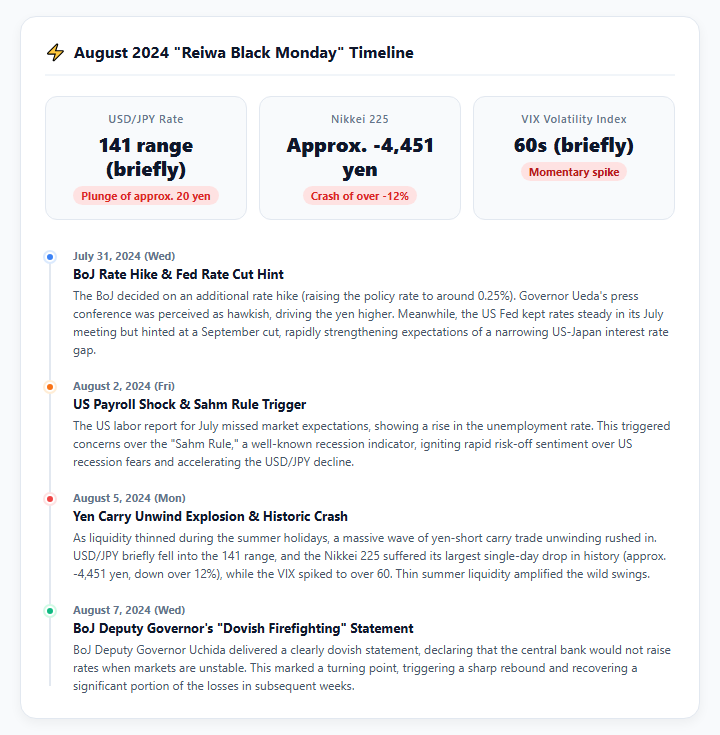
The destructive power of a rapid yen carry trade unwind was clearly demonstrated during the market turmoil of August 2024. Immediately after the BoJ decided on July 31, 2024, to raise its policy rate to around 0.25% and Governor Ueda adopted a hawkish tone, the US payroll report released on August 2 missed market expectations. Rising unemployment triggered the Sahm Rule, a historical indicator of recessions, which instantly sparked widespread growth concerns. The convergence of shifting monetary policies in Japan and the US with the US employment shock prompted an abrupt and massive unwinding of yen carry trades. As liquidity thinned during the summer holidays, panic selling cascaded when the new week opened on August 5, 2024. The USD/JPY rate plummeted from its July peak of around 162 to briefly touch the 141 range—a drop of about 20 yen in just a few weeks. Consequently, the Nikkei 225 index suffered its largest single-day drop in history, plunging by approximately 4,451 yen (over 12%), while the VIX volatility index momentarily spiked into the 60s. Please refer to the timeline below.
.
Global Credit Cycles and Spillover to Non-Bank Financial Sectors
The impact of a yen carry trade unwind is not confined to localized adjustments in foreign exchange markets; it carries the potential to escalate into a systemic crisis shaking the entire global financial system. Historically, the structural combination of excessive leverage accumulation, narrowing yield differentials, and an unexpected catalyst closely mirrors the crisis that led to the near-collapse of Long-Term Capital Management (LTCM) in September 1998. For decades, the low-cost liquidity supplied by Japan’s ultra-loose monetary policy has silently underpinned highly valued global risk assets, particularly US momentum stocks (such as tech and AI-related shares). However, when market volatility surges, institutional investors employing volatility-targeting strategies are forced by automated risk models to systematically de-risk. To cover losses incurred in currency markets, they must liquidate other high-risk assets, including US mega-cap tech stocks. This reveals a critical structural vulnerability where capital channeled into non-bank sectors rapidly reverses, triggering a cross-asset deleveraging chain reaction.
Future Market Outlook and Key Investment Strategies
The Path of Interest Rate Differentials and BoJ Forward Guidance
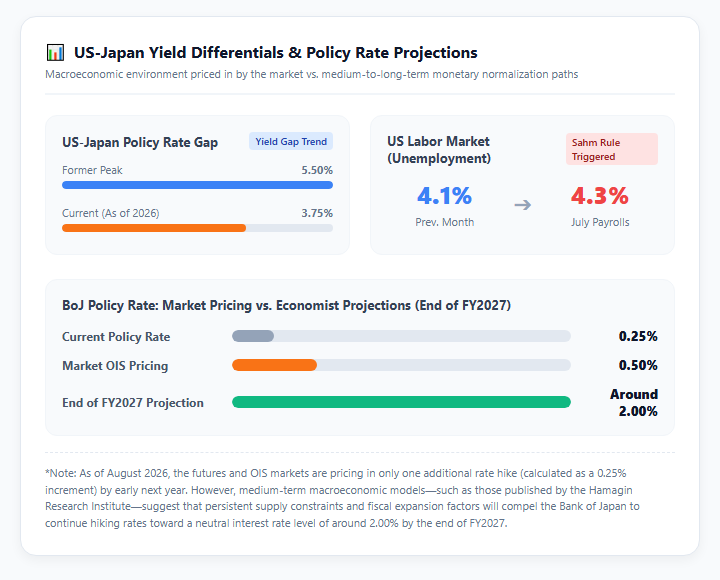
The most critical factor going forward is the gap between the BoJ’s actual pace of rate hikes and what is currently priced into the market. As of August 2026, data from futures and Overnight Index Swap (OIS) markets indicate that investors are pricing in only about one additional rate hike by early next year, reflecting an expectation of a relatively gradual normalization path. Some analysts argue that while concerns over a US economic slowdown persist, the room for further Japanese bond yield increases remains limited due to the risk of premature tightening. To prevent destabilizing financial markets, the BoJ is strongly urged to provide clear, deliberate forward guidance regarding its policy normalization path and maintain open communication with market participants. If speculation of aggressive rate hikes reignites unexpectedly, previously reduced short-yen speculative positions could face another abrupt wave of liquidation, threatening to hit both currency and equity markets with another round of severe double-sided shocks. Please refer to the chart below illustrating US-Japan monetary policy and labor market trends.
.
Shifting Investment Environments: Sector Impacts and Risk Management
As the structural unwinding of the yen carry trade progresses, investors are forced to reevaluate their portfolios. A sustained shift toward a stronger yen will provide a powerful tailwind for specific beneficiary sectors in the domestic Japanese equity market. In particular, industries highly sensitive to imported raw material costs—such as retail (including furniture giant Nitori Holdings), food products, fisheries, paper and pulp, airlines, and utility companies benefited by lower fuel costs (such as Kansai Electric Power)—are emerging as resilient sectors. However, when selecting companies within these industries, investors must look beyond simple currency advantages and carefully evaluate cost structures, commodity price trends, and the pricing power required to maintain margins after price hikes, alongside the resilience of domestic consumption. Furthermore, instead of focusing solely on USD/JPY exchange rates, a strategic shift is recommended to incorporate multi-asset risk management indicators, combining the VIX index, US technology stock movements, and other signals of global leverage.
References
- 【Federal Reserve – LTCM Crisis Retrospective】https://www.federalreserve.gov/pubs/feds/1999/199939/199939pap.pdf
- 【Bank for International Settlements – The market turbulence and carry trade unwind of August 2024】https://www.bis.org/publ/bisbull90.pdf
- 【International Monetary Fund – Global Financial Stability Report】https://www.imf.org/en/Publications/GFSR
【#YenCarryTrade #ForeignExchange #BoJRateHikes #USDJPY #SahmRule #InvestmentStrategy #SystemicRisk】


コメント