A project proposed by Will Smart Co., Ltd. to build a new cloud-based core business system for bus operators has been selected for the Ministry of Land, Infrastructure, Transport and Tourism’s (MLIT) Regional Transportation DX Promotion Project. This initiative aims to construct a highly standardized platform to address critical structural challenges in the bus industry, such as chronic driver shortages and fragmented system customizations.
- Will Smart’s Proposal Selected for MLIT Initiative
- The New Core Cloud Platform Compliant with National Bus Specifications
- The Impact of the “2024 Problem” and the Severe Driver Shortage
- Shifting from Fragmented Customization to a Unified Standard Model
- Field Testing in Nagasaki and Shizuoka
- Post-April 2027 SaaS Rollout: Securing Sustainable Regional Transit
Will Smart’s Proposal Selected for MLIT Initiative
On September 2, 2026, Will Smart Co., Ltd., a leading mobility technology firm, announced that its proposed project—New Construction of a Web-Based, Cloud-Based Core Business Platform (Planning and Performance Aggregation Systems) Compliant with Bus Operation Standard Specifications—had been officially selected for MLIT’s FY2026 initiative. This project is part of a broader national effort aimed at the nationwide deployment of re-designing public transport to eliminate transit deserts.
Currently, Japan faces a major socio-economic challenge with over 2,500 rural and semi-urban districts designated as transit deserts, where residents lack reliable access to daily transportation. The government’s decision to adopt Will Smart’s proposal highlights a strategic shift toward leveraging private-sector digital technology to secure local mobility infrastructures. Will Smart’s selection reflects its proven track record in smart mobility, particularly its prior work in digitizing bus terminals and managing complex transit data ecosystems.
The New Core Cloud Platform Compliant with National Bus Specifications
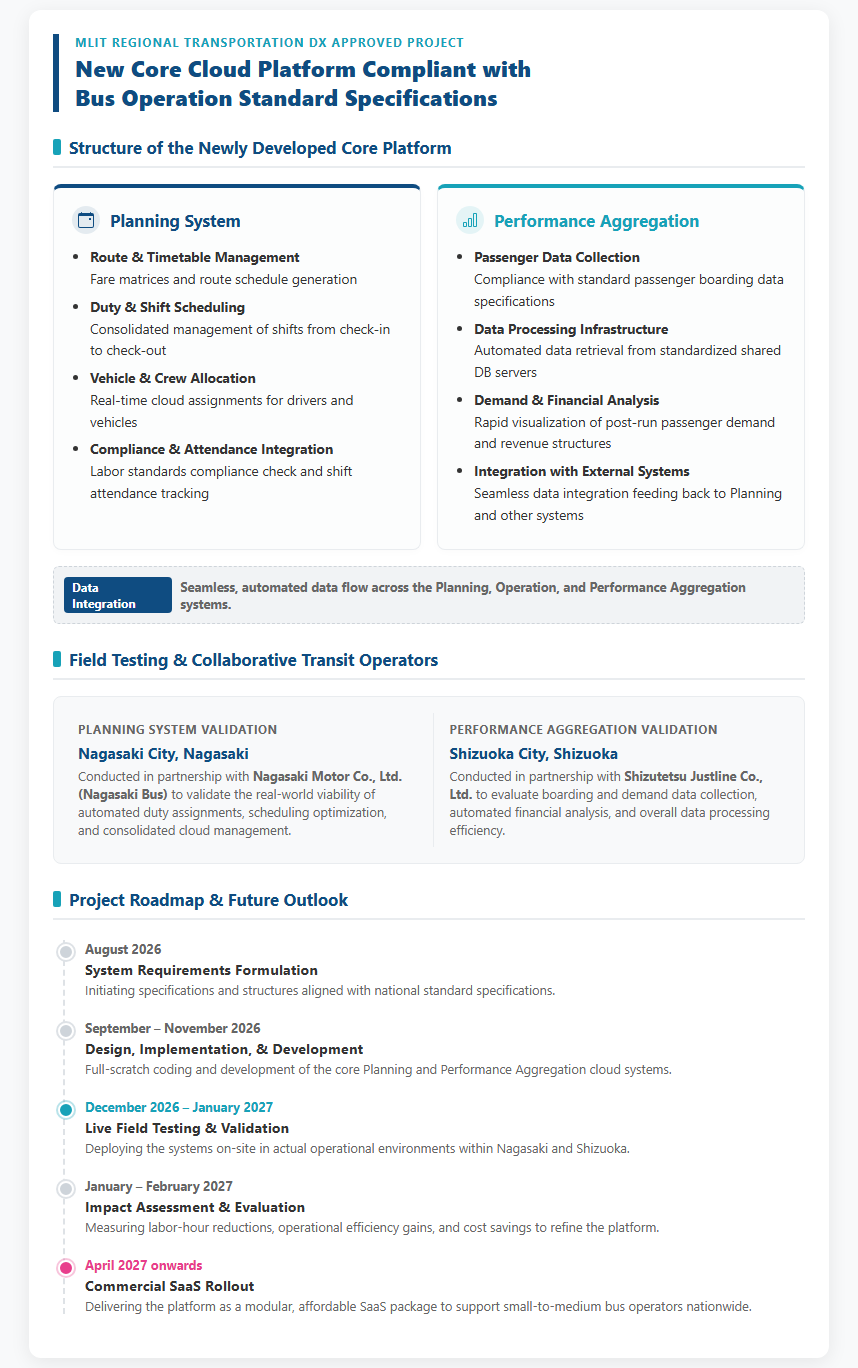
The cloud platform being developed under this project is a highly scalable, web-based, and entirely paperless system designed to fully comply with the national Bus Operation Standard Specifications set by MLIT. The platform comprises three core functional suites: Planning, Operation, and Performance Aggregation. Under this specific project, Will Smart is focusing on building and testing the Planning and Performance Aggregation systems, which are critical for optimizing resources before and after actual bus runs.
In the Planning system, operators can manage fare matrices, generate route schedules, plan shifts (duty schedules from check-in to check-out), and assign drivers and vehicles in real-time. Meanwhile, the Performance Aggregation system will comply with standard boarding data specifications to seamlessly collect, process, and analyze passenger demand and operational revenues. Rather than running these tasks in isolated silos, the platform integrates them into a unified cloud database, facilitating real-time data flow. To visualize the user experience, please refer to the initial system dashboard interface below.
Structural Challenges in the Bus Industry and the Power of Standardization
The Impact of the “2024 Problem” and the Severe Driver Shortage
The Japanese bus industry is in the midst of a historic labor crisis fueled by rapid demographic aging. According to public records, the number of active Class II heavy vehicle driver’s license holders dropped from 1,174,799 in 2003 to 871,492 in 2023—a reduction of approximately 300,000 drivers over two decades. Compounding the issue is an extreme age imbalance: roughly 50% of active drivers are currently in their 50s and 60s, whereas younger demographics in their 20s and 30s represent a mere 4.1% of the workforce. Current projections warn that Japan could face a deficit of 36,000 bus drivers by FY2030.
This shortage has been severely exacerbated by the 2024 Problem, referring to the revised labor standards enforced in April 2024. These guidelines strictly limit daily binding hours to a maximum of 13 hours under normal circumstances, mandate a minimum continuous rest period of 11 hours between shifts, and place a strict annual cap of 960 hours on overtime. Consequently, traditional, analog shift management and overtime-dependent scheduling have completely collapsed, making the adoption of efficient, automated DX tools an absolute necessity to prevent mass route cancellations.
Shifting from Fragmented Customization to a Unified Standard Model
Historically, the bus industry suffered from a complete lack of standardized business processes. This meant that whenever a bus operator sought to modernize its IT systems, vendors had to develop highly customized, bespoke software tailored to that specific operator’s legacy workflows. This localized approach created individual optimization, which in turn drove up system replacement costs, increased annual maintenance overhead, and made regional data sharing or joint operations among adjacent transit operators nearly impossible.
To dismantle these technological barriers, MLIT launched COMmmmONS (Code for Mobility Common Society), a regional transport DX promotion project, and released the Bus Operation Standard Specifications in March 2026. Will Smart’s new platform represents the first major, full-scale cloud system built from the ground up to match these standards. By aligning individual bus operators’ workflows with a unified, nationwide business model, this platform drastically reduces development costs while making cross-carrier collaboration, database integration, and regional transit data sharing incredibly straightforward.
Demonstration Roadmap and Future Outlook
Field Testing in Nagasaki and Shizuoka
The development and testing schedule for this project began in August 2026 with a thorough review of system requirements. System design, programming, and software integration are scheduled to run from September to November 2026, followed by live field testing from December 2026 to January 2027. Following these field trials, a comprehensive evaluation and impact assessment will be conducted from January to February 2027.
To guarantee real-world viability, the live trials will take place in two major municipal hubs: Nagasaki City and Shizuoka City, in close collaboration with prominent local transit operators. The Planning system will be tested on-site with Nagasaki Motor Co., Ltd. (Nagasaki Bus) to evaluate the efficiency of automated duty assignments and route scheduling. Conversely, the Performance Aggregation system will be field-tested by Shizetetsu Justline Co., Ltd. in Shizuoka City to verify the accuracy of automated boarding data collection and financial analysis, ensuring the cloud platform is thoroughly optimized for commercial use.
Post-April 2027 SaaS Rollout: Securing Sustainable Regional Transit
Following successful field testing and impact analysis, Will Smart intends to commercialize the platform as a modular SaaS package starting in April 2027. Since the platform is modular, bus operators will have the flexibility to adopt specific functions incrementally rather than replacing their entire infrastructure overnight. Utilizing a standardized SaaS model will drastically lower total cost of ownership (TCO) by reducing upfront deployment fees, recurring software maintenance costs, data update labor, and administrative overhead.
For many small and medium-sized regional bus operators facing tight budgets, this affordable cloud platform could serve as a vital lifeline. By automating complex labor compliance checks and digitizing back-office paperwork, operators can maximize their limited staffing resources. Ultimately, Will Smart’s project serves as a crucial benchmark for mobility DX in Japan, demonstrating how cloud technology can successfully preserve and sustain vital public transit systems across aging regional communities.
References
- 【Will Smart Co., Ltd. Official Website】https://willsmart.co.jp/
- 【MLIT “COMmmmONS” Project Page】https://www.mlit.go.jp/commmmons/
【#MobilityDX #RegionalTransportation #MLIT #WillSmart #CloudSystems #SmartMobility #SaaS #TransitTech】

コメント