The National Police Agency (NPA) has finalized a policy to develop an AI system that assists and automates the handling of 110 emergency calls. This initiative is driven by the need to modernize and streamline police operations in response to a severe shortage of officers and structural changes in society caused by a declining birthrate and aging population.
- Implementing AI for 110 Calls: Key Developments and Goals
- The Demographic Context: Severe Population Decline and Police Shortages
- Shifting Gears: Record Budget Requests and AI Infrastructure
- Collaborative Budgets and Voice-to-Text Support Systems
- Automated 119 Emergency Responses in Firefighting
- Limitations, Legal Risks, and the Road Ahead for Life-Critical Systems
Implementing AI for 110 Calls: Key Developments and Goals
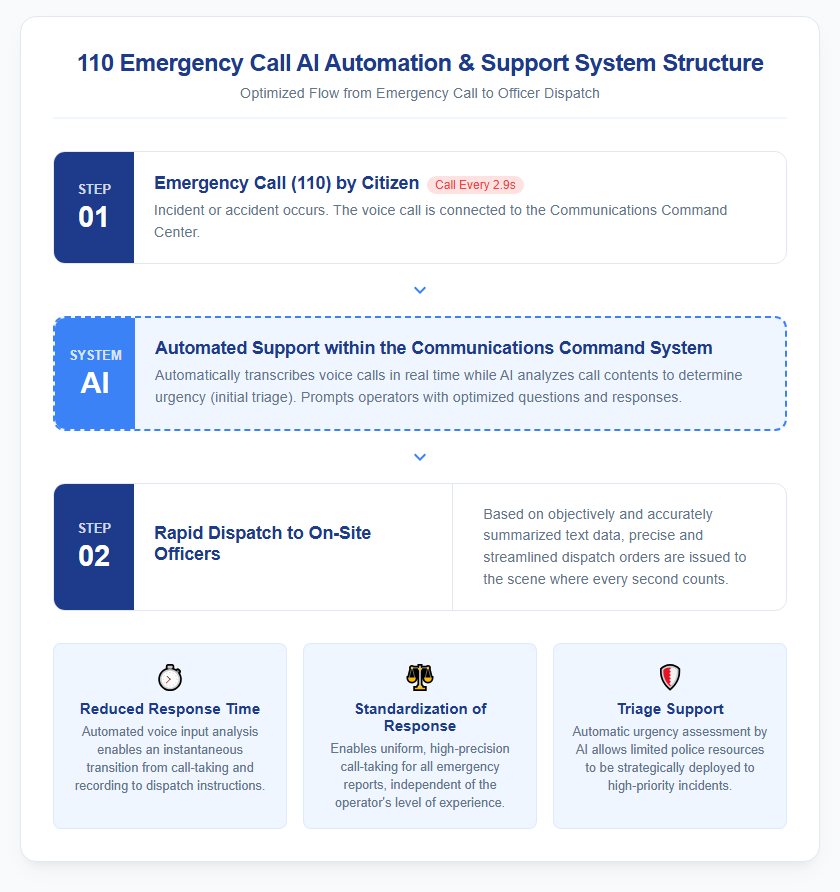
On September 7, 2026, the National Police Agency finalized its policy to develop an AI system to assist and automate responses to 110 emergency calls. Specifically, the system aims to automatically transcribe voice calls in real time and instantly analyze the level of urgency. Currently, in Japan, a 110 emergency call is received every 2.9 seconds, placing an extremely heavy workload on police communication command centers. Implementing AI to handle this immense volume of calls will enable more rapid and accurate recording of emergency reports. Furthermore, the system is designed to eliminate discrepancies in call-taking quality, which previously varied depending on the individual officer’s experience and skill level. Introducing objective AI analysis will standardize emergency responses and ensure uniform call quality. In the high-pressure environment of emergency dispatch, a delay of even a few seconds can lead to critical consequences. Therefore, AI-driven initial triaging and transcription support are highly anticipated technologies to assist on-site decision-making. As shown in the diagram below, integrating AI into the process from the reception of emergency calls to dispatching officers ensures seamless coordination.
The Demographic Context: Severe Population Decline and Police Shortages
The urgency behind the National Police Agency’s rapid push for advanced technology stems from profound demographic shifts in Japanese society. As of October 1, 2021, Japan’s total population stood at approximately 125.5 million, marking the eleventh consecutive year of decline. Furthermore, the proportion of the population aged 65 and older reached 28.9%, making Japan the world’s most rapidly aging super-aged society. Demographic projections suggest that Japan’s total population will fall below 100 million by 2053, and labor shortages have become increasingly prominent across all sectors. The police force is no exception; recent officer shortages and recruitment challenges pose a significant hurdle to organizational management. To maintain public safety with limited human and financial resources, police operations must undergo thorough optimization and streamlining. Guided by the government’s Society 5.0 initiative and key administrative digitalization plans, the police are aggressively digitizing administrative procedures. Developing AI to assist with 110 calls is a necessary innovation to adapt to a shrinking society and sustain public safety.
Unprecedented Budget Requests Backing AI Implementation
Shifting Gears: Record Budget Requests and AI Infrastructure
To accelerate the societal implementation of advanced technologies, the National Police Agency has requested substantial financial backing. In its next fiscal year budget request announced on August 28, 2026, the NPA requested a record-high 445.1 billion yen. This represents a massive increase of approximately 133.6 billion yen over the initial budget for the current fiscal year. Notably, the budget specifically allocated for AI-related initiatives skyrocketed to approximately 9 billion yen—a dramatic 16-fold increase from the current fiscal year’s allocation of 550 million yen. A major portion of this budget will be used to combat rapidly changing crime trends. For instance, to address the growing social threat of anonymous mobile crime groups (known as “Tokuryu”) and cybercrimes, the NPA plans to deploy systems that utilize AI to rapidly analyze electronic data seized from suspects’ smartphones and computers. Additionally, to improve public consultation services, the NPA official website will feature a new AI-powered diagnostic tool that automatically assesses the risk of specialized fraud and provides advice to citizens. These diverse AI systems are being established under a well-funded, multi-layered financial framework.
Collaborative Budgets and Voice-to-Text Support Systems
The next fiscal year’s budget request also includes approximately 15.4 billion yen dedicated to police-related AI systems that could potentially be adapted for use by other government ministries. This significant funding will be utilized to develop advanced voice-to-text transcription and automatic urgency-level assessment systems for both 110 emergency calls and various public consultation services. Real-time transcription and automatic urgency analysis are expected to drastically reduce the burden on understaffed communication command centers. Operators will be able to view real-time transcriptions, automated summaries, and recommended questions on their screens, allowing them to remain calm and focus entirely on providing crucial instruction to callers and dispatching units. This system development is not merely about digitizing tasks; it represents a fundamental restructuring of Japan’s public safety infrastructure to achieve maximum efficiency amid recruitment challenges. This large-scale technological investment, which also considers cross-agency adaptation, highlights the strong link between national security and state-of-the-art technology implementation.
Pioneers in Emergency AI and Future Challenges
Automated 119 Emergency Responses in Firefighting
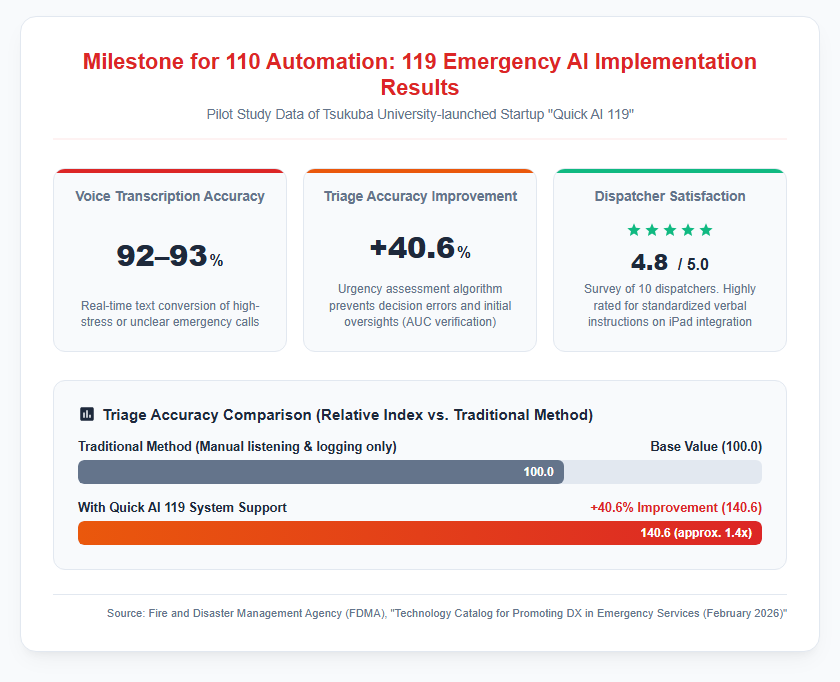
AI implementation in emergency services has already progressed rapidly in the firefighting sector under national strategies. On July 10, 2026, the government’s AI Strategy Headquarters formally approved a revised basic plan to aggressively promote the development of vertical AI systems tailored to 19 specific administrative and industrial fields, including manufacturing, finance, education, defense, and firefighting. Firefighting was highlighted as a top-priority domain, with a concrete roadmap aiming for the full-scale deployment of AI automated response systems for 119 emergency calls by 2030. Practical technical development has already shown significant progress; the updated technical catalog published by the Fire and Disaster Management Agency in February 2026 featured systems such as “Quick AI 119,” a tablet-based system developed by a startup originating from Tsukuba University. During verification tests, the system achieved a voice recognition and transcription accuracy rate of 92% to 93% for emergency calls. Additionally, the system reported a remarkable 40.6% improvement in triaging accuracy compared to traditional methods, alongside a high operator satisfaction score of 4.8 out of 5.0 among a surveyed group of ten dispatchers. As shown in the conceptual diagram below, AI-assisted automation for 119 calls is already proving its high utility and reliability, serving as a powerful milestone for the NPA’s 110 call automation plans.
Limitations, Legal Risks, and the Road Ahead for Life-Critical Systems
Despite these advancements, implementing automated systems in life-critical services like 110 and 119 calls faces persistent technological, systemic, and ethical challenges. The primary concerns involve speech recognition errors during high-stress situations and securing robust backup protocols in the event of telecommunication outages. Additionally, there are linguistic limitations regarding how accurately AI can comprehend and assess urgency when callers are in extreme panic, speak with elderly accents, or communicate in foreign languages. From a legal standpoint, liability issues remain unresolved: if a critical dispatch decision is made solely based on AI analysis and an error occurs, it is unclear who bears civil or criminal responsibility. Consequently, for the foreseeable future, a dual-layer system is deemed essential; human operators must fact-check all AI outputs, and the final dispatch commands must be executed by experienced dispatchers. Moving toward full-scale operations by 2030, the government and the National Police Agency will need to run incremental pilot studies to steadily establish public trust and system reliability.
References
- 【NPA Medium-Term Plan based on the Priority Plan for the Realization of a Digital Society】https://www.npa.go.jp/policies/policy/digital/honbun_npa.pdf
- 【NPA Cyber Security and Digital Talent Recruitment and Development Plan】https://www.npa.go.jp/policies/policy/digital/npa_cyber_digital_jinzai2025.pdf
- 【FDMA Technology Catalog for Fire Department Personnel Promoting DX in Emergency Services】https://www.fdma.go.jp/mission/enrichment/technology/items/catalog.pdf
【#Technology #AIDevelopment #NPA #Emergency110 #DisasterDX #Demographics #PublicSafety】


コメント